KOSPI Closes Down 0.57%
Individuals Bought, Institutions Sold
Decline Due to US Market Interest Rate Pressure
Drop Narrowed After China Announces Economic Growth Target
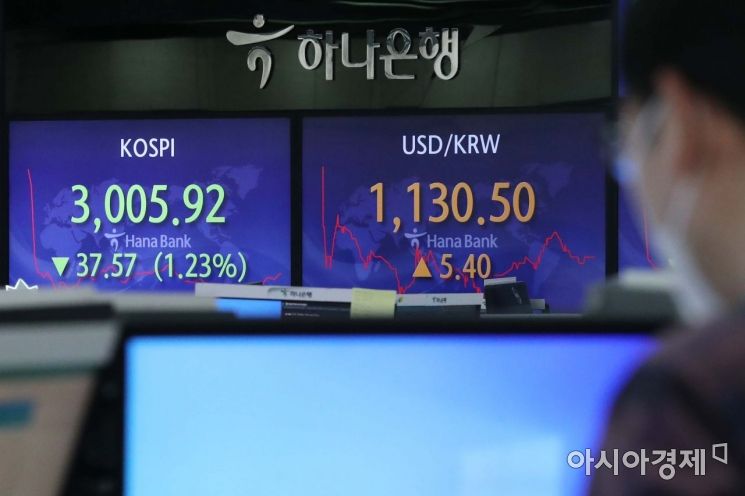 On the 5th, dealers are working in the dealing room of Hana Bank in Euljiro, Seoul. On this day, the KOSPI index opened at 3036.16, down 7.33 points (0.24%) from the previous trading day, showing a downward trend. The won-dollar exchange rate opened at 1132.0 won, up 6.9 won. Photo by Moon Honam munonam@
[Asia Economy Reporter Hwang Junho] On the 5th, the KOSPI repeatedly fluctuated around the 3000-point mark before closing lower. The market, which had started lower due to disappointment over U.S. monetary policy the previous day, fell to the 2980 level, down 1.49%, but recovered the 3000 level in the morning amid growing expectations following China's announcement of its economic growth target. However, despite individual investors continuing their net buying of over 1 trillion won following the previous day's 2 trillion won, the index failed to hold as institutions sold heavily.
On the day, the KOSPI closed at 3026.26, down 17.23 points (0.57%). Individual investors net bought 1.1895 trillion won, but foreigners net sold 370.2 billion won and institutions sold 805.5 billion won, failing to prevent the index from falling.
A total of 292 stocks rose, 567 stocks fell, and 52 stocks remained unchanged. By sector, transportation and warehousing (1.47%), medical precision (1.06%), steel and metals (1.01%), chemicals (0.44%), non-metallic minerals (0.25%), and transportation equipment (0.12%) rose.
Among the top market cap stocks, LG Chem rose 4.51%. Samsung Electronics recorded 82,100 won per share, down 0.36%. NAVER fell 3.58%, and Samsung Biologics also dropped 3.88%.
The KOSDAQ also closed down 2.72 points (0.29%) at 923.48. Individual investors net bought 132.2 billion won, but foreigners and institutions net sold 111.6 billion won and 24.6 billion won, respectively.
By sector, telecommunications equipment-related sectors rose 3.02%, and transportation parts showed gains in the 2% range. Entertainment and publishing media also rose. Among major market cap stocks, HLB rose 6.667%, trading at 80,000 won per share.
Stock Market Shaken by Market Interest Rates
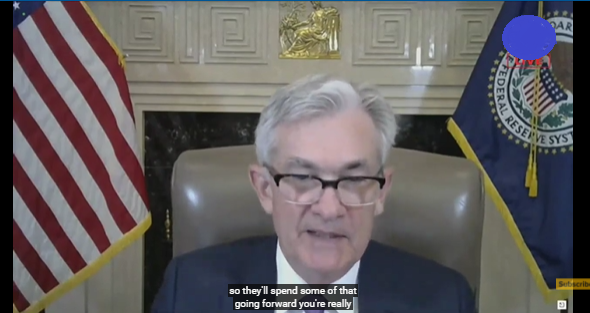
On the day, the KOSPI repeatedly moved up and down around the 3000 mark. The previous day (the 4th, local time), market interest rates fluctuated following remarks by Jerome Powell, chairman of the U.S. Federal Reserve (Fed), the central bank, which also affected the stock market.
Powell participated in a conference hosted by the U.S. economic media outlet The Wall Street Journal and described the rise in market interest rates as "noteworthy," stating, "Asset purchases will continue at the current level until we make significant progress toward our goals." Last week, the U.S. 10-year Treasury yield surged to the 1.6% range. He also emphasized, "There are inflationary pressures, but they are temporary. We will be patient."
The market interpreted Powell's remarks as the Fed tolerating recent inflation. Accordingly, the U.S. 10-year Treasury yield quickly rose to the 1.54% range. Meanwhile, downward pressure on the U.S. stock market increased, leading to a sharp decline. On the same day at the New York Stock Exchange (NYSE), the Dow Jones Industrial Average fell 1.11%, the Standard & Poor's (S&P) 500 index dropped 1.34%, and the Nasdaq index closed down sharply by 2.11%.
Shinhan Investment Corp.'s Research Center domestic stock team analyzed the market on the day, stating, "Despite Powell's recognition of inflationary pressures, the absence of meaningful monetary policy signals has led to the emergence of disappointing selling pressure."
Decline Narrowed by China's Economic Growth Target
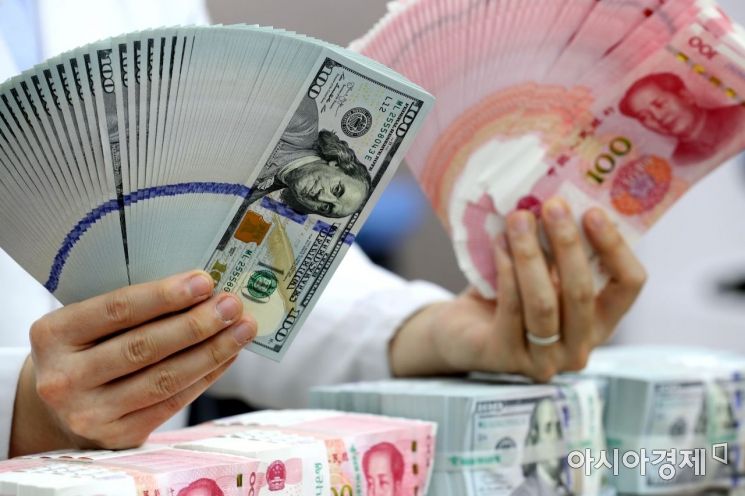 On the 5th (local time), the U.S. Department of the Treasury designated China as a currency manipulator. This is the first time in 25 years since the Clinton administration in 1994 that the U.S. has designated China as a currency manipulator. On the 6th, at the KEB Hana Bank Counterfeit Response Center in Euljiro, Seoul, an employee is organizing U.S. dollar and Chinese yuan banknotes. Photo by Moon Honam munonam@
However, despite such disappointment, the KOSPI showed signs of narrowing its decline as the Chinese government announced its economic growth target for this year. The index initially fell to 2982.45 but narrowed its losses and recovered the 3000 level from around 10:40 a.m.
On the morning of the day, Chinese Premier Li Keqiang stated in the government work report at the National People's Congress (NPC) that "this year, we will achieve a GDP growth rate of over 6%." This is different from last year. Last year, due to uncertainties caused by the spread of COVID-19, China did not set a growth target, which was unusual. China's economic growth rate last year was 2.3%.
Lee Kyung-min, a strategic market analyst at Daishin Securities, analyzed, "The KOSPI fell due to concerns over rising interest rates, but the positive announcements at the NPC helped narrow the decline."
He added, "The sharp rise in China's SHIBO interest rate has calmed, the economic policy goals met expectations, and with expanded technology investment, the Shenzhen ChiNext index turned positive. However, the U.S. 10-year Treasury yield remains near 1.6%, and the won-dollar exchange rate stays in the mid-1120 won range, which has been a burden on foreign investor demand."
The asset strategy team at SK Securities Research Center forecasted, "Given that the average growth target for local regions before this NPC was 7%, the 6% target is somewhat conservative, indicating that the Chinese government is likely to emphasize economic policy normalization."
© The Asia Business Daily(www.asiae.co.kr). All rights reserved.
![Clutching a Stolen Dior Bag, Saying "I Hate Being Poor but Real"... The Grotesque Con of a "Human Knockoff" [Slate]](https://cwcontent.asiae.co.kr/asiaresize/183/2026021902243444107_1771435474.jpg)













