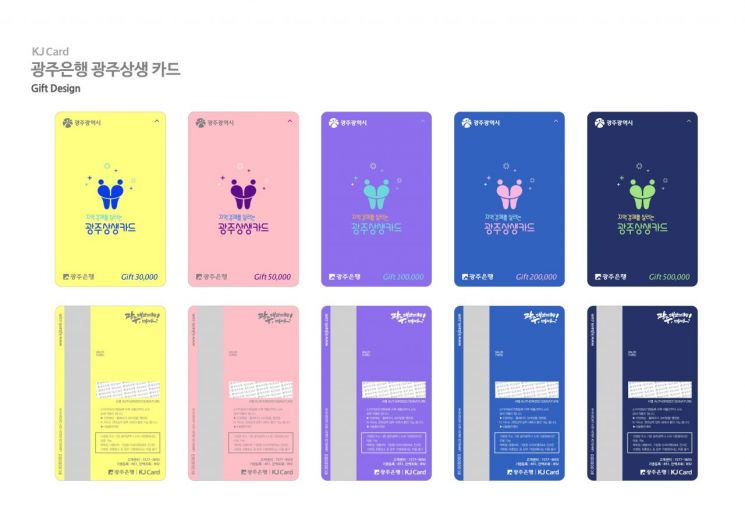
[Asia Economy Honam Reporting Headquarters Reporter Park Seon-gang] Gwangju Metropolitan City’s local currency, the ‘Gwangju Sangsaeng Card,’ has surpassed a cumulative usage amount of 1 trillion won.
According to Gwangju City on the 5th, issuance grew remarkably from 86.3 billion won in 2019 to over 10 times that amount, 864.1 billion won in 2020. As of last month, the issuance amount reached 1.1038 trillion won, with usage at 1.008 trillion won, showing a notable growth trend.
The popularity of the Gwangju Sangsaeng Card is attributed to practical benefits such as offering users a special discount of up to 100,000 won per month when spending 1 million won monthly using either the debit or prepaid card, and supporting 100% of card payment fees (0.5%~1%) for small and medium-sized businesses with annual sales under 500 million won, which account for over 76% of all businesses in Gwangju.
In response, Gwangju City plans to implement a 10% special discount until June to overcome COVID-19 and promote virtuous consumption by encouraging local capital to be used and circulated within the region.
As of last month, a total of 1,954,972 Gwangju Sangsaeng Cards have been issued, including 135,291 debit cards worth 393.8 billion won and 1,819,681 prepaid cards worth 709.8 billion won.
The Sangsaeng debit card is used by more than one in ten of the 1.25 million people aged 14 and older eligible for issuance. The prepaid cards, which are issued in various denominations ranging from 30,000 to 500,000 won and offer discounts upfront, showed higher usage rates in the order of 500,000 won, 100,000 won, and 200,000 won denominations.
The total usage amount of the Gwangju Sangsaeng Card is 1.008 trillion won, with 393.8 billion won from debit cards and 614.2 billion won from prepaid cards. The entire 1 trillion won usage was at small business franchise stores located in Gwangju, highlighting its significant role as a support pillar for local neighborhood markets amid the economic crisis caused by COVID-19.
By industry, restaurants accounted for the highest usage at 283.1 billion won (28%), followed by distribution sectors such as marts and supermarkets at 202.9 billion won (20%), medical clinics at 17%, and then education expenses, transportation, beauty and hair salons, travel and hobbies, and clothing and footwear in that order.
By age group, usage was highest among those in their 40s (33%), followed by 50s (21%) and 30s (17%), the core economic activity groups. By region, usage was highest in Buk-gu (27%), followed by Seo-gu (24%), Gwangsan-gu (22%), Nam-gu (15%), and Dong-gu (12%).
Building on the popularity of the Gwangju Sangsaeng Card, since April last year, the city has improved convenience by adding a recharge function to prepaid cards, allowing reuse without visiting a bank after the initial purchase, and permitting proxy issuance for people with disabilities.
This year, the recharge system will be enhanced to allow prepaid card recharging from bank accounts other than Gwangju Bank, and system screens for recharge, refund, and balance inquiry will be reorganized to better suit customer convenience.
In particular, the Gwangju City public delivery app, scheduled for pilot operation next month, will be linked with the Sangsaeng Card to enable its use online and provide user benefits.
Additionally, the city plans to expand the use of the Gwangju Sangsaeng Card by linking it with various policy projects promoted by different departments, payments of various awards and prizes, and attendance allowances for committees operated by the city as recommended by the Bitter Feedback Committee.
Following the enforcement of the Local Love Gift Certificate Act, the city has been accepting franchise registration applications from the 2nd of this month until June 30th. Except for department stores, large marts, corporate supermarkets, online franchises, and entertainment establishments, all businesses located in the city can become Gwangju Sangsaeng Card franchisees.
Although large-scale stores might be mistakenly considered ineligible for Sangsaeng Card use, large businesses such as Kumho World, Stationery and Toy Complex, Wise Park, Sejeong Outlet, Gwangju Mega Mall, and Gakhwa-dong Complex can all become franchisees if their business location is in Gwangju. Applications for franchise registration can be submitted within the period.
Applications can be easily made by clicking the banner on the city’s homepage or the registration screen on Gwangju Bank’s homepage, entering the business registration number, business name, representative’s name, and mobile phone number, and agreeing to the personal information usage and franchise terms. Results will be individually notified via text message within seven days of application.
To commemorate the achievement of 1 trillion won in usage and the 2nd anniversary of issuance, Gwangju Bank, the operating agency, plans to hold a prize event around the 20th of next month to mark the anniversary.
Park Jeong-hwan, Director of the City’s Job and Economy Office, said, “Interest in the Gwangju Sangsaeng Card is growing day by day, and it is contributing to the revitalization of neighborhood markets. We will actively support the service both administratively and financially to improve it for non-face-to-face and online payments preferred in the COVID-19 era, including enabling its use on the public delivery app, so that the Gwangju Sangsaeng Card can contribute to revitalizing the local economy even in difficult times.”
© The Asia Business Daily(www.asiae.co.kr). All rights reserved.
![Clutching a Stolen Dior Bag, Saying "I Hate Being Poor but Real"... The Grotesque Con of a "Human Knockoff" [Slate]](https://cwcontent.asiae.co.kr/asiaresize/183/2026021902243444107_1771435474.jpg)















