Repeated Collapse and Recovery of KOSPI Below 3000 on the 5th
Disappointment Over US Policy on Previous Day's Market Interest Rates,
Combined Effects Including China's Economic Growth Target Announcement
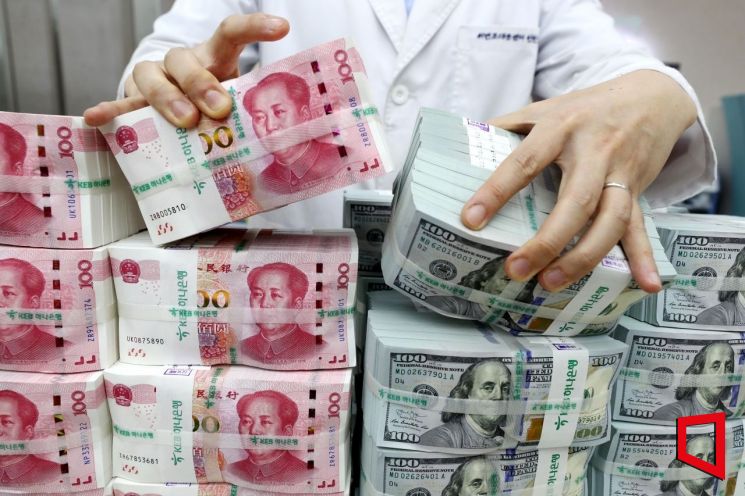 An employee is organizing US dollar and Chinese yuan bills at the KEB Hana Bank Counterfeit Response Center in Euljiro, Seoul. Photo by Mun Ho-nam munonam@
[Asia Economy Reporter Junho Hwang] On the 5th, the KOSPI fluctuated around the 3000-point mark. The previous day, the KOSPI started lower as the Federal Reserve (Fed) Chair, the central bank of the United States, did not present any significant alternatives regarding market interest rates. However, in the morning, Chinese Premier Li Keqiang announced that "China's economic growth forecast for this year is above 6%," which helped reduce the decline.
As of 10:58 a.m. that day, the KOSPI was at 2999.55, down 1.44% (43.84 points) from the previous day. Although individual investors showed a net buying intention worth 921.1 billion KRW, institutions and foreigners showed net selling intentions of 564.5 billion KRW and 331 billion KRW, respectively, causing the KOSPI to fall to as low as 2982.45 during the session. However, from 10:47 a.m., the decline narrowed, and the index briefly recovered above the 3000 mark.
Among the top market capitalization stocks, NAVER and Samsung Biologics showed declines of over 4%. Kakao fell by over 3%, while SK Hynix and Samsung SDI dropped by over 2%. Samsung Electronics also followed a downward trend.
The KOSDAQ also showed signs of being threatened below the 900-point level. As of 10:58 a.m., the KOSDAQ was down 1.53% (14.20 points) at 912.00. Individual investors showed a net buying of 175 billion KRW, while foreigners and institutions showed net selling intentions of 112.8 billion KRW and 67.1 billion KRW, respectively. Among the top 10 market capitalization stocks, HL Biotech rose by 2.53%, while the others declined.
Decline Due to Disappointment in U.S. Monetary Policy
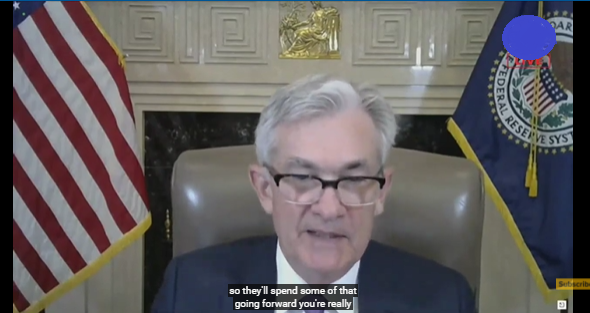
The KOSPI's volatility that day is analyzed as a result of a complex interplay between disappointment in U.S. monetary policy and expectations for China's economic growth.
The previous day, Fed Chair Powell participated in a conference hosted by the U.S. economic media outlet The Wall Street Journal and described the rise in market interest rates as "noteworthy," stating, "Asset purchases will continue at the current level until we make significant progress toward our goals." Last week, the U.S. 10-year Treasury yield surged to the 1.6% range. He also emphasized, "Inflationary pressures exist but are temporary. We will be patient."
The market interpreted Powell's remarks as the Fed's intention to tolerate recent inflation. Consequently, the U.S. 10-year Treasury yield quickly rose to the 1.54% range. Meanwhile, downward pressure increased on the U.S. stock market, leading to a sharp decline. On the New York Stock Exchange (NYSE), the Dow Jones Industrial Average fell 1.11%, the Standard & Poor's (S&P) 500 index dropped 1.34%, and the Nasdaq index closed down sharply by 2.11%.
Shinhan Investment Corp.'s Research Center domestic stock team analyzed the market that day, stating, "Despite Chair Powell's recognition of inflationary pressures, the absence of meaningful monetary policy signals has led to the emergence of disappointed selling."
China Sets Economic Growth Target Above 6% This Year... Decline Narrows
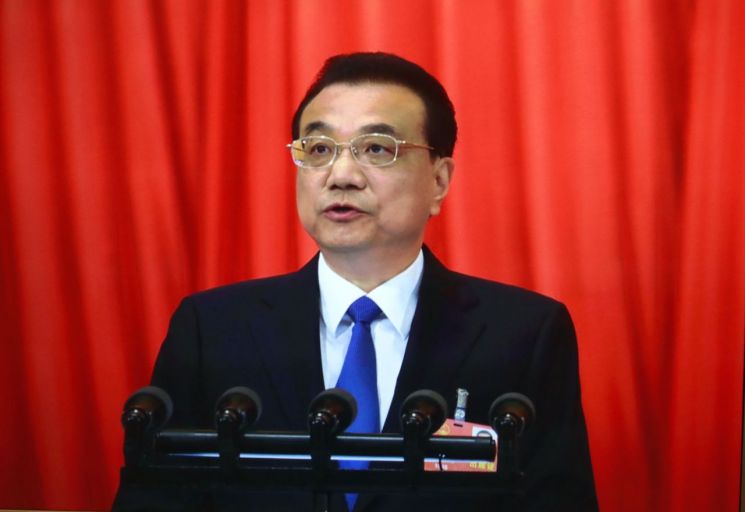
Despite such disappointment, the KOSPI showed signs of narrowing its decline as the Chinese government announced its economic growth target for this year.
That morning, Premier Li Keqiang stated in the Government Work Report at the National People's Congress (NPC) that "this year, we will achieve a GDP growth rate of over 6%." This contrasts with last year, when due to uncertainties caused by the spread of COVID-19, an economic growth target was not set unusually. Last year, China's economic growth rate was 2.3%.
However, market reactions are expected to be observed until the afternoon. SK Securities Research Center's Asset Strategy Team interpreted, "Given that the average growth target for each province before this NPC was 7%, the 6% target is somewhat conservative," adding, "This suggests that the Chinese government is likely to place emphasis on normalizing economic policies."
© The Asia Business Daily(www.asiae.co.kr). All rights reserved.



















