Seoul City Changes Traffic Methods from Tomorrow... West Road Integrated into Plaza, No Vehicle Entry
Comprehensive Traffic Measures Including New Detours... Seoul City "Measures Will Restore Previous Traffic Speed"
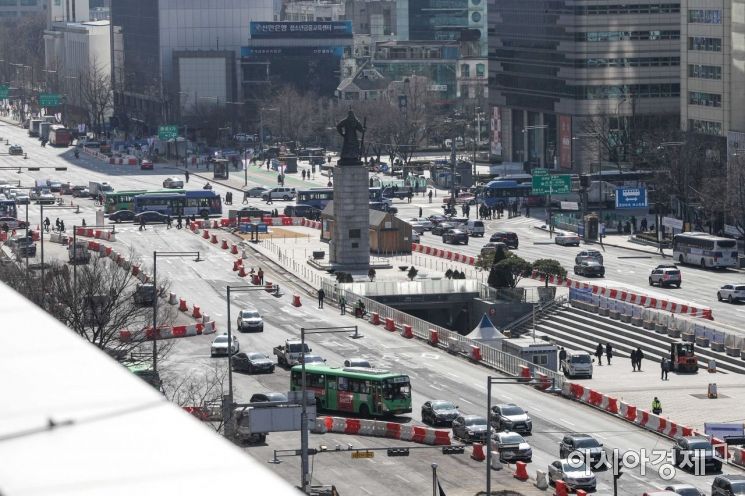 Construction is underway on Sejong-daero in Jongno-gu, Seoul, on the 23rd, as the vehicle flow route on Sejong-daero around Gwanghwamun Square is set to change starting March 6. Photo by Kang Jin-hyung aymsdream@
[Asia Economy Reporter Lim Cheol-young] From midnight on the 6th, the vehicle traffic routes around Gwanghwamun Square will change. The five lanes on the west road of Sejong Center for the Performing Arts and the five lanes on the east road of Kyobo Building will be altered so that the west road is incorporated into the square and vehicle traffic is prohibited, while the east road will be converted into a two-way lane. Although the east road has been widened, the number of lanes has been reduced to 7 to 9 lanes. Due to the widening of the five lanes, the road width and the number of lanes have decreased, which is expected to cause confusion for drivers and pedestrians as well as traffic congestion.
On the 5th, Seoul City decided to implement a comprehensive traffic plan including optimized signal operations and increased public transportation to adapt to the changed traffic environment. Two new left-turn intersections will be established at Sajik-ro and Yulgok-ro, which intersect with Sejong-daero, allowing detours to surrounding roads. Additionally, one more left-turn lane will be added to expand the capacity of residential roads used as detour routes.
Through the signal operation optimization plan, signal operations at 13 intersections on six major roads entering the city center will be adjusted before the opening. Previously, Seoul City had implemented measures from the 4th to encourage pre-distribution and detours of traffic volume. After the opening, signal optimization and signal time extensions will be applied to a total of 65 intersections across three zones to immediately reflect the changed traffic volume.
To minimize temporary road traffic congestion and inconvenience to citizens, subway lines 1, 2, 3, and 5 will be increased in frequency. Information and guidance related to the changed traffic system will be promoted through all available channels such as road electronic signs, navigation systems, and outdoor electronic billboards. Furthermore, traffic control personnel including traffic police and exemplary drivers will be concentrated at 13 major nearby intersections to promptly manage any traffic inconveniences that may occur on site. A joint task force (TF) with the Seoul Metropolitan Police Agency will be established and operated to respond immediately to traffic issues.
According to Seoul City's analysis of traffic simulations reflecting these measures, the average travel speed along the entire Sejong-daero, including the square section, after the two-way traffic implementation is about 21 km/h (compared to the 2019 annual average of 21.6 km/h). Without the traffic measures, the average speed on Sejong-daero would drop to about 19 km/h, but with the measures, it is expected to improve to the pre-construction level of 21 km/h. The length of waiting queues at intersections is also analyzed to decrease from 184 meters to 131 meters.
However, Seoul City explained that the rough simulation reflects the situation after stabilization rather than immediately after the road changes. Kang Jin-dong, head of Traffic Operations, said, "When citizens actually drive, they will feel whether they can pass through intersections in one go rather than just the travel speed," adding, "Although there are sections where waiting queues increase, this traffic plan will allow passing through at once." Regarding criticism that the analysis was based on reduced traffic volume due to the COVID-19 pandemic, he predicted that there will be no noticeable increase in traffic volume even after the pandemic ends.
Hwang Bo-yeon, Director of Urban Transportation, stated, "We will faithfully implement the comprehensive traffic plan to ensure smooth vehicle traffic without major congestion even after the two-way opening of the east road of Gwanghwamun Square," and added, "We ask citizens to refrain from using private cars and to use public transportation until traffic stabilizes on Sejong-daero and surrounding roads."
© The Asia Business Daily(www.asiae.co.kr). All rights reserved.
![Clutching a Stolen Dior Bag, Saying "I Hate Being Poor but Real"... The Grotesque Con of a "Human Knockoff" [Slate]](https://cwcontent.asiae.co.kr/asiaresize/183/2026021902243444107_1771435474.jpg)















