Leading Tech Stocks Fall Consecutively Amid US Treasury Yield Surge
Electric Vehicle Competition Also Affects... "Temporary Adjustment Period" Claims
Bitcoin Also Declines... Professor Shiller Says "No Intrinsic Value"
Deutsche Bank: "89% of Investors Believe Tesla and Bitcoin Are Both Bubbles"
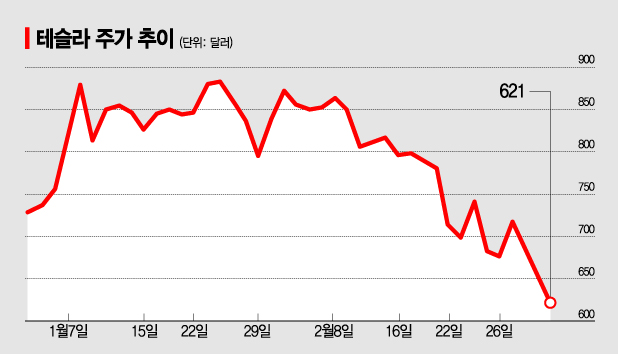
[Asia Economy Reporter Kim Suhwan] The stock price of Tesla, the U.S. electric vehicle company led by Elon Musk, has been on a continuous decline. Concerns over inflation and rising U.S. Treasury yields have been directly reflected in Tesla, the leading tech stock. Recently, Tesla's weak performance is seen as a symbolic representation of the overheating and bubble controversy in the U.S. stock market.
On the 4th (local time), Tesla's stock price on the U.S. Nasdaq closed at $621.44, down 4.86% (31.76 points) from the previous day. After hours, it fell an additional 3.43%, dropping to $600. This is the lowest level in three months since December 9 last year, when it recorded $604. Tesla's stock price has plunged 23% over two weeks.
"Signal of Bubble Burst" VS "Just a Temporary Adjustment Period"
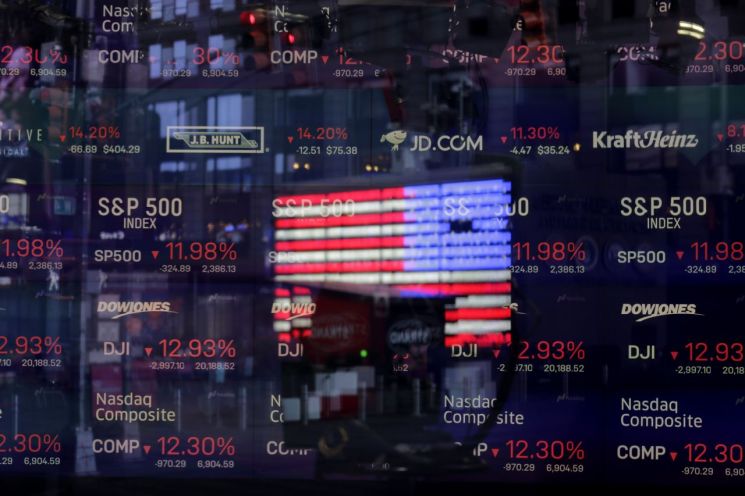
U.S. tech stocks, including Tesla, have been on a continuous decline since last month. The Nasdaq index, which is mainly composed of tech stocks, recorded a peak of 14,095.47 on the 12th of last month, then dropped about 10% over three weeks, closing at 12,723.47 on the 4th.
The main reason behind this tech stock decline appears to be inflation concerns triggered by the recent sharp rise in U.S. Treasury yields. The U.S. investment magazine Barron's reported, "The background of the tech stock decline is inflation concerns," adding, "Rising prices and interest rates cause a 'discount' effect that reduces future earnings." It is interpreted that although values rose last year due to low interest rate policies and quantitative easing, concerns over inflation inevitably become a negative factor for tech stocks that rely more on future earnings than immediate profits.
Of course, there is also a considerable interpretation that no bubble exists and this is just a temporary adjustment period. According to the CAPE (cyclically adjusted price-earnings) statistical analysis system designed by Nobel laureate Robert Shiller of Yale University to predict stock bubbles, Bloomberg reported that compared to the 2000 dot-com bubble, the current stock price level is a "natural upward trend." During the dot-com bubble, stock price levels were excessively high compared to the average price-earnings ratio over the past 100 years, but the current S&P 500 level is not interpreted as such.
Meanwhile, the intensifying competition in the electric vehicle sector within the automotive industry is also analyzed to have influenced Tesla's decline. According to Morgan Stanley's February U.S. automotive market analysis report released on the 3rd, Tesla's market share in the U.S. electric vehicle market in February dropped 12 percentage points from 81% last year to 69%.
Morgan Stanley stated that most of Tesla's market share decline in the U.S. was taken by competitor Ford. Previously, Tesla was also trailing traditional strong players like Volkswagen in the European electric vehicle market. Tesla, which held the No. 1 market share (31%) in the European electric vehicle market in 2019, fell to 13% last year, ranking fourth behind Volkswagen, Renault-Nissan Group, and Mitsubishi.
Michelle Krebs, an analyst at the online car shopping mall AutoTrader, said, "This shows that Tesla no longer monopolizes the electric vehicle market," and analyzed, "Tesla's market share decline will continue."
Bitcoin Falling Alongside
Regarding Bitcoin's decline, there is also an analysis that the 'bubble' formed last year is collapsing. Bitcoin has been fluctuating around the $48,000 level after dropping about 20% from $58,000 on the 22nd of last month.
Professor Shiller pointed out, "Bitcoin has no intrinsic value. Its current price is absurd." Earlier, Deutsche Bank reported in its own survey in January that "89% of respondents believe both tech stocks and Bitcoin are in a bubble."
© The Asia Business Daily(www.asiae.co.kr). All rights reserved.
![Clutching a Stolen Dior Bag, Saying "I Hate Being Poor but Real"... The Grotesque Con of a "Human Knockoff" [Slate]](https://cwcontent.asiae.co.kr/asiaresize/183/2026021902243444107_1771435474.jpg)
















