Announcement of the 3rd Basic Plan for Aviation Industry Development (2021-2030) and Core Technology Roadmap
[Sejong=Asia Economy Reporter Joo Sang-don] The government has decided to actively pursue the development of eco-friendly aircraft engines based on electric and hydrogen fuel propulsion systems in response to the aviation industry's trend toward sustainability. First, this year, it will begin developing technology for a 'hydrogen fuel cell-based cargo drone' capable of carrying 200 kg of cargo. Additionally, it will promote the development of core component technologies for Urban Air Mobility (UAM), commonly known as the 'flying car.'
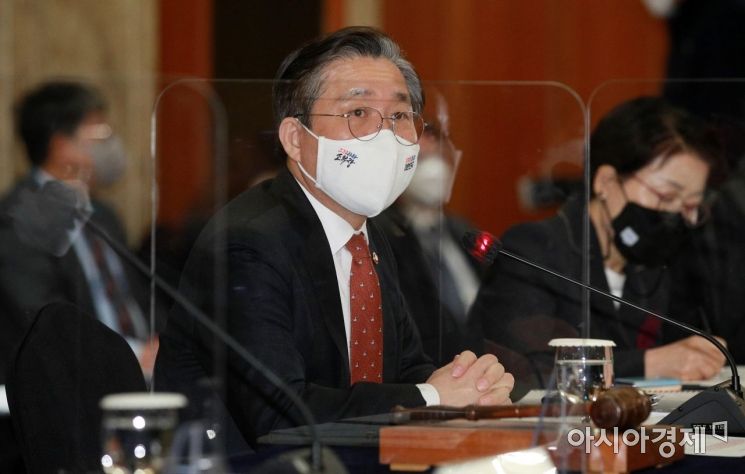
On the 5th, the Ministry of Trade, Industry and Energy held a meeting with the aviation manufacturing industry at LIG Nex1 Daejeon House, chaired by Minister Sung Yun-mo, and announced the '3rd Basic Plan for Aviation Industry Development (2021?2030)' containing these details. The Basic Plan for Aviation Industry Development is a statutory plan that presents support directions and policy tasks to efficiently and systematically operate aviation industry development policies over the next decade.
Through the Basic Plan, the government established and presented a 'Roadmap of 100 Core Technologies' to proactively respond to future technology demands in the aviation industry, such as high efficiency, smartization, and eco-friendliness. To respond to the eco-friendly trend, it will promote the development of aviation technologies including electric propulsion, high efficiency, artificial intelligence (AI), big data, new materials, and smart factories. This year, it has allocated and will support a total of 115.3 billion KRW across 22 projects, including an investment of 5.7 billion KRW for the development of hydrogen fuel cell-based cargo drone technology.
The government also plans to develop core element technologies for the core systems and frameworks of future flying vehicles (UAM·AAM), a new concept of transportation. UAM refers to flying vehicles that can carry 4 to 5 passengers within urban areas and is expected to expand into Advanced Air Mobility (AAM) for inter-city travel in the future. Morgan Stanley predicts that the related market size will reach approximately 1.5 trillion USD by 2040. To respond to this, the government will focus investment on developing core components for UAM and AAM, such as high-strength airframe structures, high-output and high-efficiency propulsion systems, and small, lightweight, low-power propulsion systems, while fostering the related industry through industry-academia-linked master's and doctoral training programs.
The announced Basic Plan also includes measures to strengthen support infrastructure to overcome industrial crises. It will continue financial support for small and medium-sized aviation companies through the Period Industry Stabilization Fund and the Aviation Industry Win-Win Cooperation Guarantee System to overcome the COVID-19 crisis and maintain the aviation industry ecosystem. Furthermore, it will build infrastructure to expand aviation industry exports by supporting quality certification, joint management of raw materials, and enhancing engineering capabilities.
Minister Sung said, "The recent global aviation market is opening a new arena of challenges and opportunities, including UAM, eco-friendly flying vehicles, AI, and various aviation electronic software," adding, "The government will do its best to provide policy support to strengthen the future competitiveness of the aviation industry."
© The Asia Business Daily(www.asiae.co.kr). All rights reserved.
![Clutching a Stolen Dior Bag, Saying "I Hate Being Poor but Real"... The Grotesque Con of a "Human Knockoff" [Slate]](https://cwcontent.asiae.co.kr/asiaresize/183/2026021902243444107_1771435474.jpg)















