Large Savings Banks Increase Salaries and Bonuses Based on Performance
Small Businesses Tighten Belts with Frozen or Reduced Bonuses
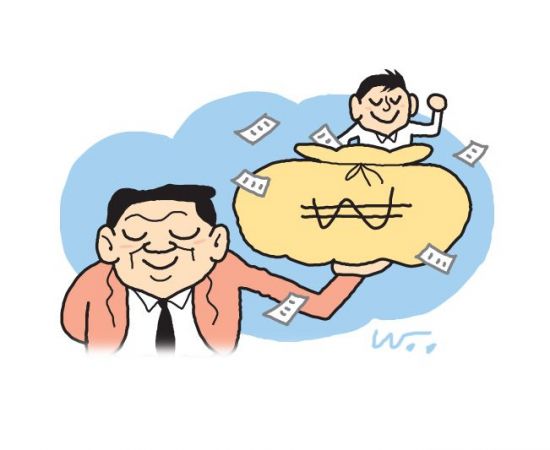
[Asia Economy Reporter Song Seung-seop] Last year, while large savings banks saw a significant increase in bonuses and annual salaries, small and medium-sized savings banks tightened their belts with salary freezes and other measures. This is seen as an indication of deepening polarization within the industry due to the impact of COVID-19.
According to the savings bank industry on the 5th, SBI Savings Bank recently paid a total performance bonus of 12.29 billion KRW to its employees, a 13% (1.43 billion KRW) increase compared to 10.86 billion KRW the previous year. Total compensation including bonuses grew from 43.05 billion KRW to 48.83 billion KRW, and the average compensation per employee rose by about 4 million KRW to 82 million KRW.
JT Savings Bank also saw its total compensation increase by about 2 billion KRW to 14.9 billion KRW last year. The average compensation per employee rose from 55 million KRW to 63 million KRW. Total compensation paid to manager-level employees increased by 320 million KRW to 1.31 billion KRW, while deputy and staff-level employees recorded 5.16 billion KRW (an increase of 590 million KRW) and 1.95 billion KRW (an increase of 420 million KRW), respectively.
Large savings banks preparing to disclose related statistics do not deny the increase in allowances due to improved performance. A representative from a savings bank said, "We will know once the management disclosure is released, but I understand that performance records were broken," adding, "Since we exceeded targets, annual salaries and bonuses were higher." Another industry insider also said, "Performance improved, and although modest, annual salaries and bonuses were increased."
Small and Medium Savings Banks Freeze Salaries and Cut Bonuses
On the other hand, small and medium-sized savings banks generally cut or did not pay bonuses at all. Savings Bank A, ranked low in asset size, saw employee performance bonuses decrease from about 1 billion KRW in 2019 to 880 million KRW. The average annual salary per employee was frozen at 50 million KRW.
During the same period, Savings Bank B’s bonuses were halved from 626 million KRW to 311 million KRW. Responsible-level employees and junior staff such as assistants and clerks did not receive any bonuses. This has led to analysis that the gap within the industry widened to the extent that even the overall boom in the secondary financial sector was not enjoyed.
In fact, customers and loan/deposit amounts in the savings bank sector, which expanded before and after COVID-19, mostly concentrated in large companies. According to the Bank of Korea’s Economic Statistics System, last year’s loan and deposit scale of savings banks rapidly grew by 12 to 13 trillion KRW compared to the previous year, reaching 77.4574 trillion KRW and 79.1764 trillion KRW, respectively. However, since most of these were concentrated in Seoul and the metropolitan area where large savings banks are located, some local areas with many small local companies saw their loan and deposit scales shrink.
Professor Sung Tae-yoon of Yonsei University’s Department of Economics analyzed, "People pushed out by strengthened loan regulations in the banking sector, facing increased credit risk, probably found it difficult to approach small savings banks," adding, "It seems they mainly visited large savings banks with high accessibility and recognition."
© The Asia Business Daily(www.asiae.co.kr). All rights reserved.
![Clutching a Stolen Dior Bag, Saying "I Hate Being Poor but Real"... The Grotesque Con of a "Human Knockoff" [Slate]](https://cwcontent.asiae.co.kr/asiaresize/183/2026021902243444107_1771435474.jpg)














