Professor Kim Jeongwon's KAIST Team Develops Terahertz Wave Streaking Technology
Electron Pulse Timing Stabilized at 5.5 Femtoseconds for 4600 Seconds
'Time Stability' Improved Over 4 Times Compared to Previous World Best Performance
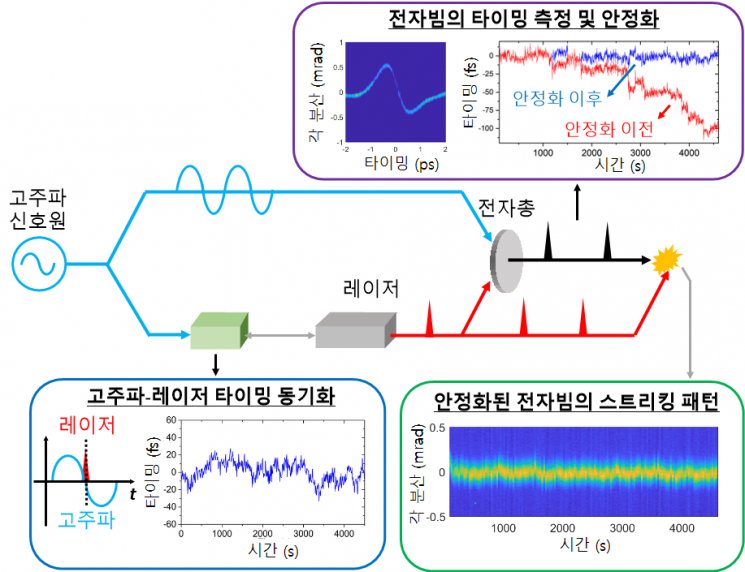 Conceptual diagram of technology for measuring and stabilizing the timing of electronic pulses. Provided by Korea Advanced Institute of Science and Technology (KAIST)
[Asia Economy Reporter Kim Bong-su] A technology has been developed that can improve the performance of ultrafast electron cameras (electron diffraction devices), which can observe the movement of electrons within atoms, by more than four times.
Korea Advanced Institute of Science and Technology (KAIST) announced on the 5th that Professor Kim Jung-won's research team in the Department of Mechanical Engineering, in collaboration with the Korea Atomic Energy Research Institute, succeeded in developing a technology to measure and control the timing of ultrashort electron pulses with an accuracy of 10 femtoseconds (one hundred trillionth of a second). Using this new timing stabilization technology, it is expected to become a core technology that significantly enhances the analytical capability of ultrafast electron diffraction (UED) techniques, enabling the identification of new properties of advanced materials such as two-dimensional materials like graphene.
Existing electron pulse timing stabilization technologies stabilized the high-frequency microwave signals generating electrons and lasers individually, but had the limitation of not being able to stabilize the timing of the electron pulses themselves over long periods.
To overcome these limitations, the research team implemented a system that measures and controls the timing of electron pulses using terahertz wave streaking technology. As a prerequisite for this terahertz wave streaking technology, precise measurement and control of the laser and microwave signals required to generate electron pulses must be achieved first. To this end, the team developed and optimized various laser-microwave-electron beam stabilization devices one by one, including a precise synchronization system between laser and microwave, an optical pulse monitoring system, and a magnet-based electron pulse compression system.
The time difference between the finally measured electron pulse and the terahertz wave was controlled and corrected using a motor. As a result, for the first time in the world, the timing of electron pulses was stabilized at the level of 5.5 femtoseconds for 4,600 seconds. This is more than four times the time stability of the previous world’s best performance.
Diffraction analysis techniques (UED) based on ultrashort electron pulses utilize the short pulse width of electron pulses (tens of femtoseconds) and speeds close to the speed of light (99.2%) for research in future advanced industrial fields such as solar cell devices and next-generation electrical and electronic material development.
The Korea Atomic Energy Research Institute already possesses the world’s highest-performance electron camera, and through this technology development, it has challenged not only improving the resolution of existing electron diffraction techniques but also observing electron dynamics within atoms, which was previously impossible.
Professor Kim Jung-won said, "In terms of a regular camera, this means being able to continuously take clearer pictures for a longer time," and added, "Continuous improvements in electron pulse timing stability and performance enhancement of ultrafast electron cameras will meet the demands of next-generation basic and industrial research such as various solar material development and electron cloud observation."
The results of this research were published as the cover paper of the February issue of the international academic journal Laser & Photonics Reviews on the 11th.
© The Asia Business Daily(www.asiae.co.kr). All rights reserved.
![Clutching a Stolen Dior Bag, Saying "I Hate Being Poor but Real"... The Grotesque Con of a "Human Knockoff" [Slate]](https://cwcontent.asiae.co.kr/asiaresize/183/2026021902243444107_1771435474.jpg)















