Comprehensive Traffic Measures Reflecting Traffic Simulation Analysis Launched by Seoul Metropolitan Police Agency and TF
New Left Turns at Intersections and Additional Lanes Completed...Traffic Volume Pre-Dispersed and Detours Guided through Signal Optimization
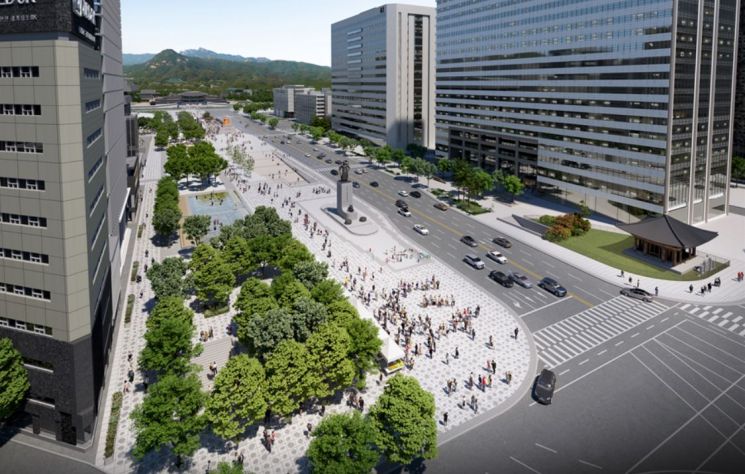
[Asia Economy Reporter Lim Cheol-young] Starting from midnight on the 6th, the east side road of Gwanghwamun Square (in front of the Kyobo Building) will be converted to two-way traffic. In response, the Seoul Metropolitan Government is implementing a 'Comprehensive Traffic Measures' plan based on traffic simulation analysis. To ensure smooth traffic flow, Seoul plans to optimize signal operations, increase public transportation services, and deploy traffic police and exemplary drivers at major nearby intersections to minimize inconvenience to citizens.
On the 5th, Seoul announced through an online briefing that temporary traffic disruptions may occur on the day of the two-way opening of the east side road of Gwanghwamun Square and due to subsequent traffic system changes. Therefore, they have prepared and will implement comprehensive traffic measures across various sectors. The core elements of Seoul’s comprehensive traffic measures include: traffic improvement projects (TSM) that improve traffic flow at surrounding intersections; optimization of signal operations reflecting the changed traffic environment; increased public transportation services to secure citizens' right of passage; deployment of traffic police and exemplary drivers for active on-site management; and promotion and guidance measures using Variable Message Signs (VMS) and navigation systems.
According to traffic simulation analysis, with the comprehensive traffic measures in place, the average travel speed along the entire Sejong-daero, including the square section, is expected to be around 21 km/h (compared to the 2019 annual average of 21.6 km/h) even after the two-way traffic change. Without these measures, the average travel speed on Sejong-daero would drop to about 19 km/h. Seoul explains that implementing the traffic measures will restore the speed to the pre-construction level of 21 km/h. The length of vehicle queues at intersections is also expected to decrease from 184 meters to 131 meters.
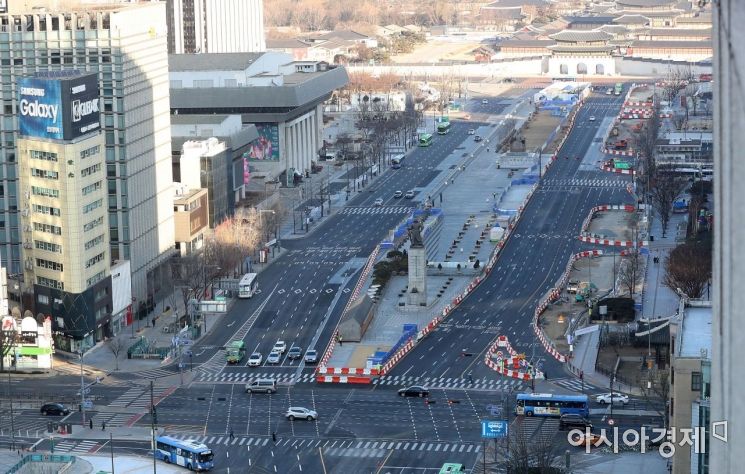 As the spread of the novel coronavirus disease (COVID-19) continues in South Korea, the downtown area of Seoul appears quiet on the last day of the New Year's holiday, January 3rd. Photo by Kim Hyun-min kimhyun81@
Seoul will first create two new left-turn lanes at intersections where Sajik-ro and Yulgok-ro meet Sejong-daero, allowing detours onto surrounding roads. Additionally, one more left-turn lane will be added to expand the capacity of residential roads used as detour routes. Kim Jin-dong, Director of Traffic Operations, stated, "We plan to continuously expand traffic improvement projects through the first half of this year, including at points where traffic congestion occurs after the opening." He added, "After the opening, signal optimization and signal time extensions will be implemented across three zones, immediately reflecting the changed traffic volumes at a total of 65 intersections."
Through the signal operation optimization plan, signal timings will also be adjusted at 13 intersections on six major roads leading into the city center before the opening. Previously, Seoul had implemented measures from the 4th to encourage pre-distribution and detours of traffic volume. After the opening, signal optimization and signal time extensions will be applied across three zones, immediately reflecting the changed traffic volumes at 65 intersections.
Furthermore, to minimize temporary road traffic congestion and citizen inconvenience, subway lines 1, 2, 3, and 5 will increase service frequency. Seoul plans to promote and provide guidance on the changed traffic system through all available channels, including Variable Message Signs, navigation systems, and outdoor electronic billboards. Additionally, to promptly manage any traffic inconveniences occurring on-site, traffic control personnel such as traffic police and exemplary drivers will be concentrated at 13 major nearby intersections. A joint task force (TF) will also be established and operated in cooperation with the Seoul Metropolitan Police Agency to respond immediately to traffic issues.
Hwang Bo-yeon, Director of Urban Transportation, said, "We will faithfully implement the comprehensive traffic measures to ensure smooth vehicle flow without major congestion even after the two-way opening of the east side road of Gwanghwamun Square." He added, "We ask citizens to refrain from using private cars and to use public transportation until traffic stabilizes on Sejong-daero and surrounding roads."
© The Asia Business Daily(www.asiae.co.kr). All rights reserved.
![Clutching a Stolen Dior Bag, Saying "I Hate Being Poor but Real"... The Grotesque Con of a "Human Knockoff" [Slate]](https://cwcontent.asiae.co.kr/asiaresize/183/2026021902243444107_1771435474.jpg)

















