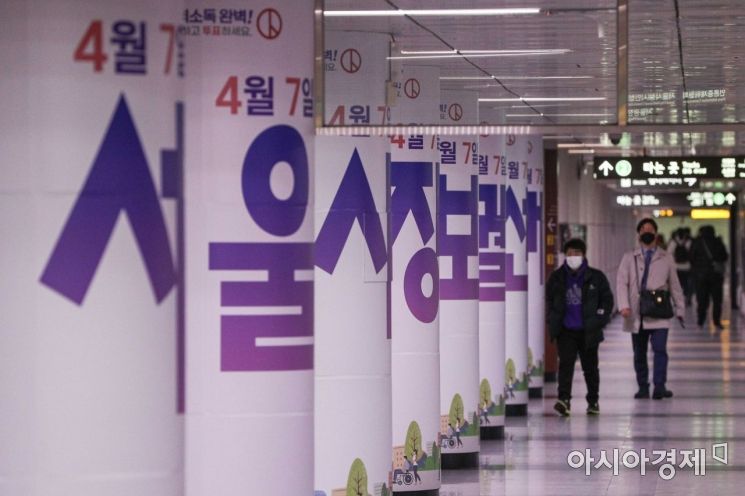
 A phrase encouraging voting participation is wrapped around a pillar in the Seoul City Hall Station concourse on the 5th, about a month before the Seoul mayoral by-election. Photo by Kang Jin-hyung aymsdream@
[Asia Economy Reporter Park Cheol-eung] The upcoming April 7 by-elections are held exactly at the midpoint between the last general election and the forthcoming presidential election. In other words, it serves as a preliminary battle that will determine the direction of the presidential race one year later, based on the evaluation of the ruling party that achieved a landslide victory in the general election. This ‘timing’ condition can work against the ruling party in the final stages of the administration. Unlike previous presidents, President Moon Jae-in’s approval rating remains above 40%, but if the ruling party loses in the by-elections, it could be interpreted as a clear signal of a full-fledged lame duck period.
A political insider said, "It is common to view that if the ruling party loses an election ahead of the presidential election, the lame duck period will come sooner. Conversely, if the ruling party wins, the path to the presidential election will be smoother, and the opposition party is likely to undergo changes at the level of dissolution and political reorganization."
The gravity of the situation is expressed in an ‘all-out war’ manner. The Democratic Party of Korea has mobilized all its human and material resources, with leader Lee Nak-yeon and floor leader Kim Tae-nyeon jointly serving as co-chairs of the election countermeasures committee since the 3rd. The People Power Party also tried to generate excitement through a sensational one-on-one debate primary and is staking its fate on unification with Ahn Cheol-soo, leader of the People’s Party.
The fate of the People Power Party is also at stake in this election. Since the crushing defeat in last year’s general election, the party has been striving for reform and leap forward under an emergency committee system, but another loss would mean the failure of this system. This also makes unification with candidate Ahn Cheol-soo difficult. From the perspective of Kim Jong-in, chairman of the People Power Party’s emergency committee, if they cannot even field a candidate using the People Power Party’s symbol, he will face accountability questions such as ‘what have we been doing all this time?’ This is the background for insisting on Ahn’s party membership or merger as a prerequisite. Hong Hyung-sik, director of Hangil Research, said, "If former Prosecutor General Yoon Seok-youl also moves into politics, whether the opposition will center around the People Power Party until the presidential election will be decided by this election."
The ‘worst-case scenario’ currently imaginable from the ruling party’s perspective is that former Yoon supports the opposition candidate. Looking only at the Seoul mayoral election, the gap in support rates between the ruling and opposition parties is not large, so former Yoon could attract moderate votes and shift the balance. A ruling party official said, "It may be difficult for former Yoon to increase his political influence solely based on the image of resisting prosecutorial reform, but he could have some influence in the by-elections, so we are paying close attention."
Professor Park Sang-chul of Kyonggi University’s Graduate School of Political Studies said, "Until now, many have viewed that the ruling party would recreate the administration, but if they lose the by-elections, their momentum will inevitably weaken," adding, "Former Yoon also seems to lack the capacity to independently build a base, so depending on the by-election results, the possibility of joining forces with the People Power Party cannot be ruled out."
© The Asia Business Daily(www.asiae.co.kr). All rights reserved.
![Clutching a Stolen Dior Bag, Saying "I Hate Being Poor but Real"... The Grotesque Con of a "Human Knockoff" [Slate]](https://cwcontent.asiae.co.kr/asiaresize/183/2026021902243444107_1771435474.jpg)
















