UNIST Professor Kim Taesung's Team Controls Delivery of Drug-like Small Molecules Without Power or External Stimuli
Applicable to Diagnostic and New Drug Development Chip Technologies.. Published in Nature Communications
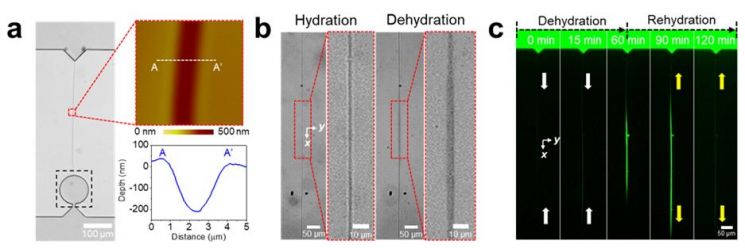 Structure of the developed microfluidic chip and fluorescence signal analysis image. Provided by Ulsan National Institute of Science and Technology
[Asia Economy Reporter Kim Bong-su] Microfluidic chips for detecting pathogens or diagnosing cancer cells require nanofilms to filter liquid samples and power devices or chemical stimuli to control sample flow. However, problems such as the need to fabricate new microfilms for filters each time or sample damage due to failure in stimulus control frequently occur. A new technology that reduces the possibility of sample damage has been developed and is attracting attention.
The research team led by Professor Kim Tae-sung of the Department of Mechanical Engineering at Ulsan National Institute of Science and Technology (UNIST) announced on the 4th that they have developed a new technology that can control the injection of small molecule substances such as drugs, neurotransmitters, and DNA fragments by the evaporation phenomenon of liquid (solvent) inside the microfluidic chip without damaging the sample.
Unlike existing methods, this technology does not require separate power devices or strong stimuli, so it does not damage the sample. It is attracting attention as a versatile control core technology capable not only of filtering or valve functions to filter samples but also of concentration and pumping functions.
Professor Kim’s team utilized the phenomenon where liquid flow is drawn toward the side where evaporation occurs to fill the empty space when liquid evaporates from tiny gaps on the wall surface of a nanoslit, which is part of the microfluidic channel. The principle is that samples contained in the liquid gather or diffuse depending on the direction of the liquid flow. The nanoslit channel height is only a few nanometers (10^-9 m), which is low, while the cross-sectional length is on the micrometer (10^-6 m) scale, maximizing changes in fluid flow caused by evaporation.
No external stimuli are needed except for humidity changes to control evaporation, and nanoslits can be easily fabricated through crack-photolithography. Crack-photolithography is a modified photolithography process commonly used in semiconductor manufacturing, developed by the research team through prior studies.
The researchers fabricated a microfluidic chip where two main chips (source chip and target chip) are connected by a nanoslit and demonstrated that the nanoslit can function as a valve or filter that concentrates samples or controls sample injection into the target chip. Notably, they achieved concentration of samples (fluorescent molecules) up to 256 times the concentration of small molecules in the source chip within just one hour.
Professor Kim explained, “Small molecule delivery control technology in microfluidic environments is impactful research attracting attention not only in the bio field but also in energy synthesis and desalination.”
Seo Sang-jin, first author and integrated MS-PhD course researcher in the Department of Mechanical Engineering at UNIST, said, “In this study, fluorescent signal-emitting molecules were used as samples to observe material transfer phenomena, but the technology can be applied to micro substances such as drugs, neurotransmitters, DNA fragments, and quantum dots. We will verify performance through collaboration with researchers in other fields.”
This research was published online on February 26 in the international journal Nature Communications.
© The Asia Business Daily(www.asiae.co.kr). All rights reserved.
![Clutching a Stolen Dior Bag, Saying "I Hate Being Poor but Real"... The Grotesque Con of a "Human Knockoff" [Slate]](https://cwcontent.asiae.co.kr/asiaresize/183/2026021902243444107_1771435474.jpg)
















