Statistics Korea Announces February Consumer Price Trends
Green Onion Up 227%, Apple 55%, Egg 41% Increase
Rent Also Rises 0.9%, Largest Increase in 3 Years
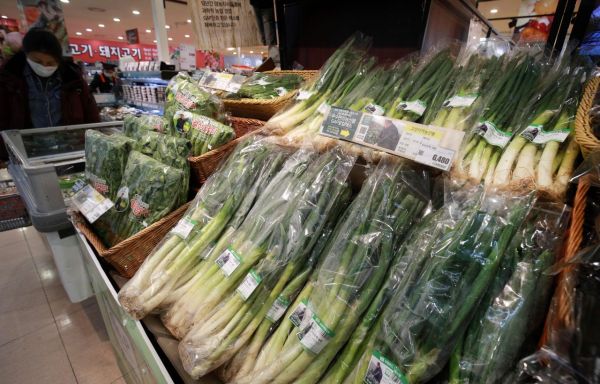 Amid the economic downturn caused by COVID-19, which has severely impacted the livelihood economy, the continuous rise in prices has also put daily food costs on high alert. According to Statistics Korea on the 25th, the consumer price index in January increased slightly by 0.6% compared to the same period last year, but agricultural, livestock, and fishery products surged by 10%. The photo shows citizens shopping at a large supermarket in Seoul on the same day. Photo by Kim Hyunmin kimhyun81@
[Sejong=Asia Economy reporters Kim Hyunjung and Moon Chaeseok] Last month, prices of agricultural, livestock, and fishery products, known as the 'basket prices' for ordinary people, recorded the largest increase in 10 years, leading the overall consumer price index to recover to a 1% range increase for the first time in five months. Although this is the largest increase in a year since the spread of COVID-19, the rise was driven by supply and demand instability such as the spread of highly pathogenic avian influenza (AI) and poor crop conditions, making it difficult to predict an economic recovery.
According to the 'February Consumer Price Trends' released by Statistics Korea on the 4th, the consumer price index last month was 107.00 (2015=100), up 1.1% compared to the same month last year. This is the highest increase in a year since February last year (1.1%) and the first time in five months since September last year (1.0%) that the increase rate recovered to the 1% range.
By item, prices of goods and services rose 1.9% and 0.5%, respectively, compared to the same month last year. Agricultural, livestock, and fishery products, which led the rise in goods prices, jumped 16.2%, marking the largest increase in 10 years since February 2011 (17.1%). Due to poor crop conditions caused by adverse weather, the price of green onions soared by 227.5%, and apples rose by 55.2%. Egg prices surged 41.7% due to the culling of laying hens caused by the spread of AI and a sharp increase in demand during the holidays. Pork and domestic beef, which saw increased household demand, also rose by 18.0% and 11.2%, respectively. Industrial products, on the other hand, fell by 0.7%, and petroleum products dropped by 6.2%, although the recent rise in international oil prices slowed the decline compared to the previous month (-8.6%). Processed foods rose 1.2%, and electricity, water, and gas fell by 5.0%. Including agricultural, livestock, and fishery products, industrial products, and electricity, water, and gas, goods prices rose by 1.9%.
Services showed a limited increase as face-to-face contact remained subdued due to the spread of COVID-19. Personal services rose 1.6%, while public services, influenced by policies such as free education, fell 2.1%. Among personal services, dining-out prices rose 1.3%, and prices excluding dining-out increased by 1.7%. Rent rose 0.9% compared to a year ago, marking the largest increase in over three years since March 2018 (0.9%). The increase rates for jeonse (long-term deposit lease) and monthly rent were 1.2% and 0.5%, respectively.
The core inflation index, which excludes agricultural products and petroleum, rose 0.8%, marking three consecutive months of increases in the 0% range. The fresh food index rose 18.9%, showing the highest increase in four months since October last year (19.9%), and the living cost index, a perception indicator, rose 1.2%. The index excluding food and energy rose 0.3%.
Statistics Korea judged that although there are price increase factors from the supply and demand side, the situation is not one to be concerned about inflation. Oh Woonseon, Director of Economic Trend Statistics at Statistics Korea, explained, "The increase in prices of agricultural and livestock products and services has widened the inflation rate," adding, "There will be efforts by price authorities and economic officials, and it is not a situation to be worried about."
© The Asia Business Daily(www.asiae.co.kr). All rights reserved.
![Clutching a Stolen Dior Bag, Saying "I Hate Being Poor but Real"... The Grotesque Con of a "Human Knockoff" [Slate]](https://cwcontent.asiae.co.kr/asiaresize/183/2026021902243444107_1771435474.jpg)















