Changes in Ethical Consumption, Accelerating ESG Management
CEO-Direct Organizations Established One After Another
Inviting External Experts and Reflecting Performance Evaluations
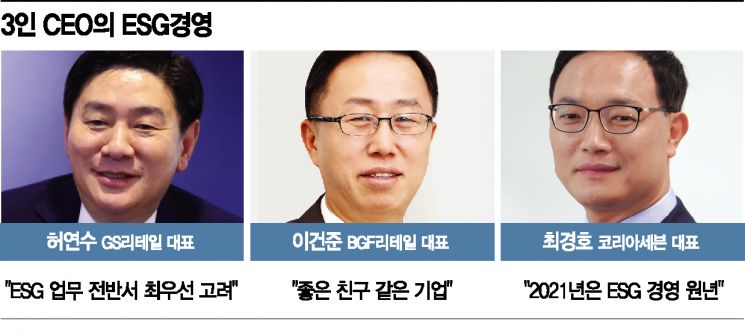
The three major convenience store chains have successively launched ESG (Environmental, Social, and Governance) organizations directly under their CEOs, marking the full-scale implementation of ESG management. As the role of convenience stores evolves from distribution points to lifestyle convenience facilities, they are actively competing to build an image of being 'good convenience stores.'
◆CEO Takes Direct Charge
According to the distribution industry on the 4th, the three convenience store chains?GS25, CU, and Seven Eleven?have recently begun concretizing their visions related to ESG management.
GS Retail (GS25) decided to reflect ESG-related items by more than 10% in the performance evaluations (MBO) not only for executives in ESG-related departments but also for team leaders and staff. Huh Yeon-su, Vice Chairman and CEO of GS Retail, emphasized that "ESG management activities must be prioritized across all work areas," leading to this recent decision.
BGF Retail (CU) is currently searching for candidates to invite external experts to the ESG Management Committee, which was launched last month with BGF CEO Hong Jung-guk and BGF Retail CEO Lee Geon-jun serving as co-chairs. A BGF Retail official stated, "Along with environmental expert Professor Lee Byung-wook from Sejong University’s Graduate School of Public Policy, we plan to recruit additional external professional advisors to provide counsel on overall ESG management." From this year, ESG performance will also be linked to the key performance indicators (KPIs) of executives in each division.
Korea Seven (Seven Eleven) became the first major affiliate of Lotte Group to establish an ESG organization in the form of a task force (TF). Choi Kyung-ho, CEO of Korea Seven, announced the ESG achievement goals and core strategies earlier this year. They plan to expand ESG-related items in employee performance evaluations and initiate changes through ESG forums and lectures.
◆Only Good Companies Survive
The reason the three convenience store chains are rolling up their sleeves to strengthen ESG management lies in changing consumer trends. Smart consumers who pursue 'good consumption' scrutinize the ingredients of products and packaging rather than attractive packaging, carefully checking the origin and any unfairness in manufacturing and distribution processes. An industry insider said, "ESG management is no longer something 'nice to do' but something 'must do,'" adding, "Turning proactive consumers who engage in good consumption into 'our allies' is an immediate challenge."
It is also analyzed that lifestyle changes due to COVID-19 have played a role in accelerating ESG management in the convenience store industry. As convenience stores have expanded their role from passively selling snacks and lunch boxes years ago to becoming a 'lifestyle platform'?where customers withdraw money, send parcels, and leave laundry close to their daily lives?attracting loyal customers has become more important than ever.
With more than 42,000 stores nationwide for GS25, CU, and Seven Eleven combined, the largest number for a single brand, this has also served as a catalyst for advancing ESG management. A convenience store industry official said, "Each convenience store operates 24-hour lighting and heating/cooling systems, which means a greater responsibility for carbon emissions," adding, "We plan to expand various social contribution initiatives, including eco-friendly efforts, building social safety nets, and public interest activities for vulnerable groups."
© The Asia Business Daily(www.asiae.co.kr). All rights reserved.
![Clutching a Stolen Dior Bag, Saying "I Hate Being Poor but Real"... The Grotesque Con of a "Human Knockoff" [Slate]](https://cwcontent.asiae.co.kr/asiaresize/183/2026021902243444107_1771435474.jpg)















