4 Major Banks' Credit Loan Interest Rates in February at 2.59~3.65% per Year... Up 0.6%P in 6 Months
Market Interest Rate Rise Also Affects Base Rate... Economic Crisis Possibility and Careful Management Needed
Experts Say "If Asset Prices Deflate as a 'Bubble', There Could Be a Major Crisis Across the Economy"
[Asia Economy Reporters Kwangho Lee and Seungseop Song] Office worker Choi Seon-gyu (46, pseudonym) took out a variable-rate mortgage loan of 300 million KRW at an annual interest rate of 2.5% from Bank A earlier this year when he moved. Choi chose the variable rate because it is generally 0.2 to 0.3 percentage points lower than the fixed rate, but with recent interest rate hikes, his concern over interest payments has grown. Even a 0.5 percentage point increase in the base rate would raise his annual interest payment from 7.5 million KRW to 9 million KRW, an increase of 1.5 million KRW.
Borrowers Under Immediate Pressure
Since the beginning of this year, bank loan interest rates have steadily risen, increasing the interest burden not only on those investing with borrowed money (debt investment) and those leveraging all their assets (all-in investors) but also on ordinary citizens. The rise in market interest rates due to inflation expectations combined with government measures to curb household loan growth has triggered warning signs for investments made through bank loans. With the COVID-19 situation calming down and consumption recovering in the second half of the year, the base interest rate is expected to rise. There are concerns that if stock and housing price volatility increases, it could trigger a crisis across the entire financial market. Experts advise that interest rate pressures during economic normalization are inevitable and that exit strategies for vulnerable groups must be prepared.
◆Record-High Household Loans... Increasing Interest Burden on Ordinary Citizens= According to the Bank of Korea, household debt from financial institutions reached 125.8 trillion KRW last year. Considering that household credit increased by 63.6 trillion KRW in 2019 alone, last year’s household debt nearly doubled compared to the previous year. The annual growth rate was 7.9%, the highest since 2017 (8.1%). This surge is attributed to the boom in debt investment and all-in investing, where many people borrowed to invest in stocks and real estate. The problem is that the total amount of debt to be repaid increases as loan interest rates rise, following the explosion of household debt in a low-interest-rate environment.
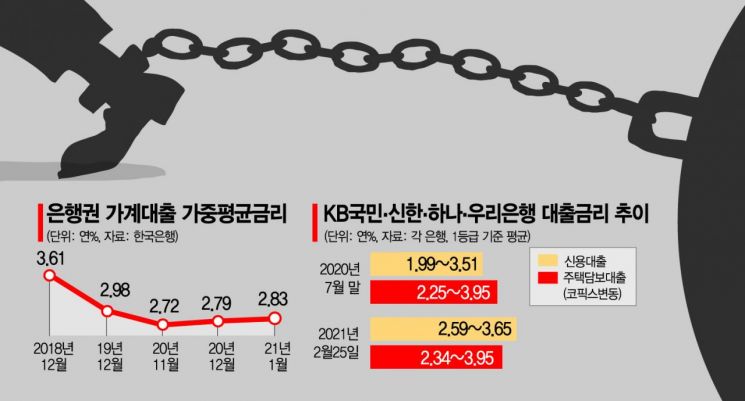
As of the end of last month, the interest rates for prime credit loans (grade 1) at the four major banks?KB Kookmin, Shinhan, Hana, and Woori?ranged from 2.59% to 3.65% annually. Compared to late July last year, when credit loan rates were in the 1% range (1.99% to 3.51%), the lower bound has increased by 0.6 percentage points. Mortgage loan rates linked to COFIX at the four major banks also rose by 0.09 percentage points (lower bound) to 2.34%?3.95% annually over the same period. This is interpreted as a result of rising market interest rates and reduced preferential rates due to regulatory pressure.
Credit loan rates use short-term financial bond rates such as 6-month and 1-year bank bonds as benchmarks. Among these, bank bond rates have been on the rise since the second half of last year. The 1-year AAA unsecured bank bond rate increased from 0.761% at the end of July last year to 0.856% at the end of February, a 0.095 percentage point rise in six months. Additionally, COFIX, which is linked to variable mortgage rates, has rebounded due to market interest rate influences.
Especially as the Biden administration in the U.S. and governments worldwide pledge budget spending for economic stimulus, if these budgets are financed through bond issuance, Korean bond yields are also likely to rise accordingly.
With market interest rates expanding and COVID-19 entering a calming phase in the second half, the Bank of Korea is more likely to raise the base interest rate. This means investors who have taken on excessive debt will be directly hit. As of the end of last year, 69.4% of bank household loans were variable rate. Considering the total bank loan balance of 850 trillion KRW, a 0.25 percentage point increase in the base rate would raise the annual interest burden on households by 1.5 trillion KRW.
◆Interest Rate Rise to Accelerate in Second Half... Need for Debt Reduction Measures= Experts point out that the rise in loan interest rates will accelerate in the second half, urging proactive preparation. If housing prices or stock prices plunge sharply, households that borrowed heavily to buy homes or stocks could face severe shocks. Household debt could exceed a ‘manageable’ level.
Professor Park Juhyun of Dongduk Women’s University’s Department of Economics predicted, “Once the COVID-19 situation settles, interest rates will rise, potentially triggering an economic crisis.” Professor Sung Taeyoon of Yonsei University’s Department of Economics noted, “If U.S. Treasury yields rise, upward pressure will also affect Korean Treasury yields, which will have a cascading effect on bank loan interest rates. Government intervention in interest rates could worsen the situation.”
Experts emphasize the need for special management as the risk of household loan defaults is higher among vulnerable groups with low income and low credit ratings. Professor Park said, “Vulnerable groups may reach a point where they cannot repay their debts.” Professor Sung also advised, “The government must carefully manage to prevent vulnerable groups from being pushed into secondary financial institutions such as mutual savings, credit unions, Saemaeul Geumgo, or loan companies.”
They also agreed on the need to monitor delinquency rates at relatively stable financial institutions. Kim Youngdo, senior researcher at the Korea Institute of Finance, said, “The situation does not seem to be deteriorating rapidly at the moment, but deferred interest payments could lead to defaults once normalization begins.” An anonymous official from an economic research institute added, “Although delinquency rates at financial institutions appear relatively healthy, they could spike sharply in a crisis. It is risky to assume there are no problems with delinquencies based on relatively stable indicators.”
Warnings have also been raised that if a ‘bubble’ bursts in asset prices centered on vulnerable groups, it could trigger a major crisis in the financial market and the overall economy. Professor Park warned, “A significant portion of funds seems to have flowed into the stock market and investment sectors without fundamentals supporting them. If the bubble bursts and asset losses occur, vulnerable groups may be unable to repay their debts.”
According to the Bank of Korea, loans from secondary financial institutions totaled 608.545 trillion KRW at the end of last year, an increase of 65.93 trillion KRW from 543.452 trillion KRW a year earlier. Bank of Korea Governor Lee Ju-yeol also warned at a press briefing last month, “If market interest rates rise sharply, loan interest rates will increase, raising debt burdens especially for vulnerable borrowers and increasing volatility in asset markets such as stocks.”
As household debt grows rapidly, financial authorities are preparing related measures to be announced around mid-month. The core is to apply the Debt Service Ratio (DSR) individually, assessing principal and interest payments against income to lend according to repayment ability. There are also plans to require monthly repayment of principal and interest on credit loans, which could further increase interest burdens on ordinary citizens.
Financial Services Commission Chairman Eun Sung-soo stated in a ‘10 Questions and Answers on Financial Issues’ letter to the press, “Financial authorities are taking the increase in household debt very seriously and will carefully monitor and manage the situation.”
However, he added, “Considering the qualitative structure of household debt and debt repayment ability, the risk of household debt leading to systemic risk is limited.”
© The Asia Business Daily(www.asiae.co.kr). All rights reserved.
![Clutching a Stolen Dior Bag, Saying "I Hate Being Poor but Real"... The Grotesque Con of a "Human Knockoff" [Slate]](https://cwcontent.asiae.co.kr/asiaresize/183/2026021902243444107_1771435474.jpg)















