2nd Anniversary of 5G Commercialization Next Month, Interview with SKT and LGU+ 5G Infrastructure Executives
"Korea's 5G is the World's Best, Challenge is to Enhance Perceived Quality... 5G SA Commercialization Soon"

[Asia Economy Reporter Seulgina Cho] "In terms of speed and coverage, South Korea's 5G network is currently at the world's highest level. We will do our best to further enhance the quality that customers actually experience."
As the telecommunications industry approaches the 2nd anniversary of '5G commercialization' early next month, the pressure on the sector is mounting. Despite investing in network infrastructure on a scale similar to the LTE rollout even amid the COVID-19 pandemic, controversies over 5G communication quality have yet to subside. The industry, which invests trillions of won annually, also voices difficulties due to the unique characteristics of 5G frequencies that prevent the use of existing equipment.
◆ "Speeds have increased since commercialization... We will enhance 5G perceived quality"
Ryu Jeonghwan, head of SK Telecom's 5GX Infrastructure Group, and Kim Daehee, head of LG Uplus's NW Infrastructure Group, who are leading the nationwide 5G network deployment, both stated in separate interviews on the 5th, "Despite the challenges posed by the characteristics of 5G frequencies and the deployment process, we are striving to improve the quality perceived by customers." In the 5G quality evaluation conducted by the Ministry of Science and ICT in the second half of last year, SK Telecom ranked first in speed and LTE fallback rate, while LG Uplus took first place in coverage area.
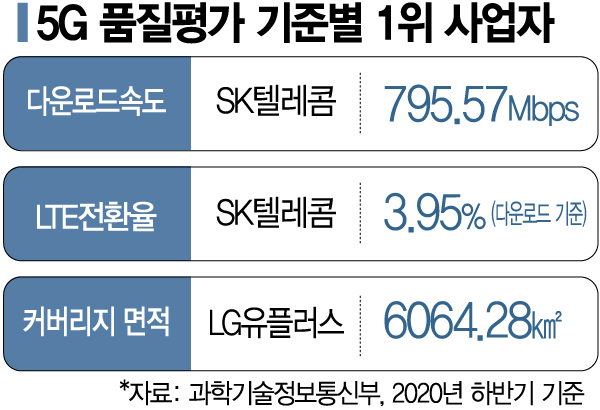
First, seemingly aware of the 5G communication quality controversies, they emphasized each company's policy to expand 5G coverage in major infrastructure and buildings with high foot traffic this year, stating, "The number of 5G base stations is by no means insufficient compared to the second year of LTE commercialization."
According to ‘Jeonpanuri’, operated by the Korea Communications Agency (KCA), the number of 5G base stations registered by the three mobile carriers last year was 141,939, surpassing the 119,007 base stations during the second year of LTE commercialization in 2012. Since the 5G commercialization on April 8, 2019, SK Telecom has deployed about 110,000 nationwide network devices by the end of last year, with approximately 51,000 units based on license numbers. This is also similar in scale to the 20 months of LTE deployment in its early days. It shows that investment continued at a level comparable to LTE despite the COVID-19 impact.
Group head Ryu explained, "Since 5G commercialization, continuous improvements in speed and quality have been made," adding, "When measuring download speeds on Garosugil, it improved from 164 Mbps in April 2019 to 1.0 Gbps by the end of last year." This is about a sixfold increase. Group head Kim also said, "With annual investments of trillions of won, more than 99% of outdoor areas in regions where 5G service is deployed currently have 5G service available." This year, they plan to further enhance perceived quality by eliminating coverage blind spots and focusing on joint deployment in suburban areas.
 Ryu Jeonghwan, Head of SK Telecom 5GX Infrastructure Group (left), and Kim Daehee, Head of LG Uplus NW Infrastructure Group
◆ More than twice the equipment needed compared to LTE
However, they also expressed difficulties. Group head Ryu referred to survey results from OpenSignal in the UK and Omdia, saying, "South Korea is building a world-class 5G network in terms of speed and coverage, but domestic customers' expectations are also very high." He explained that the evaluation criteria themselves are inevitably stringent.
Moreover, unlike LTE, 5G requires more than twice the equipment per base station, and all equipment must be newly deployed. Additionally, the conditions for building base stations worsened as the COVID-19 spread intensified last year. LTE, which could use existing 2G networks, effectively had about 25 years to perfect its current quality. However, the fact that 5G is still in its early deployment stage and is being directly compared to LTE quality is also a burden for the industry.
Group head Kim said, "LTE connected multiple antennas to a single base station device, but 5G base stations have integrated equipment (RRH) and antennas (RU). It is more challenging to build as densely as LTE," adding, "The radio wave reach of the 3.5 GHz band used for 5G is relatively shorter than LTE frequency bands, which is also a difficulty."
Regarding the reduction in wireless facility investment (CAPEX) by the three carriers last year, he explained, "We have been investing hundreds of millions of won annually since 2018," calling it a kind of 'high effect.' He added, "Efforts to eliminate coverage blind spots and focus on joint deployment in suburban areas may create an effect where the total investment amount appears to have decreased." In the first year of 5G commercialization in 2019, the combined CAPEX of SK Telecom (including its subsidiary SK Broadband), KT, and LG Uplus reached 9.5967 trillion won. Last year's figure was lower at 8.2761 trillion won.
◆ 5G SA commercialization soon... Concerns over 28 GHz
The domestic telecommunications industry is also preparing to commercialize 5G SA (Standalone mode) soon. SK Telecom plans to commercialize it for B2B (business-to-business) sites as early as the first half of this year. LG Uplus has also completed segment-by-segment technical verification and plans to launch it as soon as the device and service environment are ready within the year. 5G SA supports 5G services without running 4G and 5G in parallel, thus providing higher quality. In particular, 5G Option 4 is the next-generation 5G standard SA that goes beyond the current SA technology Option 2, which uses only 5G base stations, by enabling services combined with LTE networks.
However, there are deep concerns regarding the 28 GHz band network, which secures a bandwidth ten times wider than the 3.5 GHz band. Group head Ryu said, "We participated in a national project and completed the 28 GHz network deployment at Incheon Airport to provide services such as quarantine robots," but added, "We are exploring its potential use for B2B requiring 'mobility, ultra-low latency, and large data transmission.' Considering customer demands, business feasibility, and ecosystem conditions, it is not an easy situation." Group head Kim briefly mentioned, "We will develop 28 GHz B2B solutions and strive to find related demand." Besides demand, miniaturization of equipment and device improvements for B2B are also urgent.
Recently, the industry has paid attention to reports that the 5G speed of Verizon in the U.S., which preemptively introduced 28 GHz, is declining. As a result, there is a growing need among U.S. operators for the mid-band frequencies used in South Korea.
© The Asia Business Daily(www.asiae.co.kr). All rights reserved.
![Clutching a Stolen Dior Bag, Saying "I Hate Being Poor but Real"... The Grotesque Con of a "Human Knockoff" [Slate]](https://cwcontent.asiae.co.kr/asiaresize/183/2026021902243444107_1771435474.jpg)

















