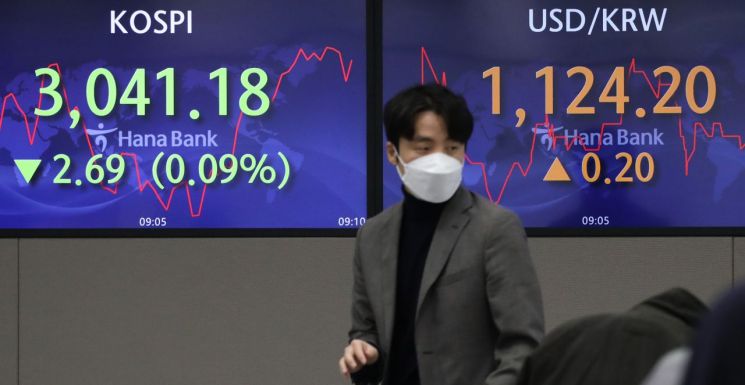
[Asia Economy Reporter Ji-hwan Park] On the morning of the 3rd, the KOSPI is showing a market trend of alternating between gains and losses. Market experts advise that a wait-and-see strategy is more effective than an aggressive buying approach until the issue of U.S. Treasury bond yields stabilizes.
As of 10:33 a.m. that day, the KOSPI was trading at 3,034.34, down 9.53 points (0.31%) from the previous day. The index opened at 3,041.20, down 2.67 points (0.09%) from the previous closing price, and has been fluctuating between gains and losses, maintaining a sideways trend.
Institutions are defending the index with net purchases of 142.6 billion KRW. Individual investors also switched from net selling in the early session to net buying of 33.4 billion KRW. On the other hand, foreign investors showed net sales of 182.7 billion KRW.
The weakness in the U.S. stock market overnight is interpreted as having influenced the domestic market. On the New York Stock Exchange (NYSE), the Dow Jones Industrial Average closed at 31,391.52, down 143.99 points (0.46%) from the previous session. The Standard & Poor's (S&P) 500 index fell 31.53 points (0.81%) to 3,870.29, and the tech-heavy Nasdaq index dropped 230.04 points (1.69%) to 13,358.79.
Last week, the U.S. 10-year Treasury yield exceeded 1.6%, but this week it has stabilized around the 1.4% range. However, the market is expected to continue experiencing volatility as investors closely monitor Treasury yield trends. Additionally, concerns expressed by Guo Shuqing, Chairman of the China Banking and Insurance Regulatory Commission, about bubbles in the global financial market and China's real estate sector have added downward pressure.
Dong-gil Noh, a researcher at NH Investment & Securities, explained, "Looking at the prices of Korean ETFs last night, U.S. investors expected the domestic stock market to fall by about 1%. However, the decline was mitigated as institutional investors entered with buying orders today." He added, "Since the overall trend is still downward, it seems necessary to maintain a wait-and-see approach rather than aggressive buying until the U.S. interest rate issue is resolved."
The stock prices of the top 10 companies by market capitalization are mixed. Large domestic semiconductor stocks such as Samsung Electronics (-0.84%) and SK Hynix (-1.04%) are showing slight weakness. This is attributed to the Philadelphia Semiconductor Index falling 3.10% in the U.S. market overnight. Sang-young Seo, a researcher at Kiwoom Securities, analyzed, "The U.S. market is showing sector differentiation, with technology stocks like semiconductors leading the decline while cyclical stocks are rebounding. The 3.10% drop in the Philadelphia Semiconductor Index is a burden on the domestic market." LG Chem recorded the largest decline at -2.92%. Meanwhile, NAVER (0.53%) and Celltrion (2.40%) rose.
At the same time, the KOSDAQ index was down 0.12% (1.08 points) at 922.09 compared to the previous day. The index started at 922.52, down 0.65 points (0.07%), and has been fluctuating between gains and losses.
On the KOSDAQ, individual investors are net buyers with 71.8 billion KRW. Conversely, foreign and institutional investors are net sellers of 51.8 billion KRW and 13.6 billion KRW, respectively.
Among the top 10 companies by market capitalization on the KOSDAQ, Celltrion Healthcare (0.96%) and Celltrion Pharm (1.10%) rose. Alteogen showed the largest gain at 2.21%. Meanwhile, HLB (-1.11%) and Kakao Games (-0.94%) declined.
© The Asia Business Daily(www.asiae.co.kr). All rights reserved.
![Clutching a Stolen Dior Bag, Saying "I Hate Being Poor but Real"... The Grotesque Con of a "Human Knockoff" [Slate]](https://cwcontent.asiae.co.kr/asiaresize/183/2026021902243444107_1771435474.jpg)















