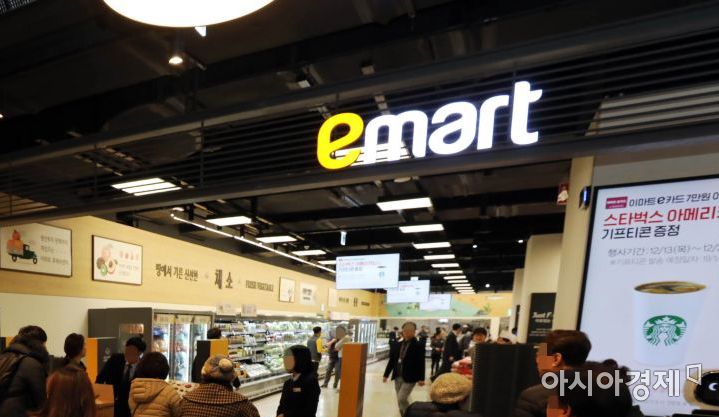
[Asia Economy Reporter Ji Yeon-jin] As COVID-19 vaccinations have accelerated, expectations for economic recovery have driven up prices of crude oil and various raw materials, leading to product price increases. With domestic and international stock markets experiencing prolonged corrections due to inflation concerns, attention is turning to stocks benefiting from price hikes.
On the 3rd, according to an analysis by Daishin Securities of the interest rate spread (the spread between the benchmark interest rate and 3-year and 10-year government bond yields) indicating rising market interest rates and the stock price trends of various retail channels, Emart's stock price direction precisely matched the interest rate spread.
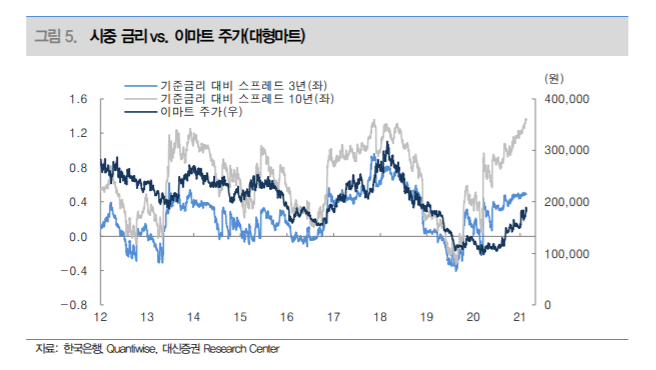
From the end of 2016 to 2017, a global economic recovery breeze blew, and with the domestic economy benefiting from the semiconductor super cycle and the removal of political uncertainties, consumer sentiment recovered, leading to rising interest rates and inflation. At that time, not only Emart but also Lotte Shopping saw improved earnings in channels such as large discount stores and supermarket divisions that benefited from price increases, resulting in stock price gains.
Convenience stores, as key distribution channels for essential consumer goods, also clearly reflected the effect of purchase price increases due to inflation. Looking at the stock price trend of BGF Retail, a pure convenience store company, the stock price rose sharply in 2017, similar to large discount stores.
However, during the same period, department store channel stock prices did not rise as much. Although inflation reflected economic recovery, the nature of department stores handling high-priced luxury goods meant they relatively benefited less from price increases. The characteristic of this channel, which relies more on increased foot traffic than price hikes, was clearly reflected in the stock price trends.
Due to the COVID-19 pandemic causing problems in global supply lines, a mismatch between demand and supply has led suppliers to begin raising prices in earnest. Coupled with increased liquidity and expectations for economic recovery, inflation has started in earnest. Domestic retail sales in 2019, before the COVID-19 pandemic, increased by 1.9%, and considering the consumer price inflation rate was 0.4% at that time, the actual increase in retail sales volume was only 1.5%.
In 2020, when the COVID-19 impact was severe, domestic retail sales grew by only 0.4%, and considering last year's consumer price inflation rate of 0.5%, the retail sales volume growth rate was -0.1%, indicating a contraction. This year, retail sales volume is expected to increase due to consumption recovery, with inflation driving overall retail market growth. The Bank of Korea projected last November that this year's consumer price inflation rate would be 1.0%, but reflecting the recent sharp inflation trend, the February forecast was raised to 1.3%. Considering the recent rapid rise in interest rates, the inflation forecast is likely to be revised upward further.
Recent significant growth in domestic exports is also expected to lead to increased consumption. Domestic consumer sentiment is greatly influenced by Korea's export economy, as exports account for over 50% of the country's GDP. When export conditions improve, consumer sentiment tends to improve simultaneously. Although Korea's exports decreased by 5.4% year-on-year due to the COVID-19 impact last year, a clear recovery trend has been observed since November, with exports in the fourth quarter of last year increasing by 4.2% year-on-year.
Yoo Jeong-hyun, an analyst at Daishin Securities, said, "Since consumer sentiment stimulates purchase volume (Q), offline retail channels are expected to show a moderate recovery in purchase volume compared to the previous year this year," adding, "Although online shopping preference and growth rates are still higher than offline, major retail channels such as large discount stores, convenience stores, and department stores, which experienced double-digit declines last year, are expected to show high growth due to increased purchase volume (Q) and the effect of price increases."
© The Asia Business Daily(www.asiae.co.kr). All rights reserved.
![Clutching a Stolen Dior Bag, Saying "I Hate Being Poor but Real"... The Grotesque Con of a "Human Knockoff" [Slate]](https://cwcontent.asiae.co.kr/asiaresize/183/2026021902243444107_1771435474.jpg)
















