[Asia Economy Reporter Dongwoo Lee] Hyundai Glovis is teaming up with China's largest private logistics group, Changjiu, to expand logistics operations between China and Europe. The strategy involves selling a portion of the shares of Adampol, a subsidiary of Hyundai Glovis Europe located in Poland, to Changjiu to strengthen their partnership.
Hyundai Glovis expects synergy as Changjiu's vast volume of China-originated European shipments will be added to the European rail transshipment infrastructure owned by Hyundai Glovis. To this end, Hyundai Glovis launched a joint business combining the strengths of both companies under the specialized China-Europe rail transport brand 'ECT (Euro China Train)'.
On the 3rd, Hyundai Glovis announced that it signed a share investment agreement with Changjiu Group for Adampol. According to the agreement, Hyundai Glovis will sell 30% of Adampol's shares to Changjiu and jointly pursue business as investment partners.
Founded in 1997, Changjiu is headquartered in Beijing and operates businesses including finished vehicle logistics, new car sales, special vehicle manufacturing, and automotive finance. In 2019, the group's total sales were approximately 7 trillion KRW. In the same year, it transported about 3.2 million finished vehicles of over 60 automobile brands produced in China by land and rail.
Adampol, acquired by Hyundai Glovis Europe in 2014, operates a train terminal equipped with a rail freight transshipment system in Malaszewicze, near the eastern border of Poland. Collaboration with Changjiu, which secures China Transcontinental Railway (TCR) transport volumes, is expected to create synergy. Changjiu loads about 4,100 FEU (1 FEU = one 40-foot container), including 10,000 finished vehicles, annually onto express freight trains traveling between China and Europe.
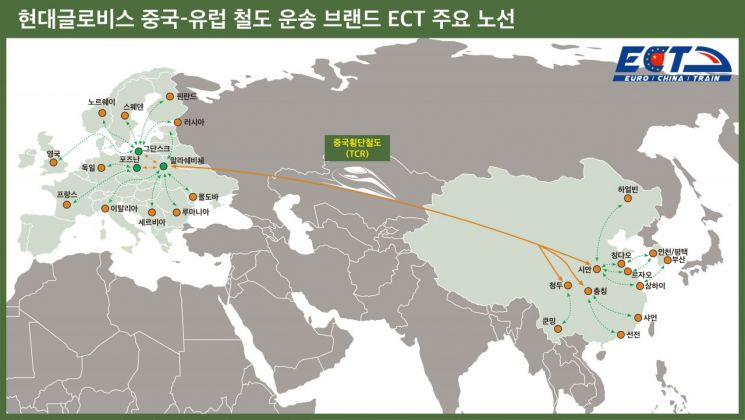
TCR is a railway line connecting various parts of China such as Qingdao, Xi’an, and Chongqing to European regions via Kazakhstan, Russia, and other Commonwealth of Independent States (CIS) countries. China and Europe use the standard gauge of 1,435 mm track width, while CIS countries use the broad gauge of 1,520 mm.
Therefore, TCR requires transshipment of cargo at the China-Kazakhstan border and again upon entering Europe. If Changjiu’s trains crossing the European border exclusively use Adampol’s Malaszewicze transshipment system, it will be advantageous for shippers in terms of cost reduction and schedule management. Additionally, Changjiu’s existing large-scale TCR volume provides price competitiveness, which is expected to help attract new shippers between China and Europe.
Both Companies Launch China-Europe Rail Transport Specialized Brand ECT
Hyundai Glovis plans to provide differentiated logistics services utilizing the China Transcontinental Railway by launching the specialized China-Europe rail transport brand ECT.
Through ECT, Hyundai Glovis and Changjiu Group plan to continuously expand transport coverage from inland Chinese cities such as Xi’an and Chongqing through Poland to Western Europe including Germany and the United Kingdom, as well as Northern Europe including Norway and Sweden. To this end, they will pioneer a rail logistics route directly connecting Malaszewicze and the northern port city of Gdansk.
Hyundai Glovis stated, "Since Gdansk is fully equipped with port logistics infrastructure connecting rail and sea, using ECT allows cargo to be transported directly by sea from Poland through the Baltic Sea to the Scandinavian Peninsula and the United Kingdom." This shortens the transport period by an average of four days compared to the existing TCR route, which moves cargo by rail to Hamburg and Duisburg in Germany and then by sea to Northern Europe.
The recent surge in maritime freight rates due to the COVID-19 pandemic has also made rail transport an attractive alternative. The rail freight rate for one 40-foot container (FEU) from China to Europe was $3,800 to $6,000 in early last year before COVID-19, while sea freight was $800 to $2,500. As of the 19th of this month, the Asia-North America East Coast sea freight rate rose to $4,800 per FEU.
Hyundai Glovis plans aggressive sales targeting finished vehicle manufacturers in Europe and China by leveraging its automotive logistics expertise and Changjiu’s network within China. Recently, the two companies jointly conducted a pilot rail transport of a premium German brand’s finished vehicles from Dingolfing, Germany to Chengdu, China. They plan to secure main volumes through joint sales efforts in the future.
Additionally, they intend to focus sales on non-affiliated container cargo moving between Europe and China, including electronics, chemical products, parts, machinery, and equipment. Korean companies operating in China and Europe are also key potential shippers.
A Hyundai Glovis official said, "Through Changjiu’s equity participation, we will maximize the capabilities of both companies, develop the cooperative relationship, and expand the Eurasian logistics territory.”
© The Asia Business Daily(www.asiae.co.kr). All rights reserved.