[Asia Economy Reporter Seulgina Jo] "We must restore market competition by promoting the 'K App Market'."
The reason KT and LG Uplus decided to invest in One Store, a subsidiary of their competitor SK Telecom, stems from a sense of crisis that overseas platforms, which demonstrate overwhelming market dominance, have effectively taken control of the domestic ICT ecosystem. To avoid becoming a "digital colony" or a "content subcontracting base," the three mobile carriers have determined that it is time to join forces to nurture native platforms.
In particular, Google's announcement to take a hefty 30% commission on applications, leveraging its roughly 70% share of the domestic market, directly prompted the three fiercely competing telecom companies to unite.
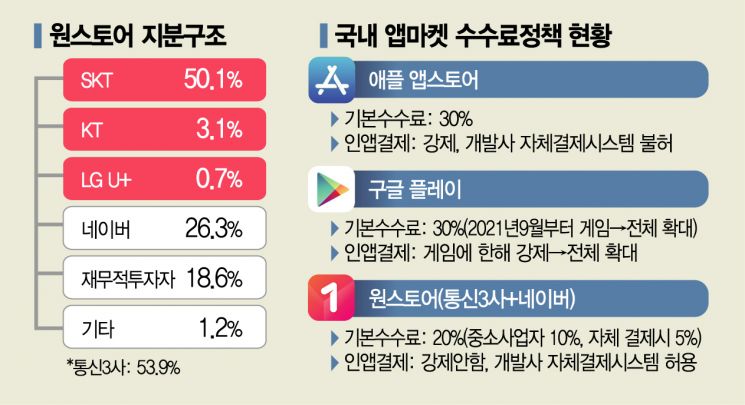
◆Investment by the Three Telecom Companies... Birth of the K App Market
According to One Store on the 3rd, with KT and LG Uplus investing in shares, the company's shareholding structure has been reorganized as the three telecom companies (53.9%), Naver (26.3%), and financial investors (18.6%). Within the telecom trio, SK Telecom holds 50.1%, KT 3.1%, and LG Uplus 0.7%. Previously, the shareholding structure was SK Telecom (52.1%), Naver (27.4%), and financial investors (19.4%). ▶Related article "Can't tolerate Google and Apple's abuse of power" - Native app market One Store's counterattack
One Store, which celebrated its 5th anniversary the day before, was launched in 2016 by integrating the app markets operated separately by the three telecom companies and Naver. However, apart from business cooperation such as membership discounts, KT and LG Uplus did not invest in One Store shares at its inception. This was because there was no reason to help grow the flagship subsidiary of SK Telecom, a competitor in the mobile telecommunications market.
However, with KT and LG Uplus investing in One Store shares after five years, it is expected that the three telecom companies will lead the full-scale development of the K App Market. One Store also plans to establish a joint responsibility management system. Lee Jaehwan, CEO of One Store, emphasized, "We will become Korea's representative app market that coexists with the industry and provides greater benefits to users."
◆Consensus on "Nurturing Native App Markets"
Above all, the three telecom companies share the view that they must nurture a native app market capable of competing against overseas platforms to strengthen the domestic ICT ecosystem. In particular, the controversy over Google's "app toll" confirmed that a platform company with a dominant market position can shake the industry ecosystem simply by changing its policies. Such commission hikes increase the cost burden on app developers, threatening their survival, and inevitably lead to increased costs for consumers as well. As of August last year, Google's Play Store held a 71.2% share of the domestic app market, far surpassing One Store's 18.3%.
Following the app toll controversy, inquiries from companies considering One Store, a native platform, as an alternative to endure the abuse of the app market giants have been steadily increasing, influencing the actions of the three telecom companies.
One Store's app commission is currently 20%, much lower than Apple and Google's 30%. It does not force in-app payments, which have become an industry norm. Rather, since July 2018, it has implemented a groundbreaking policy reducing commissions to 5% if developers use their own payment systems. As the COVID-19 pandemic prolonged, last year it halved commissions (from 20% to 10%) for small and medium-sized businesses. Experts agree that platform companies should be able to lower commissions through market competition. Such competition allows consumers to receive better services and prices.
KT and LG Uplus are reportedly optimistic about One Store's growth potential. One Store is pursuing an initial public offering (IPO) this year. Last year, it succeeded in turning an annual profit for the first time since its establishment. With transaction volume rising for 10 consecutive quarters, the year-on-year transaction growth rate reached 34.4%. Monthly active users (MAU) number approximately 15.4 million, and total content downloads to date are estimated at about 500 million.
© The Asia Business Daily(www.asiae.co.kr). All rights reserved.
![Clutching a Stolen Dior Bag, Saying "I Hate Being Poor but Real"... The Grotesque Con of a "Human Knockoff" [Slate]](https://cwcontent.asiae.co.kr/asiaresize/183/2026021902243444107_1771435474.jpg)











