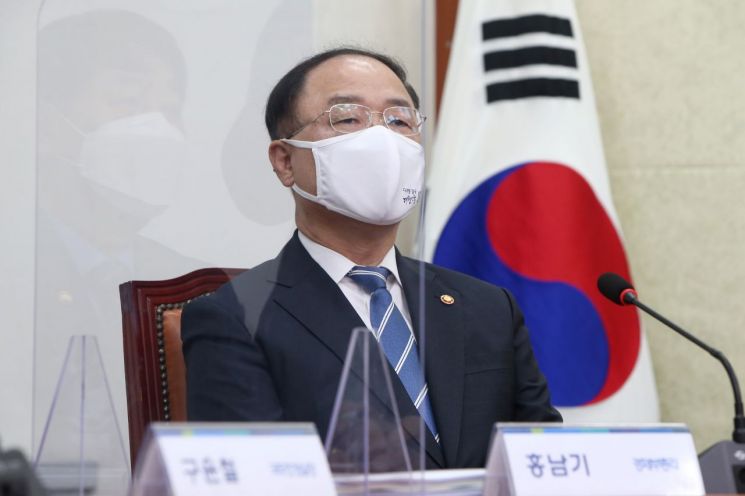
 Hong Nam-ki, Deputy Prime Minister for Economy and Minister of Economy and Finance [Image source=Yonhap News]
[Asia Economy Reporter Son Sun-hee] Hong Nam-ki, Deputy Prime Minister and Minister of Economy and Finance, said on the 2nd regarding the 4th disaster relief fund worth 19.5 trillion won announced that day, "Even if I hear harsh criticism in many ways, I could not help but convey the voice of the fiscal authorities." It appears he was expressing his thoughts on the conflict rumors that arose during the ruling party-government consultation process.
On the same day, Hong posted on his social media (SNS), "The government also wants to provide maximum support to as many suffering citizens as possible, but it could not ignore the fact that if government spending increases, someone among the people must bear the cost," he wrote.
He added, "During the preparation of the supplementary budget, the government had to prioritize the urgent situation of accumulating COVID-19 damage and the suffering livelihood economy, but at the same time, it had to consider the rapid increase in national debt last year and the tight fiscal conditions of managing debt (94 trillion won in deficit bonds based on the 2021 main budget), which is about one-fifth of this year's total budget of 558 trillion won," he reiterated.
Hong emphasized, "With this supplementary budget, the national debt ratio of our country in 2021 is expected to rise to 48.2%. Although the absolute level is still lower than the average of OECD countries, the speed of debt increase is not a situation to be complacent about." He added, "It took 7 to 9 years for the national debt-to-GDP ratio to move from 20% to the 30% range and from the 30% range to the 40% range, but due to the unprecedented COVID-19 crisis response, at the current pace, it is expected to take only 2 to 3 years to reach from the 40% range to the 50% range."
Furthermore, he said, "For non-reserve currency countries like ours, managing external credibility is important. Among OECD countries (as of 2019), the average national debt ratio of reserve currency countries exceeds 100%, while the debt ratio of non-reserve currency countries does not exceed 50%. This point also needs to be noted." He added, "In particular, in the mid to long term, the downward trend in growth rate, response to ultra-low birthrate, arrival of a super-aged society, and special situations in preparation for unification could rapidly increase fiscal expenditure, which cannot be overlooked."
Nevertheless, Hong said regarding the 4th disaster relief fund plan, which includes the additional supplementary budget of 15 trillion won, "We will actively prepare and implement damage support measures by understanding the pain of the people."
© The Asia Business Daily(www.asiae.co.kr). All rights reserved.
![Clutching a Stolen Dior Bag, Saying "I Hate Being Poor but Real"... The Grotesque Con of a "Human Knockoff" [Slate]](https://cwcontent.asiae.co.kr/asiaresize/183/2026021902243444107_1771435474.jpg)















