Mayor Lee Yong-seop Announces Hosting Plan
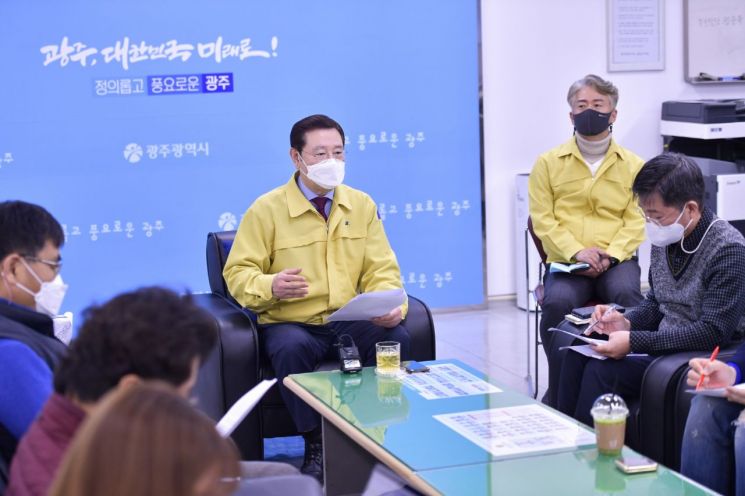
[Asia Economy Honam Reporting Headquarters Reporter Park Seon-gang] Gwangju Metropolitan City is actively promoting the attraction of the ‘National High Magnetic Field Research Center’ in collaboration with the Basic Power Research Institute of Seoul National University to lead future advanced industries.
On the 2nd, Gwangju announced that it aims to lead future advanced industries by securing high magnetic field research, which is essential for the advancement of various scientific fields and manufacturing industries. In particular, it plans to integrate high magnetic field research results into regional strategic industries such as advanced medical care, new energy industries, and eco-friendly automobiles to create next-generation growth engines.
High magnetic field research facilities are considered one of the three major core large-scale research facilities in the field of modern condensed matter physics, alongside synchrotron accelerators and neutron scattering experimental devices.
Scientific advanced countries such as the United States, Germany, and France have established national high magnetic field research centers to support the enhancement of national competitiveness in basic science. However, in South Korea, although the National High Magnetic Field Research Center was selected as a ‘short-term priority large-scale research facility’ to be rapidly established in the ‘2nd National Large-scale Research Facility Construction Roadmap’ approved by the National Science and Technology Committee in 2012, related technologies have not been consolidated as research has been dispersed across research institutes and universities.
The Basic Power Research Institute of Seoul National University, which has decided to jointly promote the attraction of the National High Magnetic Field Research Center to Gwangju with the city, holds a unique position in the field of high magnetic fields. Professor Han Seung-yong’s research team achieved the world’s highest record in direct current magnetic field technology in 2019 in collaboration with the U.S. High Magnetic Field Research Center.
The research team enabled the generation of ultra-high magnetic fields (a direct current magnetic field record of 45.5 Tesla) that surpass existing limits more safely through new no-insulation high-temperature superconducting magnet technology, and miniaturized the magnet’s size and weight to less than 1/100.
For example, the currently used MRI operates at about 3 Tesla, and recently, a 7 Tesla MRI was approved by the FDA. If clinical MRIs exceeding 45 Tesla are developed using this research, diagnostic images with more than 100 times higher resolution than existing ones can be obtained, which will have revolutionary effects in diagnosing early-stage cancer, dementia, and other vascular brain diseases.
Additionally, some suggest that while semiconductors currently represent South Korea’s national brand and drive economic growth, high magnetic field-based core technologies could serve as a promising technology playing a second semiconductor role in the country’s future development.
Mayor Lee Yong-seop of Gwangju said, “We will promote the attraction of the National High Magnetic Field Research Center to Gwangju as one of this year’s priority projects,” adding, “This is another bold and innovative challenge that will open a new future for Gwangju following the selection of artificial intelligence.”
He continued, “Since 2016, Gwangju has been preparing for this by starting the ‘Gwangju Metropolitan City High Magnetic Field R&D Support and Infrastructure Activation’ planning research. In June last year, we signed a business agreement with the Korea Basic Science Institute (KBSI), which conducts national-level high magnetic field research, to build a ‘Magnetic Application Science Research Center.’ In July last year, we held the ‘2020 Magnetic Application Science Technology Forum’ with top domestic experts, KBSI, Korea Electrotechnology Research Institute, LS Cable & System, and others. We have been steadily preparing for the attraction of the ‘National High Magnetic Field Research Center’ with related ministries, the National Assembly, and research institutions,” he explained.
He said, “Technologies utilizing high magnetic fields are widely used in various scientific fields such as materials, energy, and life sciences. In particular, high magnetic field application technologies have significant ripple effects across medical fields such as MRI for cancer diagnosis and analytical equipment for new drug development, energy fields such as energy storage devices, transportation fields such as electric propulsion systems, and manufacturing industries including high-efficiency industrial equipment. If our city secures high magnetic field research, it will not only become a leading city in future basic science but also create new future growth engines for Gwangju by linking with regional strategic industries such as advanced medical care, new energy industries, and eco-friendly automobiles,” he evaluated.
He added, “The attraction of the National High Magnetic Field Research Center to Gwangju will provide cutting-edge basic science research infrastructure that will serve as the two wings responsible for Gwangju’s next 100 years, along with artificial intelligence, establishing Gwangju as a global leading city. We will definitely attract the high magnetic field research center, a core facility of future basic science technology, to Gwangju to simultaneously resolve the shortage of large-scale basic science research infrastructure,” he said.
© The Asia Business Daily(www.asiae.co.kr). All rights reserved.
![Clutching a Stolen Dior Bag, Saying "I Hate Being Poor but Real"... The Grotesque Con of a "Human Knockoff" [Slate]](https://cwcontent.asiae.co.kr/asiaresize/183/2026021902243444107_1771435474.jpg)















