March 1st Rally Ends Without Major Clashes
Investigation Launched into 8 Fake News Cases Related to Vaccines
Police Role Grows Amid COVID-19 Spread
"Strict Response to Illegal Activities"
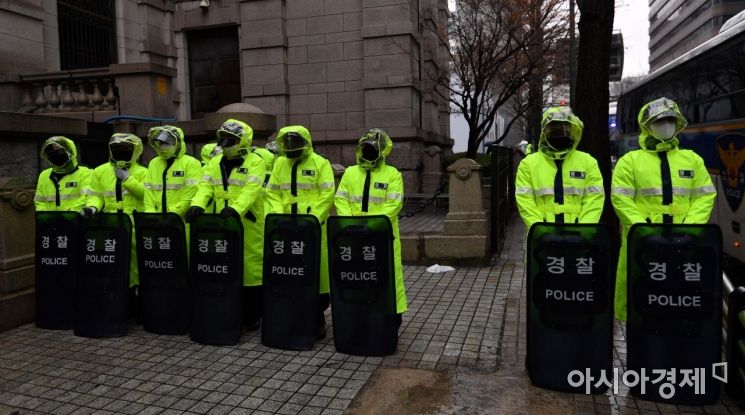 Police forces are on guard duty on Namdaemun-ro, Jung-gu, Seoul, where rallies by conservative groups are scheduled throughout the city on the 1st. Photo by Jinhyung Kang aymsdream@
[Asia Economy Reporter Lee Gwan-ju] The March 1st Independence Movement Day rallies held across downtown Seoul concluded quietly without any significant clashes. As the police finished managing the rallies, a flood of ‘fake news’ centered around COVID-19 vaccines emerged, prompting the police to launch another ‘war against COVID-19.’
According to the police on the 2nd, various rallies and protests, including small-scale gatherings, press conferences, one-person protests, and vehicle protests, took place at 85 locations in Seoul the previous day. The police deployed 118 companies and over 7,000 officers on site to manage the rallies. Since the so-called ‘Gwangbokjeol rally’ by conservative groups on August 15 last year led to a sharp increase in COVID-19 cases, the police have maintained a strong stance, including completely blocking downtown rallies on Gaecheonjeol.
Under police supervision, most rallies proceeded peacefully while adhering to quarantine guidelines. However, some unreported rallies and marches occurred. About 40 people, including members of the 4·15 Election Fraud National Struggle Headquarters, held a press conference at Tapgol Park and marched to Bosingak. The police requested dispersal, citing that the number of participants exceeded the rally limit of nine. The Seoul Metropolitan Police Agency stated that "based on collected evidence, legal action is being considered" against them.
Although the March 1st rallies passed safely amid ongoing COVID-19 spread and heightened tension, responding to fake news related to vaccines has now become an urgent task for the police.
Among these fake news are absurd claims such as wireless identification chips being implanted in the body through vaccines or that elderly people who receive vaccines are more prone to dementia. In fact, in Incheon on the 25th of last month, a woman in her 60s was caught by the police for posting flyers on the streets claiming ‘COVID-19 vaccines contain chips.’ As of this date, the police have launched investigations into eight cases of vaccine-related fake news.
Since the first domestic COVID-19 case was confirmed in January last year, the police have maintained a COVID-19 response system for over a year. The ‘COVID-19 Rapid Response Team,’ formed in March last year with 8,559 personnel nationwide to support epidemiological investigations and respond to violations of the Infectious Disease Control and Prevention Act, is still operational. The police’s role has continuously expanded, starting with deploying officers to transport evacuees from Wuhan, China, to tracking down missing confirmed cases and contacts, investigating mask hoarding, and cracking down on quarantine guideline violations.
This police response is expected to continue until COVID-19 is eradicated. Especially this year, with the police divided into the National Police, Autonomous Police, and National Investigation Headquarters, organic cooperation and coordination of duties are required to maintain response capabilities. A police official said, "We will strictly deal with all illegal activities related to COVID-19, including fake news," and added, "We will continue to support nationwide efforts to prevent the spread of COVID-19."
© The Asia Business Daily(www.asiae.co.kr). All rights reserved.
![Clutching a Stolen Dior Bag, Saying "I Hate Being Poor but Real"... The Grotesque Con of a "Human Knockoff" [Slate]](https://cwcontent.asiae.co.kr/asiaresize/183/2026021902243444107_1771435474.jpg)















