Foreign Investors Take Lead in Stock Market
Since the Beginning of the Year, KOSPI Fluctuates According to Foreign Capital Movements
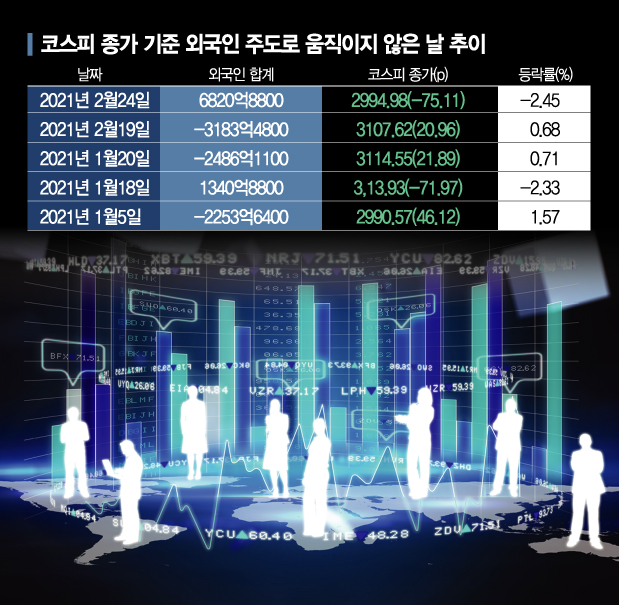
[Asia Economy Reporter Junho Hwang] The lead in the stock market has returned to foreigners. After the stock market shock caused by COVID-19 last year, individual investors who had been dominating the market have become cautious, allowing foreigners to take control. The market has been moving down when foreigners sell and up when they buy, and this trend is expected to strengthen going forward.
Foreigners: Market Rises When They Buy, Falls When They Sell
According to the Korea Exchange on the 2nd, there were 18 trading days this year when foreigners were net buyers in the KOSPI, and except for the 24th and the 18th of last month, the market rose on all those days. Conversely, on 20 trading days when foreigners sold, the market declined on all but three days. Except for five trading days, the index’s ups and downs were determined by foreigners’ movements.
Meanwhile, the net buying and selling direction of individuals, who were the main drivers of last year’s KOSPI rise, mostly moved in the opposite direction to the index. This month, only about four days and five days last month saw individuals’ direction align with the index.
Notably, the number of days this month when foreigners’ net buying or selling amounts exceeded those of individuals or institutions increased to seven, compared to two days last month. This indicates that foreigners’ share is gradually increasing in the volatile market where the KOSPI fluctuates between 2900 and 3200.
Weakened Individual Investors
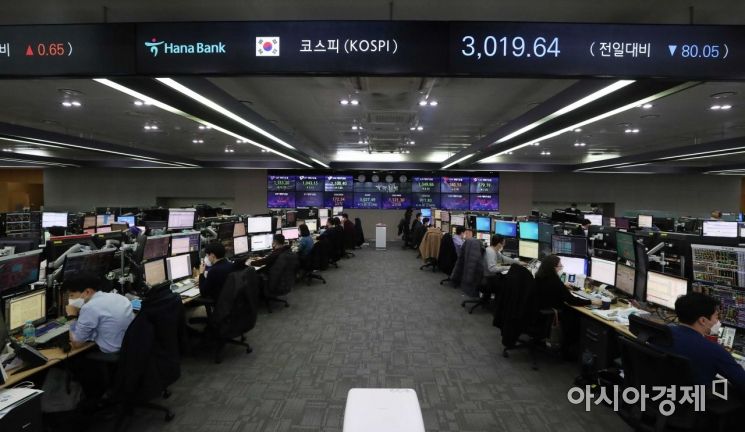 On the 26th, when the KOSPI index started with a sharp decline, dealers were working in the dealing room of Hana Bank in Euljiro, Seoul. On that day, the KOSPI opened at 3,089.49, down 10.20 points (-0.33%) from the previous trading day, showing a downward trend. Photo by Moon Honam munonam@
The decline in individual investor sentiment is relatively highlighting foreigners’ strength. Since the stock market shock caused by the spread of COVID-19 in March last year, individuals continuously purchased stocks and emerged as the main drivers of the KOSPI rise. However, as domestic and international factors have increased price volatility this year, investor sentiment is gradually weakening. Securities account deposits fell from 68 trillion won on the 1st to 65 trillion won on the 25th. The average daily net buying amount by individuals this month also decreased by about 63%.
Institutions are also losing strength. Pension funds are gradually withdrawing from the stock market due to asset allocation adjustments following the early-year market rise. Fund redemption volumes are increasing due to growing direct investment demand.
The foreigner-led market is expected to continue. Economic recovery driven by vaccine distribution is anticipated to attract foreign inflows. The forecast of improved earnings last year, announced earlier this year, pushed the KOSPI up to 3200, and economic recovery due to vaccine distribution is expected to act as a catalyst for foreign inflows. The won’s depreciation accompanying economic recovery also enhances the attractiveness of the Korean stock market. If the won continues to weaken, foreigners can also gain from currency exchange profits. Sanghyun Park, a researcher at Hi Investment & Securities, said, "If the U.S. interest rate surge continues causing stock price adjustments, the preference for safe assets will strengthen, and the dollar’s strong trend will continue."
Yujun Choi, a researcher at Shinhan Financial Investment, explained, "Foreign demand is likely to concentrate on specific sectors rather than the entire KOSPI." He added, "This year, foreigners’ net buying strength is high in communication services, materials, and financial sectors. Excluding communication services composed of internet, gaming, and telecom companies, it can be seen as having a reflation (economic recovery + inflation) investment tendency." He further predicted, "Due to rising market interest rates and commodity prices, foreigners’ demand will also weigh more on materials and financial sectors."
© The Asia Business Daily(www.asiae.co.kr). All rights reserved.
![Clutching a Stolen Dior Bag, Saying "I Hate Being Poor but Real"... The Grotesque Con of a "Human Knockoff" [Slate]](https://cwcontent.asiae.co.kr/asiaresize/183/2026021902243444107_1771435474.jpg)

















