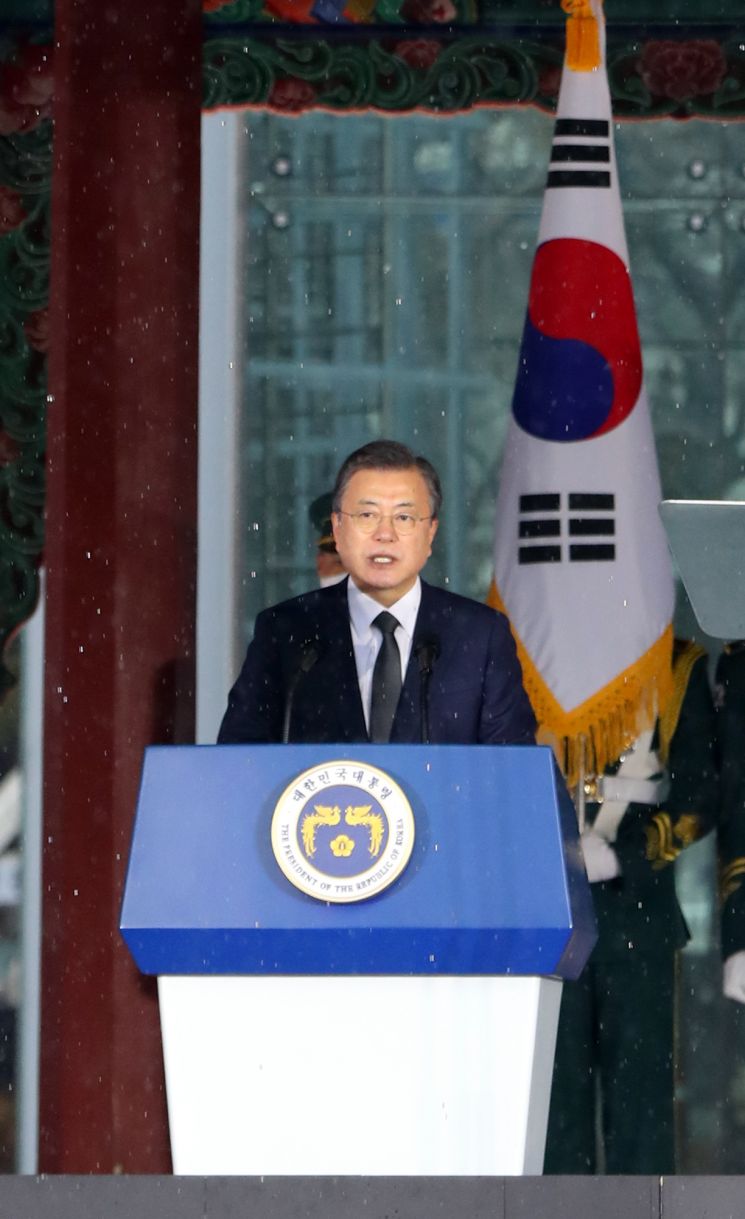
[Asia Economy Reporter Lee Ji-eun] Although President Moon Jae-in expressed a willingness to engage in dialogue with Japan instead of using the term 'Geukil (克日, overcoming Japan)' in his March 1st Independence Movement Day commemorative speech, Japan has responded by demanding "concrete proposals," resulting in a continued stalemate between the two countries. Experts predict that without solutions to the comfort women and forced labor issues, the two countries will inevitably remain at an impasse for the time being.
On the 1st, Chief Cabinet Secretary Kato Katsunobu stated at a regular press conference regarding President Moon's March 1st speech, "What is important is that South Korea takes responsibility and responds concretely to resolve bilateral issues," adding, "This has been the consistent position of the Japanese government so far." This merely reiterated Japan's existing stance that "South Korea must take action." Local media such as Kyodo News and NHK also evaluated that there was "nothing new" in President Moon's speech, citing the lack of solutions to the comfort women and forced labor issues.
Earlier, President Moon declared in his speech that he is ready to engage in dialogue to address bilateral issues. This marked a shift from the previous stance of 'Geukil' toward a future-oriented relationship. However, he firmly maintained the 'two-track' approach of separating past issues from practical Korea-Japan cooperation by stating, "Let us resolve past issues as they are." Ultimately, while President Moon expressed willingness to dialogue, he did not change the existing position emphasizing the 'two-track' approach, and Japan also stuck to its stance, leaving the differences unresolved.
Experts foresee that although the Moon administration's hardline stance toward Japan has softened around the launch of the Biden administration, which emphasizes trilateral cooperation among South Korea, the U.S., and Japan, improving bilateral relations remains distant without substantive measures addressing historical issues. Lee Myeon-woo, Deputy Director of the Sejong Institute, said, "It is positive that President Moon expressed willingness to dialogue in this speech, but Japan will not be satisfied with just that expression of intent," adding, "Without concrete responses from South Korea, improving bilateral relations will be difficult." He also noted, "Since the Biden administration values security cooperation among South Korea, the U.S., and Japan, limited cooperation in the security sector may be possible."
Meanwhile, diplomatic channels between the two countries remain cold. Kang Chang-il, the South Korean ambassador to Japan, has been in office for a month but has yet to arrange meetings with Prime Minister Suga Yoshihide or Foreign Minister Motegi Toshimitsu. Although Foreign Minister Chung Eui-yong has been in office for nearly a month, there has been no Korea-Japan foreign ministers' phone call yet. The new Japanese ambassador to South Korea, Aiboshi Koichi, has not met with Minister Chung but instead held talks with First Vice Foreign Minister Choi Jong-geon.
© The Asia Business Daily(www.asiae.co.kr). All rights reserved.
![Clutching a Stolen Dior Bag, Saying "I Hate Being Poor but Real"... The Grotesque Con of a "Human Knockoff" [Slate]](https://cwcontent.asiae.co.kr/asiaresize/183/2026021902243444107_1771435474.jpg)















