[Asia Economy Reporter Park Cheol-eung] On the day the Gadeokdo New Airport Special Act was passed in the National Assembly, a bill was also proposed to exempt preliminary feasibility (pre-feasibility) studies for metropolitan transportation infrastructure such as railroads. The Busan, Ulsan, and Gyeongnam (PK) regions are emphasizing the need to establish a metropolitan railway network in addition to the new airport, and there is a nationwide enthusiasm for building metropolitan transportation networks, including the Seoul metropolitan area and the Chungcheong region. There are also considerable concerns that large-scale construction projects will be promoted indiscriminately, triggered by the Gadeokdo New Airport.
According to the National Assembly on the 2nd, Choi Jong-yoon, a member of the Democratic Party of Korea, proposed an amendment to the National Finance Act on the 26th of last month to exclude metropolitan transportation facilities and metropolitan bus transportation projects, where the project implementer bears more than 80% of the funding, from the pre-feasibility study requirements.
The Gadeokdo New Airport Special Act, which allows the Ministry of Economy and Finance to exempt pre-feasibility studies when deemed necessary for rapid and smooth progress, also passed the plenary session of the National Assembly on the same day.
Representative Choi explained the background of the proposal, stating, "Since the project implementer is required to pay a burden charge to support the construction and improvement of metropolitan transportation facilities and metropolitan bus transportation projects, a significant portion of the funding is secured. Due to the pre-feasibility study, the implementation of metropolitan transportation improvement measures in new towns is delayed, causing inconvenience to residents." He represents the Hanam district in Gyeonggi Province and argues that the Seoul Metropolitan Express Railway (GTX) Line D should include the Gimpo-Hanam route.
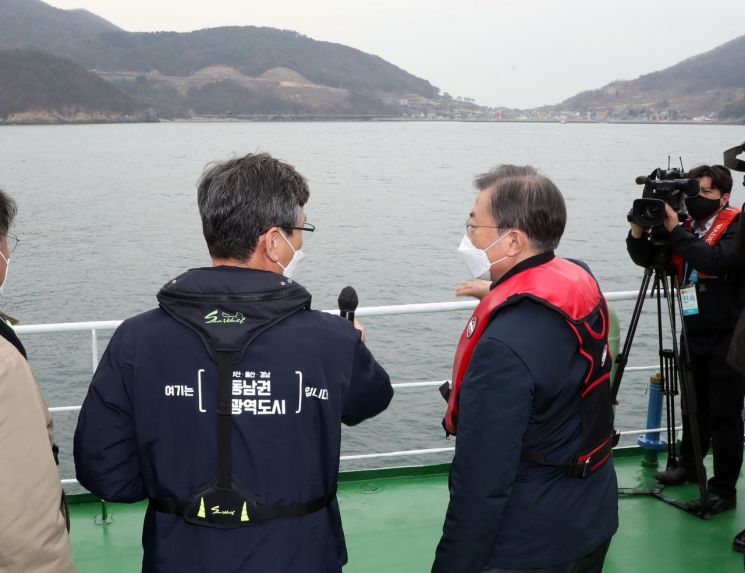
The Democratic Party and PK local government heads are promoting the introduction of a metropolitan railway network connecting Busan, Ulsan, and Masan in addition to the new airport. On the 25th of last month, President Moon Jae-in, who visited Busan, supported this by stating, "Busan, Ulsan, and Gyeongnam are already connected as a living area, and connecting the metropolitan transportation network can reduce the living area to within one hour."
Meanwhile, following the passage of the Gadeokdo New Airport Special Act, the 'Yeongjong International City General Association,' a group of residents in the Incheon area, issued a statement on the 28th of last month demanding the exemption of pre-feasibility studies for the GTX Line D and the Second Airport Railroad, which are transportation infrastructures in the Incheon Airport area. In the Chungcheong region, there is a demand to establish a new metropolitan railway network connecting 'Daejeon (Sintanjin) ? Sejong (Jochiwon) ? Osong ? Cheongju city center ? Ogeunjang (Cheongju International Airport).'
With the presidential election scheduled for March next year, large-scale construction projects may follow one after another. The People's Solidarity for Participatory Democracy recently criticized the Gadeokdo New Airport Special Act in a commentary, stating, "There is even suspicion that the political circles are rushing into airport construction as part of populist pledges," and expressed serious concern that "this could set a precedent for pushing large-scale national projects without verification during every election."
© The Asia Business Daily(www.asiae.co.kr). All rights reserved.
![Clutching a Stolen Dior Bag, Saying "I Hate Being Poor but Real"... The Grotesque Con of a "Human Knockoff" [Slate]](https://cwcontent.asiae.co.kr/asiaresize/183/2026021902243444107_1771435474.jpg)















