Ministry of Employment Announces 'Improvement Measures for Working Conditions of Foreign Workers'
Targeting Foreign Workers in Rural and Fishing Areas... Expansion of Reasons for Workplace Changes
Six-Month Implementation Period Granted for Improving Foreign Workers' Housing Conditions
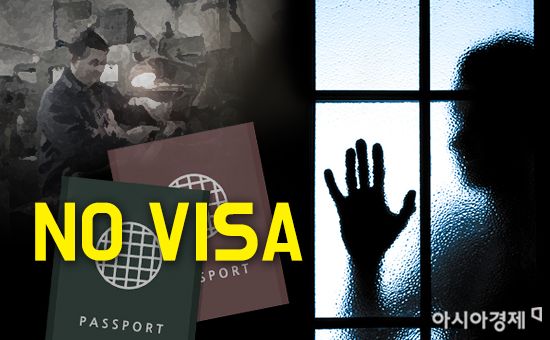
[Sejong=Asia Economy Reporter Moon Chaeseok] From now on, foreign workers employed in agricultural and fishing villages will be able to enroll in health insurance immediately upon entry. Health insurance premiums will also be reduced and supported by up to 50%. Their rights to change workplaces will be expanded, and measures to improve living conditions will be implemented.
On the 2nd, the government announced measures to improve working conditions, including eliminating blind spots in health insurance coverage for foreign workers, reducing foreign workers' responsibilities when changing workplaces, and granting a grace period for improving living conditions. This is interpreted as a system improvement to enhance the productivity of foreign workers, who are considered a solution to the "population cliff," where the proportion of the working-age population aged 15-64 is rapidly declining.
First, foreign workers employed at workplaces without business registration will be allowed to enroll in regional health insurance immediately upon entry. According to the government, workplaces that hire foreign workers but lack business registration certificates are all in agriculture, livestock, or fisheries. Foreign workers affiliated with such workplaces are currently allowed to enroll as regional subscribers only after six months of entry under the Health Insurance Act. This measure is expected to reduce cases of restricted access to medical care.
After the reform, foreign workers will be included in the 22% health insurance premium reduction service for agricultural and rural areas because they will be classified as foreigners subject to mandatory health insurance enrollment. The government also plans to secure a budget through the agricultural and fishing health insurance premium support project to enable them to receive 28% premium support in the future.
The government plans to revise and promulgate the notification by the end of this month to expand the reasons for which foreign workers are not held responsible, so that limits on the number of workplace changes do not apply to foreign workers.
Foreign workers will be allowed to change workplaces if they are provided with illegal temporary structures as accommodations instead of proper lodging, or if they are recommended to leave during the off-season or fishing ban periods. They can also change workplaces if a serious accident occurs at the workplace due to the employer’s violation of the Industrial Safety and Health Act, or if the foreign worker suffers physical or mental injuries or illnesses requiring more than three months of rest.
If the employer has not enrolled foreign workers in exclusive insurance (departure maturity insurance, wage arrears guarantee insurance) or social insurance, or if the foreign worker is sexually assaulted by the employer, coworkers, the employer’s spouse, cohabitant, or direct relatives, the foreign worker will be allowed to change workplaces.
Until now, foreign workers had to continue working only at the initially authorized workplace. They could change workplaces up to five times during the five-year employment period only when the employer terminated the labor contract or the contract expired. Because reasons beyond the foreign workers’ responsibility were not widely recognized, it was difficult for them to change workplaces freely despite unfair treatment.
The criteria for recognizing wage arrears will also be relaxed. Currently, wage arrears are recognized if 30% or more of the monthly wage is unpaid for two months or more (or 10% or more for four months or more). The current standard will be clarified to require the arrears to be continuous for two months or more. Cases where 30% or more of the monthly wage is unpaid two or more times, or 10% or more four or more times, will also be added to recognized wage arrears.
Additionally, employers will be granted a grace period to improve the living conditions of foreign workers.
Since January, agricultural, livestock, and fishing workplaces have been prohibited from employing foreign workers in illegal temporary structures such as those inside vinyl greenhouses. In agricultural households, the employment ban has been enforced without a grace period, raising concerns about insufficient preparation time to improve foreign workers’ accommodations.
Accordingly, a six-month grace period until September 1 will be granted only for reemployment permits corresponding to contract extensions starting from today. If accommodations are not improved within the grace period, reemployment permits for the employer will be canceled, and foreign workers will be allowed to change workplaces.
Lee Jae-gap, Minister of Employment and Labor, said, "Now that foreign workers have become essential personnel in our agricultural, fishing villages, and industrial sites, it is necessary to improve their basic working environment while also finding ways for employers and workers to coexist." He added, "We will actively promote these improvement measures with related ministries and improve the system by balancing the opinions of foreign workers and employers."
© The Asia Business Daily(www.asiae.co.kr). All rights reserved.
















