[Sejong=Asia Economy Reporter Joo Sang-don] The Ministry of Environment announced on the 1st that from the 2nd to April 30th, it will intensively collect agricultural waste left unattended in rural farmland areas nationwide during the spring season.
Agricultural waste mainly consists of discarded plastic film and empty pesticide containers. Of the approximately 320,000 tons of plastic film generated annually nationwide (including foreign substances), about 19%, or 60,000 tons, remain uncollected, left unattended, or are illegally incinerated. This causes secondary environmental pollution such as fine dust generation and is a cause of forest fires.
The intensive collection of agricultural waste is conducted twice a year, in spring (March-April) and autumn (November-December), in cooperation with local governments, the NongHyup (National Agricultural Cooperative Federation), and farmers' organizations around the busy farming seasons.
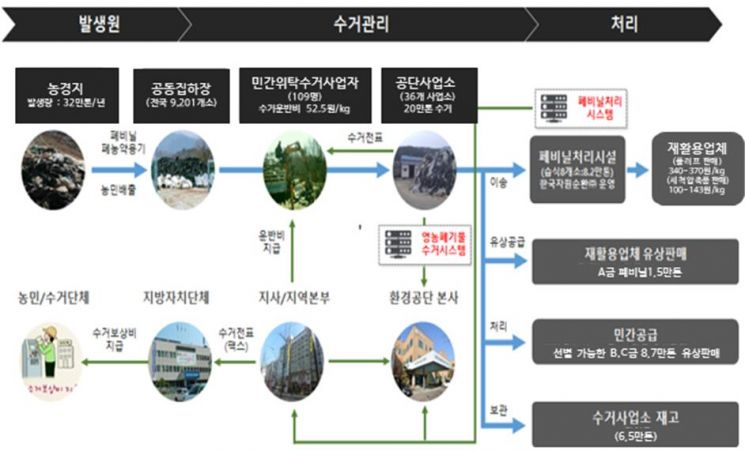
The agricultural waste collected by village is transported to the Korea Environment Corporation under the Ministry of Environment, where plastic film is crushed, washed, and compressed to be recycled as raw materials. Empty pesticide containers are either recycled or incinerated.
This year's intensive collection period is planned to be conducted about two weeks earlier than the previous year in line with the 2nd Seasonal Fine Dust Management Plan to strengthen fine dust reduction measures.
In particular, the Ministry of Environment will set up situation rooms at the Korea Environment Corporation’s five environmental headquarters and four branch offices to monitor the status of agricultural waste brought to collection centers during the intensive collection period and actively support private consignment collection operators and local governments.
During the intensive collection period, the Ministry of Environment also plans to promote the proper disposal methods of agricultural waste and the collection reward system to farmers in each region.
However, to minimize the impact of COVID-19, no regional collection events will be held; instead, the Korea Environment Corporation and private consignment collection operators will attach promotional posters about the collection reward system on collection vehicles and other places.
The collection reward system pays farmers a reward when they bring agricultural waste to joint collection sites designated by local governments, with compensation varying by type and amount of waste. For plastic film, local governments pay collection rewards ranging from 50 to 330 KRW per kilogram (varies by local government). For empty pesticide containers, 80 KRW per bag-type container and 100 KRW per bottle-type container are paid respectively.
The Korea Environment Corporation plans to award a total of about 10 million KRW (up to 1 million KRW per organization) to local governments with excellent collection performance by combining the results of the first and second halves of this year.
© The Asia Business Daily(www.asiae.co.kr). All rights reserved.
![Clutching a Stolen Dior Bag, Saying "I Hate Being Poor but Real"... The Grotesque Con of a "Human Knockoff" [Slate]](https://cwcontent.asiae.co.kr/asiaresize/183/2026021902243444107_1771435474.jpg)















