"1 Trillion Won Replacement Cost Burden by Each Company Should Reflect Last Year's Performance"
Negotiations Difficult Despite Need to Decide Contribution Ratios This Week
Hyundai Motor Likely to Pre-Reflect and Pursue Litigation Including Reimbursement Claims
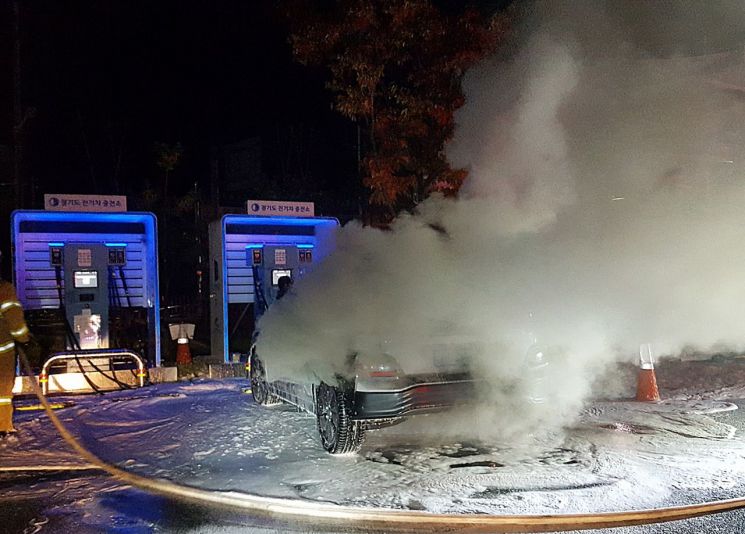 Last October, a fire broke out while charging a Kona electric vehicle in the parking lot of a community center in Namyangju, and the local fire station extinguished it. <이미지출처:연합뉴스>
[Asia Economy Reporter Choi Dae-yeol] As the disagreement over the cost of electric vehicle battery replacement between Hyundai Motor Company and LG Energy Solution (formerly LG Chem's battery division) remains unresolved, the likelihood of a lawsuit has increased. This is because the cause of the battery fires has not been fully identified, leaving the parties at odds over how to share the replacement costs.
Hyundai Motor has decided to finalize the cost-sharing ratio by the end of this week at the latest, aiming to reflect the replacement costs in last year's financial results. However, since negotiations have stalled, Hyundai is reportedly considering initially bearing the costs and later recovering them through litigation against LG Energy Solution, the battery supplier.
According to industry sources on the 1st, Hyundai and LG officials exchanged opinions around the end of last month, before and after the Ministry of Land, Infrastructure and Transport's recall (voluntary corrective action) announcement, but no significant progress was made. The decision to replace the batteries was made without conclusively determining the cause of the fires, and the two companies have yet to decide how to split the replacement costs, which amount to about 1 trillion won.
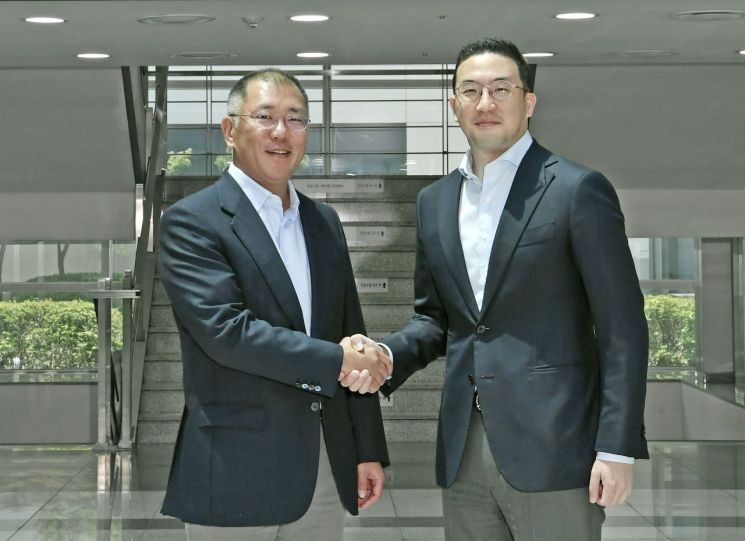 In June of last year, Chung Eui-sun, Chairman of Hyundai Motor Company (left), and Koo Kwang-mo, Chairman of LG Group, met at the LG Chem Ochang Plant in Cheongju.
 Automakers Sensitive to EV Fire Issues
Battery Replacement to Begin Sequentially from End of This Month... Expected to Take Several Months
Hyundai's Dedicated Platform Applied Ioniq 5 Unveiled Worldwide
Hyundai reportedly insists that LG should bear the full cost of the replacement batteries or an equivalent amount. This is because a preliminary conclusion was reached that some cells in high-voltage batteries produced at specific times and factories were defective, potentially causing internal short circuits and fires. During last October's recall, batteries were not replaced but the battery management system (BMS) was adjusted; however, fires continued in recalled vehicles, leading to the decision to replace the entire battery.
From Hyundai's perspective, which aims to increase its share in the electric vehicle market, there is a strong desire to quickly resolve the fire issue, even if it incurs substantial costs. Having just unveiled the Ioniq 5, the first model built on its dedicated platform, both domestically and internationally, Hyundai cannot afford to appear as a company that handles consumer safety issues carelessly.
Even excluding the cost of new batteries, significant expenses are expected for vehicle rentals and other costs during the replacement period. Hyundai also intends to reflect these costs in last year's financial results. If accounted for this year, it could hamper the company's overall performance throughout the year. Considering these factors, Hyundai must conclude negotiations with LG and finalize the cost-sharing plan by the end of this week at the latest.
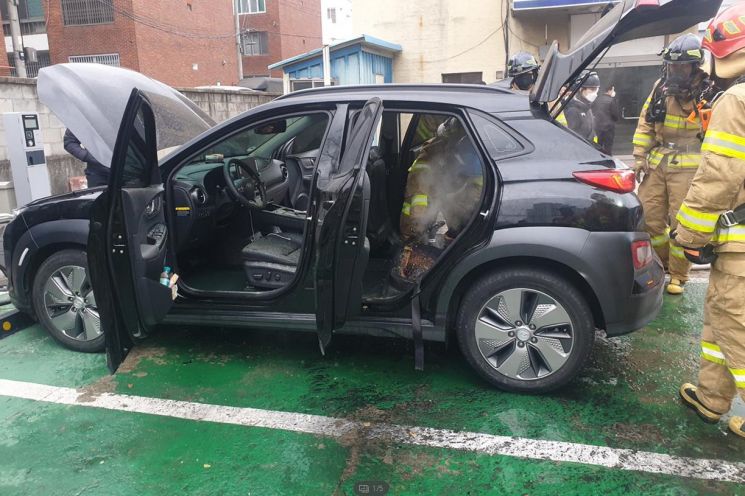 In January, a Kona EV charging at an electric vehicle charger of a taxi company in Dalseo-gu, Daegu caught fire for unknown reasons, and firefighters at the scene are extinguishing the fire.
 The problem is that the Korea Automotive Technology Institute, which has been conducting investigations for several months, has not been able to identify a definitive cause. So far, only possible causes have been confirmed, but no final conclusion has been reached. This is why the two companies' statements issued immediately after the Ministry of Land, Infrastructure and Transport's announcement show subtle differences in perspective. The institute continues to conduct fire reproduction experiments and will keep monitoring whether the recall was appropriate, indicating that much remains to be clarified.
As a result, Hyundai is reportedly considering bearing all costs related to battery replacement and associated procedures upfront, then pursuing legal action such as subrogation claims to recover costs from LG. Previously, after the 2019 energy storage system (ESS) fire incident, insurance companies filed subrogation lawsuits against LG Chem for handling costs. According to industry sources, Hyundai estimates the cost of this battery replacement at around 1.04 trillion won. LG is said to have accounted for about 100 billion won in handling costs last year following the recall announcement.
© The Asia Business Daily(www.asiae.co.kr). All rights reserved.
![Clutching a Stolen Dior Bag, Saying "I Hate Being Poor but Real"... The Grotesque Con of a "Human Knockoff" [Slate]](https://cwcontent.asiae.co.kr/asiaresize/183/2026021902243444107_1771435474.jpg)

















