Ministry of Education Announces 'Support Plan for Local Universities and Regional Balanced Talent Development'
Expansion of Co-Growth Models Including Region-Specialized Shared Universities
Strengthening Management Such as Systematizing Closure of Financially Restricted Universities
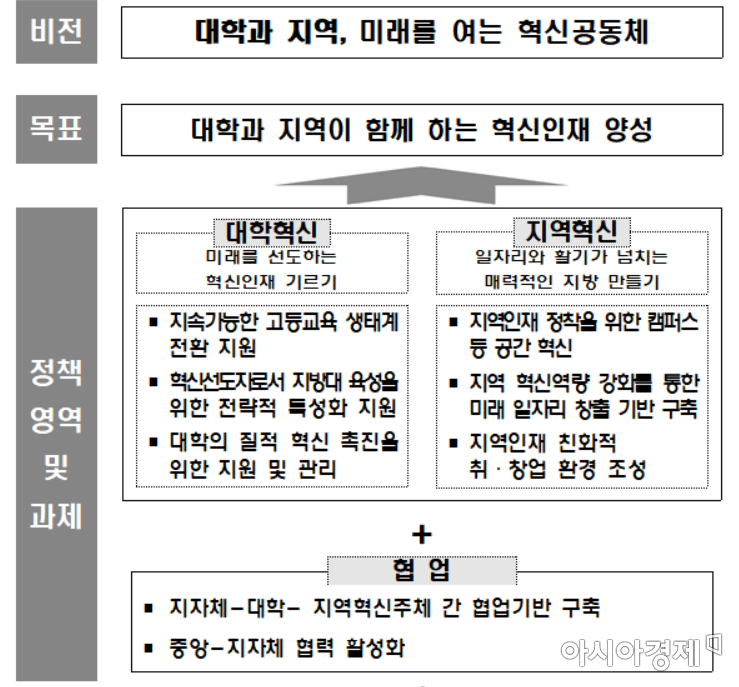
[Asia Economy Reporter Han Jinju] To address the outflow of local talent and the decline in school-age population, the government has presented both incentives and penalties. It will expand high school education innovation models such as shared universities and regional innovation platforms to strengthen the capabilities of local universities. At the same time, it will strengthen management from appropriate scaling to school closures in connection with projects restricting financial support for local universities.
On the 28th, the Ministry of Education announced the '2nd Support Plan for Local Universities and Regional Balanced Talent Development' together with related ministries and 14 non-metropolitan cities and provinces. This plan is established every five years according to the Local University Promotion Act.
According to Statistics Korea, in 2019, 13 cities and provinces excluding the metropolitan area and Sejong experienced a net outflow of people in their 20s. Although there are complex factors such as jobs, education, and housing, both outflows at the university admission stage and job-seeking stage are increasing. The net outflow of people in their 20s by region was highest in Jeonbuk (-4.5%), Jeonnam (-4.2%), Gyeongbuk and Gyeongnam (-3.3%), while Sejong (9.3%) and Seoul (3.3%) saw inflows.
In particular, the under-enrollment problem is worsening more in local areas than in the metropolitan area, more in general universities than in junior colleges, and more in small private universities than in national universities. Last year, the number of unfilled spots in the metropolitan area was 2,170, while in non-metropolitan areas it was 11,986, five times higher. The enrollment rate of local base national universities was 99.8%, but that of small private universities was only 85.4%.
As the difficulty of attracting excellent talent to local universities intensifies, the Ministry of Education has prepared a local university promotion support plan to improve the system and foster distinctive local universities. The 2nd basic plan focuses on redefining the role of local universities to prevent the outflow of regional talent. It sets major tasks based on the framework of ▲University Innovation ▲Regional Innovation ▲Collaboration.
University innovation involves easing regulations and supporting financial expansion so that local universities can grow together through collaboration. Based on cooperation between local governments and universities, it will build a shared growth ecosystem through region-specialized shared university models and the digital innovation shared university project launched this year. Regional innovation platform areas will be designated as 'Higher Education Innovation Specialized Areas,' where higher education regulations will be waived for up to six years and key standards related to university operations will be significantly relaxed.
The regional balance of university financial support projects will be institutionalized, and existing projects for national universities will be gradually integrated. Additionally, through the enactment of the National University Act, plans for financial expansion and efficiency will be prepared, and a comprehensive higher education financial expansion plan will be established by September. Selection of regional talent will be made mandatory in local universities' medical, pharmaceutical, and nursing graduate schools, and criteria for regional talent will be strengthened.
Support for specialization of local universities will also be provided. It will create leading models for the internationalization of education at excellent local universities, such as activating joint online degree programs with foreign universities, and gradually increase the proportion of local universities in the Government Scholarship Program (GKS). The 3rd phase of the Leading University for Industry-Academia Cooperation project will be promoted to support the nurturing of regional New Deal talents.
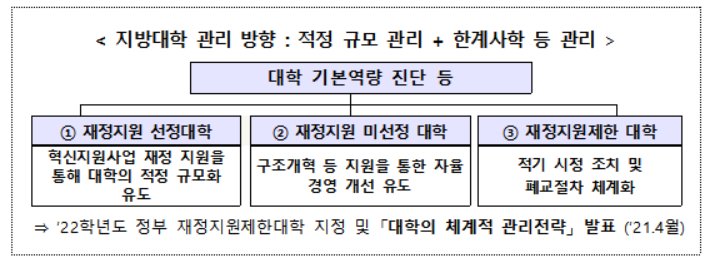
Systematic management to improve the quality of local universities, including those with government financial support restrictions, will be strengthened. The Ministry of Education plans to designate universities with restricted financial support in April and announce a systematic management strategy. Universities selected for financial support will be guided to appropriate enrollment sizes by applying maintenance enrollment rates, while unselected universities will be allowed to pursue autonomous management improvements through deregulation such as structural reforms. Universities with restricted financial support will have a systematized school closure procedure to establish a prompt liquidation system.
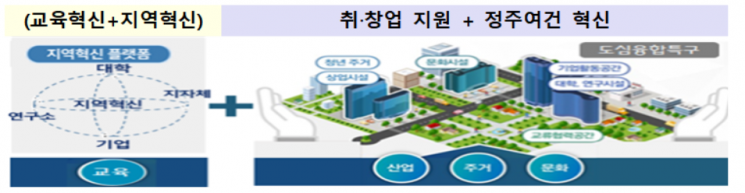
Efforts to create quality jobs and friendly living conditions where regional talent can settle will be carried out simultaneously. To promote the influx of companies, campus space innovation will be pursued. Support will be provided to establish five 'Urban Convergence Special Zones' by 2025, integrating education, start-ups, culture, and residential spaces in connection with the 'Regional Innovation Platform' project. The number of 'Campus Innovation Parks,' which create urban high-tech industrial complexes within campuses, will be expanded to five this year, and special exceptions will be introduced to allow campus relocations within innovation city industry-academia-research clusters.
Deputy Prime Minister and Minister of Education Yoo Eun-hye said, "The outflow of talent to the metropolitan area stems not only from educational issues but also from complex factors such as jobs and living conditions, so a comprehensive approach is necessary," adding, "Collaboration among various institutions is more important than anything else for sharing and co-growth among universities, regions, and sectors, and we will faithfully implement the basic plan to support innovation in universities and regions."
© The Asia Business Daily(www.asiae.co.kr). All rights reserved.
![Clutching a Stolen Dior Bag, Saying "I Hate Being Poor but Real"... The Grotesque Con of a "Human Knockoff" [Slate]](https://cwcontent.asiae.co.kr/asiaresize/183/2026021902243444107_1771435474.jpg)


















