AI Interpreting Bone Age via X-ray... Vuno Listed Last Month
JLK, First in Industry to Enter KOSDAQ, Utilizes 'Technology Special Listing'
Analysis Suggests GDP Could Increase by 2.4 Trillion KRW if Telemedicine Regulations Ease
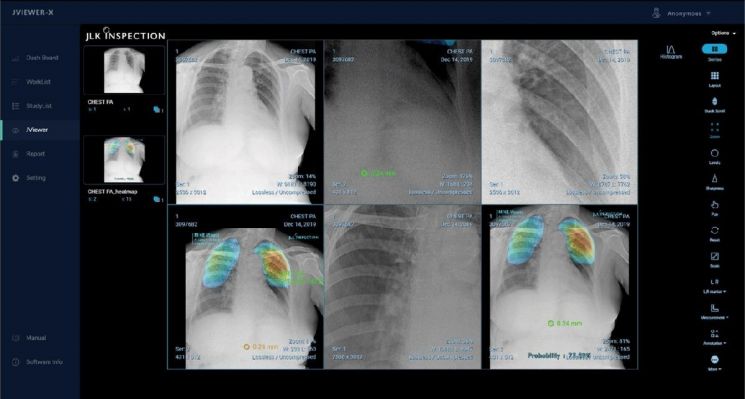
[Asia Economy Reporter Junhyung Lee] As the artificial intelligence (AI) healthcare market rapidly grows, domestic startups are consecutively going public through initial public offerings (IPOs). The technology-special listing system, which grants listing opportunities to companies with excellent technological capabilities, has also played a role.
One of the domestic medical AI startups, VUNO, was listed on the KOSDAQ on the 26th of last month. Following JLK, which entered KOSDAQ in 2019, it is the second company in the medical AI solution industry to be listed. VUNO provides an AI solution that interprets bone age from X-rays.
In addition, Lunit and Deepnoid are aiming to go public this year. Lunit, which offers medical imaging diagnostic solutions based on deep learning technology, is reportedly planning to list within the fourth quarter of this year. Deepnoid, which provides software that diagnoses pulmonary diseases using AI, also filed for preliminary review for listing with the Korea Exchange at the end of last year.
The background of this 'relay IPO' is the rapidly growing AI healthcare market. According to market research firm Markets and Markets (MnM), the global AI healthcare market has shown an average annual growth rate of 50% since 2018. It is expected to form a market worth 43 trillion KRW by 2025. Furthermore, the industry anticipates that the domestic AI healthcare market will grow at an average annual rate of 45%, reaching a market size of 2.0465 trillion KRW in 2023.
Not only the increase in valuation due to market expansion but also the technology-special listing system has had an impact. JLK, the first company in the industry to be listed, is a technology-special listing company that passed the technology evaluation in 2019.
The technology-special listing system is a system that grants listing opportunities to companies with excellent technological capabilities even if they do not meet all profitability requirements for listing. Initially, only companies in the pharmaceutical and bio sectors were eligible, but since 2014 it has been expanded to all industries. To qualify for a technology-special listing, a company must receive a technology evaluation of grade A or BBB or higher from two or more specialized evaluation agencies.
With the increase in demand for non-face-to-face medical services due to COVID-19, the market growth rate may increase further. According to the Federation of Korean Industries, the global telemedicine market was worth 43.6 trillion KRW last year. It is expected to grow to 50.6 trillion KRW this year.
Meanwhile, the private research institute Fighterch Research Institute predicted that if regulations related to telemedicine services are relaxed, the gross domestic product (GDP) could increase by approximately 2.4 trillion KRW.
© The Asia Business Daily(www.asiae.co.kr). All rights reserved.
![Clutching a Stolen Dior Bag, Saying "I Hate Being Poor but Real"... The Grotesque Con of a "Human Knockoff" [Slate]](https://cwcontent.asiae.co.kr/asiaresize/183/2026021902243444107_1771435474.jpg)















