Exclusive Exhibition of National Intangible Cultural Heritage No. 80 Embroiderer Late Hansangsu (1932~2016) Masterpieces Until April 18... Opportunity to Appreciate Over 130 Splendid and Elegant Joseon Dynasty Court Embroidery Works Created with Gold and Colored Threads
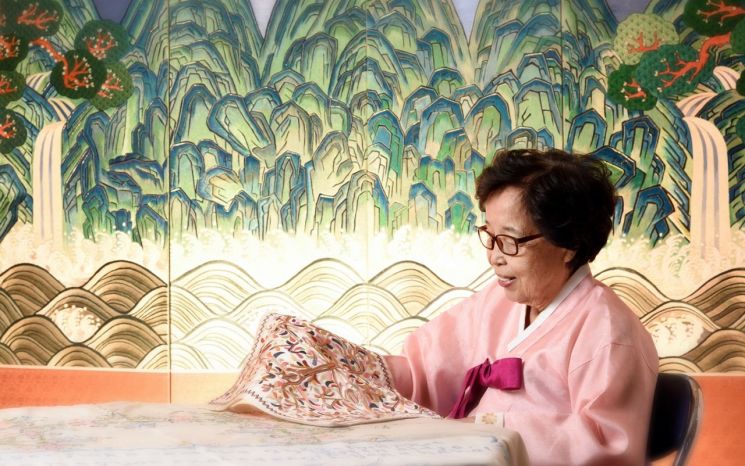
[Asia Economy Reporter Jongil Park] Seongbuk-gu and Seongbuk Seonjam Museum are extending the special inaugural exhibition "The World of Hansangsu Embroidery" at the Hansangsu Embroidery Museum until April 18.
This is a great opportunity to appreciate a large collection of traditional Korean embroidery and elegant royal court embroidery works, researched throughout the lifetime of Hansangsu, a National Intangible Cultural Heritage embroidery master.
Located in Seongbuk-dong (96 Seongbuk-ro), the Seongbuk Seonjam Museum is dedicated to researching, preserving, and exhibiting artifacts related to sericulture and silk, as well as the Seonjam Festival, an important state ritual during the Joseon Dynasty.
Every spring, the Joseon royal family held a ritual at the Seonjamdan in Seongbuk-dong, Seongbuk-gu, Seoul, to honor Seonjam, the founder of silkworm rearing. Following this, the queen personally demonstrated exemplary silkworm rearing in the palace through the Chinjam rite, encouraging the people to engage in sericulture and praying for a bountiful harvest.
Silk obtained from silkworm cocoons played a vital role in Korea's traditional industries and clothing culture, holding a long history in traditional life through garments, knots, embroidery, and more.
Since its opening in 2018, the Seongbuk Seonjam Museum has hosted special exhibitions related to traditional clothing and lifestyle.
This exhibition, "The World of Hansangsu Embroidery," allows visitors to fully enjoy the beauty of traditional Korean embroidery created by the country's first designated National Intangible Cultural Heritage embroidery master.
An exhibition official emphasized, "Embroidery, an art form loved by many for centuries from the royal court to common households, is created by crossing, assembling, continuing, or arranging silkworm threads. This is a rare opportunity to properly appreciate this art."
Hansangsu, the embroidery master, was the inaugural holder of National Intangible Cultural Heritage No. 80 for embroidery. He discovered and researched the unique beauty of Korean embroidery and pioneered it as a traditional embroidery genre. Since beginning his embroidery journey in 1953 at age 21 after meeting Jo Jeong-ho (then a professor in the Home Economics Department at Ewha Womans University) in Busan, he elevated embroidery to a comprehensive art form through consistent work and mentoring younger generations. In 1981, he won the Presidential Award for his work "Embroidered Gwaebul," and in 1984, he was designated the inaugural holder of National Intangible Cultural Heritage No. 80 for embroidery.
Hansangsu's greatest achievement was restoring ancient embroidery stitching techniques such as chain stitch and joining stitch, establishing 60 basic stitching methods of Korean embroidery, and researching and reproducing traditional Korean embroidery, which had been interrupted.
Based on materials he personally collected nationwide, he traced the origins of Korean embroidery in royal court embroidery, Buddhist embroidery, and folk embroidery, reflecting these in his works and pioneering the path of traditional Korean embroidery. In his later years, he focused on spreading the beauty of traditional embroidery domestically and internationally, clarifying and inheriting the essence of traditional embroidery.
The exhibition features over 130 embroidery works from various fields, including royal court embroidery. It showcases splendid and elegant pieces reproducing Joseon Dynasty royal court embroidery, such as the red ceremonial robe (Jeokui) worn by the queen during the Korean Empire period, the wedding robe (Hwalot) worn by princesses, the imperial robes and accessories of the Korean Empire emperor and empress, the queen's wide red belt (Daedae), an embroidered wide belt (Gwangdae) made by referencing the half-burned portrait of King Cheoljong, and a phoenix folding screen embroidered based on the original from Changdeokgung Daejojeon.
Visitors can also appreciate diverse works reflecting the lives of ancestors, such as embroidered book covers (Chaekgeori), embroidered decorations used in religious ceremonies, and lacquerware with embroidery.
In a dedicated space recreated as "Hansangsu's Embroidery Room," visitors can see embroidery tools personally used by Hansangsu during his lifetime. These include a wooden thimble frame made in the early 20th century, embroidery hoop legs from the 1970s, colorful spools of thread, sewing kits, embroidery materials, norigae ornaments, and sewing machines?all bearing the marks of Hansangsu's hands.
The archive space related to Hansangsu is also noteworthy. Here, visitors can directly access materials created throughout his life, including books he authored, past newspaper interviews, and exhibition catalogs.
In April, embroidery demonstrations linked to the special exhibition will be held. Kim Young-ran, director of the Hansangsu Embroidery Museum, which relocated from Gahoe-dong to Seongbuk-dong and reopened in 2019, and a National Intangible Cultural Heritage No. 80 embroidery master, will demonstrate traditional Korean embroidery techniques. This will be a rare chance to see and experience traditional Korean embroidery firsthand, immersing in the charm of embroidery woven with beautiful colors and neat lines.
For more detailed information about "The World of Hansangsu Embroidery" exhibition, please visit the Seongbuk Seonjam Museum website or contact them by phone.
© The Asia Business Daily(www.asiae.co.kr). All rights reserved.
![Clutching a Stolen Dior Bag, Saying "I Hate Being Poor but Real"... The Grotesque Con of a "Human Knockoff" [Slate]](https://cwcontent.asiae.co.kr/asiaresize/183/2026021902243444107_1771435474.jpg)















