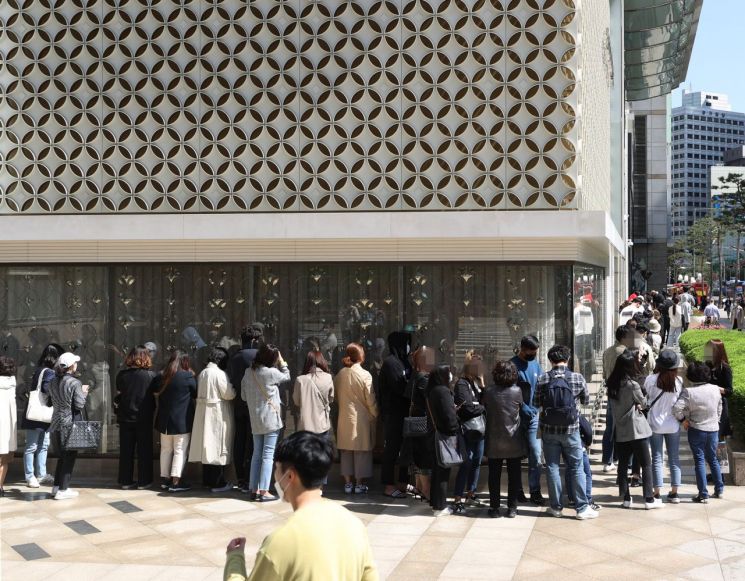
 Last May, when luxury brand Chanel announced a price increase, customers lined up and waited in front of the luxury goods hall at the Lotte Department Store main branch in Jung-gu, Seoul.
 [Image source=Yonhap News]
[Asia Economy Reporter Seungjin Lee] "We cannot refund the price reduction, and if you cancel the purchase, you will be excluded from the reservation queue."
Last month, office worker Kim Suyeon (33, pseudonym), who spent millions of won to purchase a luxury bag, lost sleep due to frustration. Having made up her mind, Kim visited a luxury store and proceeded with what is called a ‘full payment waiting’ by paying the full price to reserve the desired bag, which was out of stock. However, within a few days, the bag’s price was reduced, and when Kim visited the store to request a refund of the price difference, her request was denied.
Kim explained, "I was told that cancellation is only possible a few weeks later when the product arrives at the store," adding, "I paid with my own money, but there are no clear regulations or explanations, and it’s absurd that the customer has to struggle."
Unabated Love for Luxury Goods
According to the fashion industry on the 27th, despite the overall economic downturn caused by COVID-19 last year, the luxury market grew. According to a survey by the Ministry of Trade, Industry and Energy, total sales at 57 stores of the three department stores?Lotte, Shinsegae, and Hyundai?in 2020 decreased by 9.8% compared to the previous year. However, sales of overseas famous brands (luxury goods) increased by 15.1% year-on-year, continuing their growth trend. In particular, luxury sales at the three department stores increased every month compared to the previous year, except for March, when the first wave of COVID-19 began.
Whenever news of luxury brand price hikes or opportunities to buy at lower prices spread, so-called ‘open runs’ (rushing to luxury stores at opening time) occurred despite the COVID-19 impact. The domestic luxury market, which was worth 13 trillion won in 2018, is estimated to have exceeded 15 trillion won last year.
However, domestic consumers’ love for luxury goods has turned into consumer dissatisfaction due to the luxury industry’s excessive ‘bold business practices.’ Various cases have been reported, such as frequently raising and then lowering product prices, charging higher prices after selling by reservation purchase due to lack of stock, or not refunding the reduced price.
The ‘Value’ of Luxury
Recently, luxury brands such as Chanel, Louis Vuitton, Prada, and Dior have implemented some price increases and decreases on certain products. Louis Vuitton, which raised prices in May last year, increased prices of mini handbags and pouches by up to 25% last month. Fendi sharply raised the price of the ‘Baguette leather bag’ by about 20% in October last year, then quietly lowered the price last month. Dior also recently reduced the price of the ‘Toile de Jouy Book Tote Large’ by 100,000 won. None of these changes were accompanied by special announcements or customer notifications.
Customers who proceeded with full payment waiting amid such fluctuating luxury prices are increasingly dissatisfied. Some luxury brands allow full payment waiting but require customers to pay the difference if the price rises before receiving the product. Conversely, if the price is reduced, they refund the difference only if the customer cancels and repurchases. Since customers who have waited for months lose their reservation priority upon cancellation, many end up purchasing reluctantly.
Jung Hyunyi (35, pseudonym), who has extensive luxury purchasing experience, said, "Even if the product price is reduced, most people just buy it, accepting a loss of several hundred thousand won, because they don’t know when the stock will arrive," adding, "Some products are so scarce that ‘open runs’ occur when price hikes are announced, so customers have no choice but to be led by luxury brands despite being customers."
As such unfair cases increase, the Korea Fair Trade Commission is also closely monitoring the situation. A Fair Trade Commission official said, "Paying the full product price in advance, rather than a deposit for a future product, could be problematic," adding, "However, it is necessary to examine whether the seller provided sufficient explanation to the consumer and whether the consumer agreed to it. A judgment can be made only after specific cases are reported."
© The Asia Business Daily(www.asiae.co.kr). All rights reserved.
![Clutching a Stolen Dior Bag, Saying "I Hate Being Poor but Real"... The Grotesque Con of a "Human Knockoff" [Slate]](https://cwcontent.asiae.co.kr/asiaresize/183/2026021902243444107_1771435474.jpg)















