Closed at 3012.95... Dropped to 2988 Intraday
Institutions Sold Net Over 1 Trillion... Despite Individuals' Net Buying of 3.8 Trillion, Index Defense Insufficient
"Foreign Investors Reduce Emerging Market Stock Holdings Amid Prolonged Market Correction Outlook"
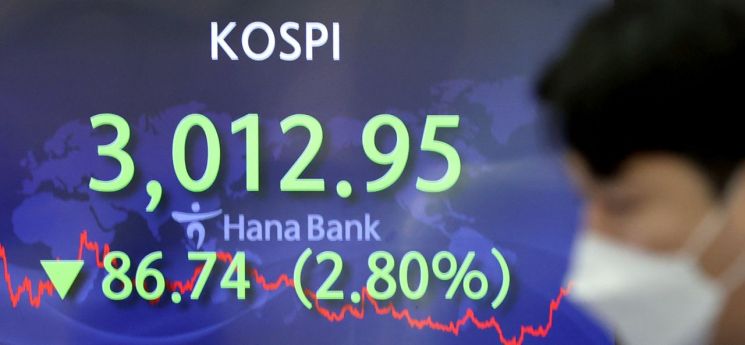 On the 26th afternoon, the KOSPI index closed at 3,012.95, down 86.74 points (2.80%) from the previous day, as dealers were working in the Hana Bank dealing room in Jung-gu, Seoul.
 [Photo by Yonhap News]
[Asia Economy Reporter Minwoo Lee] Foreign investors sold stocks in the KOSPI market at an all-time high scale. This is interpreted as a result of withdrawing funds from emerging market stocks, judging that a period of stock price adjustment will continue for the time being due to the rise in U.S. Treasury yields.
On the 26th, the KOSPI closed at 3,012.95, down 2.80% (86.74 points) from the previous day. The KOSPI started slightly lower at 3,089.49, then widened its decline to 3.5%, falling to 2,988. It then slightly rebounded near the end of the session, recovering above the 3,000 level.
The dual selling pressure from foreigners and institutions is cited as the background for the index decline. In particular, foreigners net sold 2.8183 trillion KRW on the day, surpassing the previous record of 2.4278 trillion KRW on November 20 last year, marking the largest scale ever. Institutions also sold 1.0307 trillion KRW worth of stocks. Although individuals net bought 3.7821 trillion KRW, they could not prevent the index from falling.
The sharp rise in the U.S. 10-year Treasury yield on the 25th (local time) is interpreted as having affected the domestic stock market following the U.S. stock market. The U.S. 10-year Treasury yield exceeded 1.5%, reaching as high as 1.614% during the session. This level is similar to mid-February last year before the full spread of COVID-19. The three major U.S. stock indices?the Dow Jones Industrial Average (-1.75%), S&P 500 (-2.45%), and Nasdaq (-3.52%)?all fell in succession. Despite Federal Reserve Chairman Jerome Powell stating that tightening is not due to strong inflationary pressure, market fears of inflation remained.
Hwang Sewoon, a research fellow at the Korea Capital Market Institute, explained, "Foreign investors seem to be reducing their exposure to emerging market stocks, anticipating a prolonged stock market adjustment period," adding, "This could be a burden on both the real estate and stock markets."
All sectors declined. Many sectors including Chemicals (-3.68%), Electrical & Electronics (-3.63%), Machinery (-3.25%), Manufacturing (-3.15%), and Securities (-3.08%) fell more than 3%.
Most of the top 10 market capitalization stocks fell. LG Chem had the largest drop at -6.6%, followed by SK Hynix (-4.7%), Samsung SDI (-4.2%), Celltrion (-3.4%), Samsung Electronics, Hyundai Motor, Samsung Biologics (all -3.2%), and NAVER (-2.0%). Only Kia Motors (3.1%) and Kakao (0.7%) rose.
The KOSDAQ showed a similar trend. It closed at 919.94, down 2.38% (22.27 points) from the previous day. After a slightly lower start, it fell to 904.18, threatening the 900 level. However, it slightly rebounded in the latter part of the session, rising above 910.
Again, strong selling pressure from foreigners and institutions was observed, with net sales of 228.7 billion KRW and 157.6 billion KRW respectively. Meanwhile, individuals net bought 397.5 billion KRW.
Almost all sectors declined. The Telecommunications Equipment sector had the largest drop at -4.40%, followed by Information Devices (-3.93%), Internet (-3.88%), Paper & Wood (-3.88%), Distribution (-3.21%), and Broadcasting Services (-3.16%), with many sectors falling more than 3%.
The top 10 market capitalization stocks also mostly declined. Celltrion Pharm’s drop was the largest at -4.8%, followed by Alteogen (-4.5%), Celltrion Healthcare (-3.9%), SK Materials (-3.8%), Kakao Games (-3.7%), CJ ENM (-3.4%), and EcoPro BM (-2.2%). Only HL Biopharma (8.7%) and Seegene (0.1%) rose.
Professor Kim Youngik of Sogang University Graduate School of Economics said, "Adjustments will appear in stock markets worldwide, including the U.S.," and predicted, "Rather, funds will flow into the Chinese market, which is trying to grow its financial market by showing a remarkable recovery in the real economy and implementing large-scale stimulus measures."
© The Asia Business Daily(www.asiae.co.kr). All rights reserved.
![Clutching a Stolen Dior Bag, Saying "I Hate Being Poor but Real"... The Grotesque Con of a "Human Knockoff" [Slate]](https://cwcontent.asiae.co.kr/asiaresize/183/2026021902243444107_1771435474.jpg)
















