Korea Post Headquarters to Issue 752,000 Copies of 4 Types on the 26th
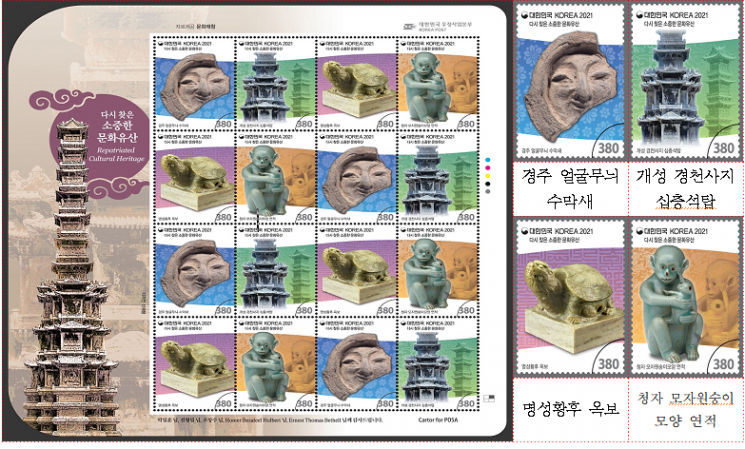
[Asia Economy Reporter Kim Bong-su] The Korea Post under the Ministry of Science and ICT, together with the Cultural Heritage Administration, issued 752,000 commemorative stamps on the 26th to raise public interest and understanding about the repatriation of Korean cultural assets taken overseas.
Among the approximately 193,000 items scattered across more than 20 countries worldwide, the commemorative stamps feature national treasure-level repatriated cultural assets recovered through individual efforts, including the Gyeongju Face-patterned Sumaksae, the Kaesong Gyeongcheonsa Ten-story Stone Pagoda, Empress Myeongseong's Jade Seal, and the Celadon Monkey-shaped Inkstone.
Known as the "Smile of Silla," the 'Gyeongju Face-patterned Sumaksae' is the only hand-molded sumaksae tile used on wooden buildings, representing the outstanding tile and architectural technology of its time. Park Il-hoon, the director of the Gyeongju Branch of the National Museum (now the National Gyeongju Museum), earnestly requested the return of the sumaksae from the Japanese collector Tanaka, and after over nine years of persuasion, it was donated to the National Gyeongju Museum in October 1972.
The 'Kaesong Gyeongcheonsa Ten-story Stone Pagoda' (National Treasure No. 86) was illicitly taken out by Tanaka Misuyaki, the Japanese Minister of the Imperial Household, in 1907 but was repatriated through the efforts of American Homer Hulbert and British Ernest Bethell. This stone pagoda, representing the late Goryeo period, is praised for its grand scale of 13.5 meters in height and the delicate carving techniques on the front of the pagoda. It is currently exhibited at the National Museum of Korea.
The 'Empress Myeongseong Jade Seal' was purchased through a fundraising campaign by Mrs. Cho Chang-soo (1925?2009), who worked for 44 years as an Asian curator at the Smithsonian National Museum of Natural History, from an American collector and Korean War veteran who auctioned off 93 artifacts, and then donated to the National Museum of Korea. The jade seal holds national treasure-level value and was used in various state ceremonies, symbolizing the dignity of royal authority.
The 'Celadon Monkey-shaped Inkstone' (National Treasure No. 270) is one of 20 Goryeo celadon pieces acquired by John Gassby, a British lawyer residing in Japan, from Kansong Jeon Hyeong-pil (1906?1962), who led efforts to collect and protect Korean cultural assets. This celadon inkstone is rare for its monkey shape, and especially unique for depicting a mother and baby monkey together, earning high praise for its artistic level and value.
Park Jong-seok, head of the Korea Post, said, "We hope that the issuance of these stamps will serve as an opportunity to reflect on the value of the repatriated cultural assets and the stories of those who worked hard for their return." The commemorative stamps can be purchased by visiting a nearby post office or applying through the Internet Post Office.
© The Asia Business Daily(www.asiae.co.kr). All rights reserved.
![Clutching a Stolen Dior Bag, Saying "I Hate Being Poor but Real"... The Grotesque Con of a "Human Knockoff" [Slate]](https://cwcontent.asiae.co.kr/asiaresize/183/2026021902243444107_1771435474.jpg)















