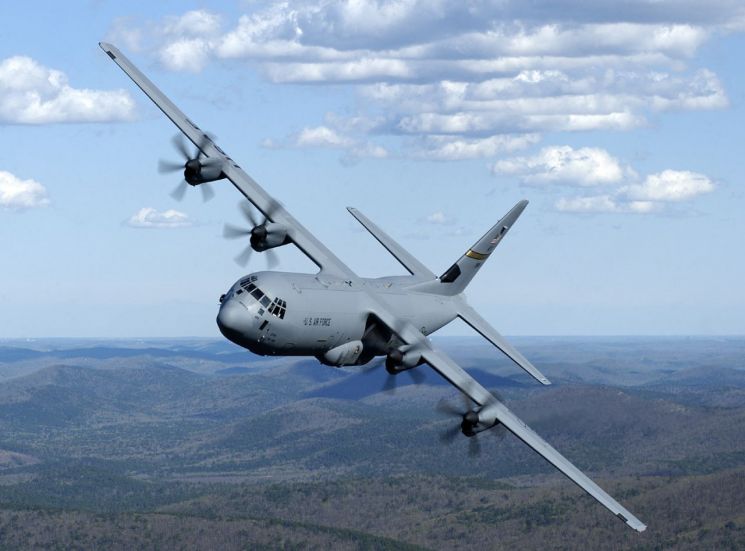
[Monthly Defense Times Editor-in-Chief An Seung-beom] The C-130J transport aircraft was first deployed at the U.S. Air Force Little Rock Air Force Base in 2004 and achieved Initial Operational Capability (IOC) approval in 2006. Various platforms based on the C-130J, such as the KC-130J and Harvest Hawk, are currently deployed. A total of 17 countries have introduced the C-130J and its derivative aircraft, and the Republic of Korea Air Force has also acquired four C-130J-30s.
The C-130J features engines with increased thrust compared to the existing C-130H transport (Rolls-Royce AE 2100D3 turboprop engines) and redesigned composite material propellers with a more aerodynamically efficient shape, resulting in a maximum takeoff weight increase of about 20,000 pounds and an approximate 40% extension in range.
Additionally, the active use of new materials has reduced the aircraft’s empty weight while increasing engine thrust, enhancing acceleration performance and further improving short takeoff capabilities.
Another improvement of the C-130J is its extensive digitalization. The cockpit is equipped with a HUD and various digital MFD instrument panels, significantly modernizing the interface between pilots and the aircraft. In particular, the introduction of an integrated electronic warfare system allows for comprehensive threat awareness and effective response to multiple complex threats, thereby enhancing survivability in the field.
The integrated electronic warfare system includes the AN/ALR-56M RWR radar warning receiver, which covers a wide range from the E band to the K band.
The AN/AAR-47 missile warning system is also integrated, displaying missile approach rate, direction, and distance on the self-defense system display. To counter these threats, the LAIRCM, a highly directional IRCM system based on NEMESIS, and the AN/ALQ-157, which uses various IR signals to jam multiple IR-guided missiles, are incorporated as self-defense equipment.
For navigation, in addition to INS and GPS, a collision avoidance system (E-TCAS), which is part of the Identification Friend or Foe (IFF) system, is integrated. Furthermore, the AN/APN-243 SKE2000 is included as part of the navigation system to avoid terrain collisions. The internal cargo space volume is approximately 127.4 m³, capable of accommodating cargo or personnel weighing over 37,000 pounds.
The Republic of Korea Air Force is seeking to acquire an additional three C-130J-30 transport aircraft through the FMS method. Currently, a project review related to this is underway.
© The Asia Business Daily(www.asiae.co.kr). All rights reserved.
![Clutching a Stolen Dior Bag, Saying "I Hate Being Poor but Real"... The Grotesque Con of a "Human Knockoff" [Slate]](https://cwcontent.asiae.co.kr/asiaresize/183/2026021902243444107_1771435474.jpg)















