Prosecution: "Most Fatalities Due to Drunk Driving, Severe Punishment Inevitable Considering Families' Pain"
Passenger's Lawyer: "Questioning Whether Duty of Care Responsibility Can Be Held"
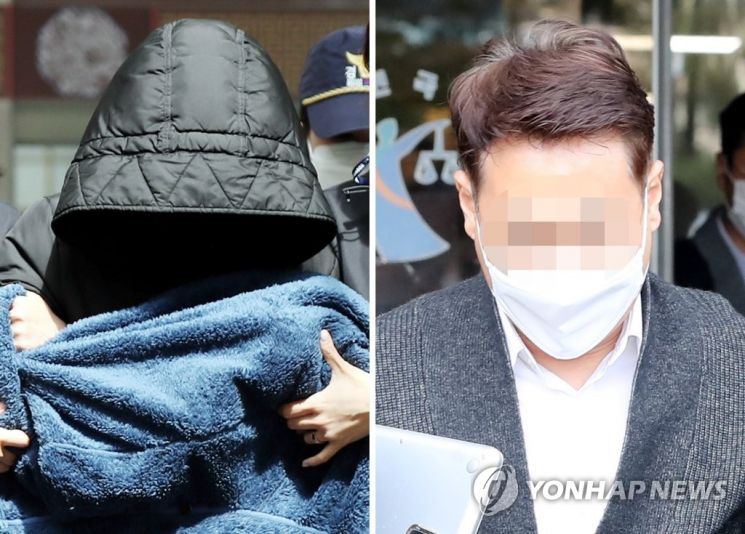 In September last year, a drunk driver (left in the photo) hit and killed a man in his 50s who was delivering chicken in Eulwangri, Incheon, along with a passenger.
 Photo by Yonhap News
[Asia Economy Reporter Park Hyesook] Last September, the prosecution sought heavy sentences by applying the 'Yoon Chang-ho Act' and other laws to a drunk driver and a passenger who fatally struck a man in his 50s delivering chicken near Eulwangri Beach in Incheon.
On the 25th, at the sentencing hearing presided over by Judge Kim Ji-hee of the Incheon District Court Criminal Division 3, the prosecution requested a 10-year prison sentence for A (35, female), who was indicted on charges of causing death by dangerous driving under the Act on the Aggravated Punishment of Specific Crimes and drunk driving under the Road Traffic Act.
Additionally, the prosecution requested a 6-year prison sentence for B (48, male), the passenger who was jointly indicted on charges of causing death by dangerous driving under the Special Act and instigating drunk driving under the Road Traffic Act.
The prosecution stated, "The defendants caused the death of the head of a precious family due to drunk driving, which is a very serious offense. The victim had been working diligently and lost his life while riding a motorcycle for his livelihood on the day of the accident, so considering the wounds of the bereaved family, severe punishment is inevitable."
They continued, "A drove under the influence, exceeding the speed limit, and collided with the motorcycle, causing a fatal accident, which makes the offense grave. The passenger B failed in his duty of care by allowing the heavily intoxicated A to drive. Especially, during the investigation and trial, B minimized responsibility and repeatedly said 'I don't remember,' which worsens the nature of the crime."
Wearing a light blue prison uniform in court, A made a final statement, saying, "I have committed an unforgivable crime and know that no words can earn forgiveness. However, I am deeply reflecting and want to ask for forgiveness from the deceased and the bereaved family."
B also said, "I am truly sorry for causing social unrest and sincerely apologize to the victim and their family. I want to apologize in person, not just here in court, and I definitely want to reach a settlement."
However, B's lawyer argued, "A gave contradictory or inconsistent statements to the investigative authorities, making those statements hard to believe. B opened the car door for A with a remote controller to allow A to drive because B was unaware of how intoxicated A was and could not drive himself. It is unclear how B can be held responsible for failing to exercise caution while B was asleep."
At the trial, the prosecution maintained the charge of causing death by dangerous driving under the Special Act against B and provisionally added the charge of aiding drunk driving. This means that if the charge of instigating drunk driving is acquitted, B can still be punished for aiding drunk driving.
The first trial sentencing hearing for these defendants is scheduled to be held on April 1 at the Incheon District Court.
A was arrested and indicted on charges of driving a Mercedes-Benz car while intoxicated for about 400 meters near Eulwangri Beach in Jung-gu, Incheon, at 12:55 a.m. on September 9 last year, hitting and killing C (54, male at the time of death), who was delivering chicken on a motorcycle.
At the time, the Mercedes-Benz driven by A exceeded the speed limit (60 km/h) by 22 km/h, crossed the center line, and drove in the opposite direction. A's blood alcohol concentration was 0.194%, far exceeding the license cancellation threshold of 0.08%.
B was indicted on charges of effectively causing drunk driving by opening the door of the Mercedes-Benz, worth about 200 million won and owned by his company, with a remote controller so that A, who had been drinking together before the accident, could get in the driver's seat.
The prosecution judged that B actively encouraged A's drunk driving rather than merely aiding it and applied the so-called 'Yoon Chang-ho Act' to both. Notably, this is the first case where a passenger in a drunk driving vehicle has been prosecuted under the Yoon Chang-ho Act.
The Yoon Chang-ho Act refers to the amended Special Act that strengthens punishment for drunk driving fatal accidents and the amended Road Traffic Act that tightens standards for license suspension and cancellation. The Yoon Chang-ho Act allows for a sentence of three years or more in prison or life imprisonment for drivers who cause fatal accidents.
© The Asia Business Daily(www.asiae.co.kr). All rights reserved.
![Clutching a Stolen Dior Bag, Saying "I Hate Being Poor but Real"... The Grotesque Con of a "Human Knockoff" [Slate]](https://cwcontent.asiae.co.kr/asiaresize/183/2026021902243444107_1771435474.jpg)















