How Is the Level of Sanctions in the Financial Sector Determined?
[Asia Economy Reporter Park Sun-mi] On the 25th, the Financial Supervisory Service (FSS) emphasized the objectivity of the disciplinary review process and firmly stated that FSS Governor Yoon Seok-heon is not involved, as it held a disciplinary review committee for Woori Bank and Shinhan Bank regarding the Lime Fund incident.
On the 25th, the FSS stated, "The disciplinary review committee, an advisory body to the FSS Governor, is composed of external financial experts from the legal and academic fields," adding, "Among the eight members of the plenary session reviewing major disciplinary actions, three are ex officio members, and only one is a pure internal member of the FSS (the disciplinary review committee chairman)." It further added, "The FSS Governor does not intervene in the disciplinary review process at all," and "The disciplinary review is operated mainly by five external civilian members, ensuring the objectivity of the review process."
Governor Yoon Seok-heon's involvement begins only after the disciplinary review. The FSS Governor accepts and decides on the resolutions after the disciplinary review. Then, the Financial Services Commission (FSC) recommends measures (including imposition of fines and penalties) regarding the pointed issues, and the final decision and resolution are made through this procedure.
The FSS also emphasized that by conducting the review in a plenary session format, it actively guarantees procedural defense rights by providing sufficient opportunities for the subjects of discipline to make statements and rebuttals. The committee members thoroughly investigate the substantive facts through intense debates and Q&A between the Inspection Department and the subjects of discipline, and fairly deliberate by sufficiently discussing from an objective perspective to determine the disciplinary review stance related to the level of sanctions.
The FSS determines the level of sanctions comprehensively considering the motive and degree of illegal or unfair acts found in the inspection results of financial companies, based on the disciplinary standards stipulated in related regulations such as the 'Financial Institution Inspection and Sanctions Regulations.'
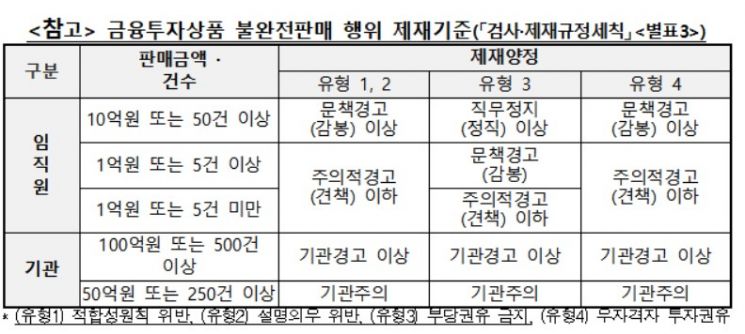
First, regarding incomplete sales of financial investment products, the 'Detailed Rules on Financial Institution Inspection and Sanctions Regulations' set disciplinary standards according to the amount and number of incomplete sales for each type of incomplete sales, and based on these disciplinary standards, a basic sanction is determined, then the planned sanction level is decided considering the number of investors, loss scale, violation period, and so forth.
Also, regarding violations of the obligation to establish internal control standards, Article 24 of the 'Governance Act' clearly states the obligation of banks and other financial companies to establish effective internal control standards in the process of developing and selling new products. When a financial company violates this, the sanction level is determined comprehensively considering the motive and degree of the violation of the obligation.
However, 'post-incident remediation efforts' are grounds for mitigation of sanctions for institutions and executives. Article 46 of the Detailed Rules on Inspection and Sanctions Regulations stipulates 'whether sufficient compensation and damage recovery efforts for financial transaction victims' as a consideration factor in sanctions.
© The Asia Business Daily(www.asiae.co.kr). All rights reserved.
![Clutching a Stolen Dior Bag, Saying "I Hate Being Poor but Real"... The Grotesque Con of a "Human Knockoff" [Slate]](https://cwcontent.asiae.co.kr/asiaresize/183/2026021902243444107_1771435474.jpg)
















