First Shipment of AZ Vaccine on Previous Day Moved to Nursing Hospitals and Health Centers
On-site Final Vaccination Preparations Underway... Expectations and Concerns Coexist
Complaints of 'Vaccine Discrimination' at Large Hospitals Starting Vaccinations in March
[Asia Economy Reporter Kim Ji-hee] Domestic COVID-19 vaccination is just one day away. Starting with the first shipment of AstraZeneca vaccines from SK Bioscience's Andong plant the day before, frontline medical facilities and hospitals, including quarantine authorities, are actively preparing for vaccinations beginning on the 26th.
At medical sites facing imminent vaccination, expectations and concerns coexist. While there is great hope that vaccination will free people from the fear of COVID-19 infection, doubts about the efficacy and safety of the AstraZeneca vaccine, which accounts for the majority of the initial supply, remain a challenge to be resolved. In large hospitals where both Pfizer and AstraZeneca vaccines will be introduced from next month, voices of dissatisfaction are emerging, especially among those scheduled to receive the AstraZeneca vaccine.
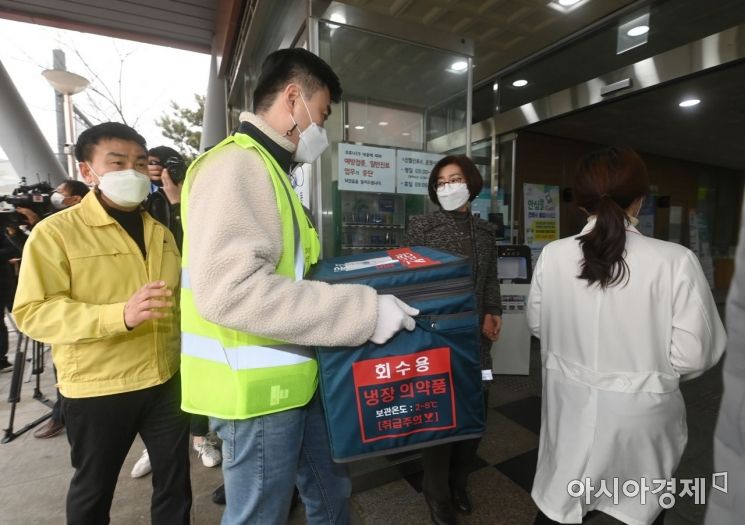 The AstraZeneca vaccine, departing from the Gtree BNT logistics center in Icheon-si, Gyeonggi-do, is arriving at the Gwonsun-gu Public Health Center in Suwon-si, Gyeonggi-do on the morning of the 25th. 2021.2.25 Photo by Joint Press Corps
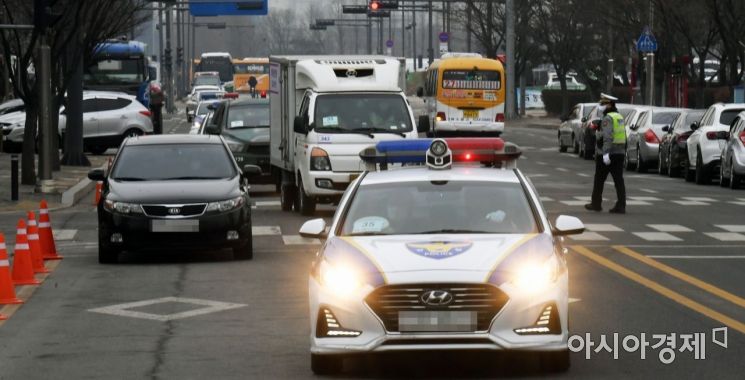 On the morning of the 25th, a transport truck carrying AstraZeneca vaccines arrived at the Gwonseon District Public Health Center in Suwon-si, Gyeonggi Province, from the Icheon Gtree BNT logistics center. The vaccines delivered here are enough to vaccinate 500 people.
 Photo by Joint Press Corps
◆Vaccines Arrive One After Another at Nursing Hospitals and Public Health Centers= At around 8:50 a.m. on the 25th, five boxes containing 1,000 doses (enough for 500 people) of the AstraZeneca vaccine arrived at the Gwonseon-gu Public Health Center in Suwon-si, Gyeonggi-do. The vaccines delivered that day are the first batch to be administered by mid-March to approximately 460 residents and workers under 65 years old at 17 nursing facilities and 5 psychiatric rehabilitation facilities in the district. Actual vaccinations will begin on the 2nd of next month, scheduled in advance considering social distancing measures.
The arrived vaccines were moved to the vaccination room on the first floor and underwent a receiving procedure lasting about 10 minutes. If no damage or issues are found during this process, the vaccines are transferred to a dedicated refrigerator on the same floor for storage. The dedicated refrigerator maintains a temperature of 3 to 4 degrees Celsius and is equipped with an auto-call function that sounds an alarm if the temperature deviates. A public health center official said, "After the vaccination officer opened the boxes and confirmed the numbers matched and there was no damage, the vaccines were immediately placed in the dedicated storage freezer," adding, "The vaccines are constantly checked by on-duty staff who pay close attention to security."
Woo Tae-ok, head of the Gwonseon-gu Public Health Center, said, "Many citizens visit to inquire about when they can get vaccinated because they want to recover their daily lives quickly through vaccination," and added, "On the other hand, since this is the first COVID-19 vaccination, there is some vague anxiety, so it seems that the health authorities and government need to respond actively."
Despite several simulation drills, unexpected situations occurred. The vaccine transport container inside a vehicle heading to Jeju the previous evening deviated from the proper storage temperature during transit. The integrated control system detected this, and the vaccine and vehicle were replaced for transport. Also, trucks carrying vaccines from the Icheon logistics center nationwide, which were scheduled to depart every 10 minutes starting at 5:30 a.m. that day, experienced delays of over two hours. Although loading time per truck was expected to be 10 minutes, it actually took 20 minutes.
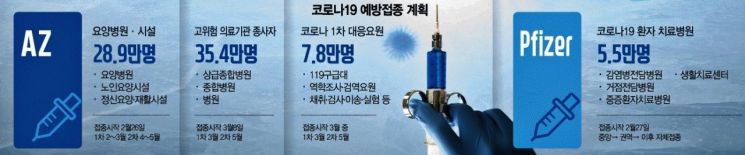
◆'Different Vaccines Under One Roof' Sparks Complaints in Medical Field= Complaints have also surfaced regarding the types of vaccines to be administered. Despite the government's explanation that there are no issues with the safety and efficacy of AstraZeneca, concerns have not been fully alleviated. In large hospitals where vaccinations start in March, voices say, "It is unfair that some people in the same hospital receive the Pfizer vaccine while others receive the AstraZeneca vaccine."
Large hospitals such as Seoul National University Hospital recently began a preliminary survey asking staff whether they consent to vaccination. During this process, controversy arose when it became known that COVID-19 frontline workers and other healthcare personnel would receive different vaccines. This is a measure based on the government's vaccination plan. Even if working at the same hospital, those directly involved in treating COVID-19 patients belong to the 'COVID-19 patient treatment hospital (55,000 people)' group and receive the Pfizer vaccine. The rest are classified as 'high-risk healthcare workers (354,000 people)' and are scheduled to receive the AstraZeneca vaccine starting March 8.
Kim (32), who works at a university hospital in Seoul, said, "Even those responsible for respiratory-related tests, who are at high risk of exposure without masks, are designated as AstraZeneca vaccine recipients," and argued, "There is practically no significant difference in risk among those working in the same hospital, so dividing them so sharply is unfair." Another employee at a tertiary hospital said, "I am scheduled to be involved in rapid COVID-19 testing, but the current criteria for recipient surveys mean that vaccine types may differ," adding, "People working in hospitals are naturally more sensitive to prevention rates and side effects, so some around me say they will get vaccinated later."
© The Asia Business Daily(www.asiae.co.kr). All rights reserved.
![Clutching a Stolen Dior Bag, Saying "I Hate Being Poor but Real"... The Grotesque Con of a "Human Knockoff" [Slate]](https://cwcontent.asiae.co.kr/asiaresize/183/2026021902243444107_1771435474.jpg)

















