Reconciliation Gesture Immediately After Pangong Lake Troop Withdrawal... Expansion of India Investment
Possible Xi Jinping Visit to India... Aiming to Weaken the Quad
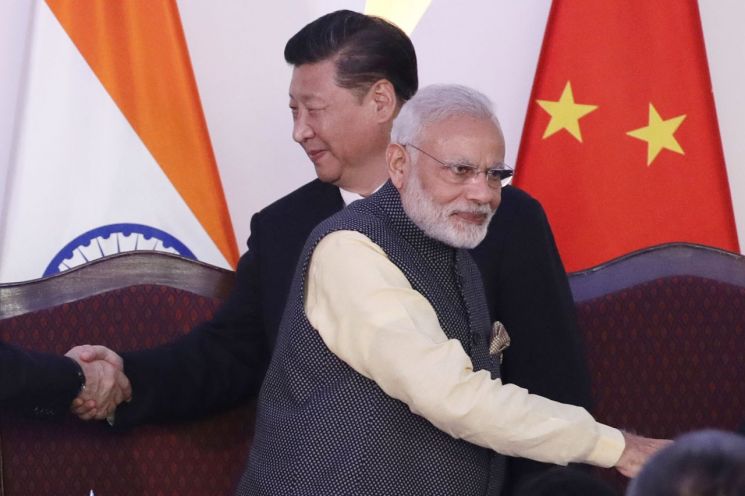
[Asia Economy Reporter Hyunwoo Lee] As China completed the troop withdrawal from the Pangong Lake area, a major border dispute region with India, it immediately announced active support for India, which is scheduled to host the BRICS summit this year as the chair country, accelerating the improvement of bilateral relations. Some speculate that Chinese President Xi Jinping may personally visit India to hold talks with Indian Prime Minister Narendra Modi at this BRICS summit, leading to expectations of a significant increase in Chinese investment in India. China's proactive reconciliation gesture is interpreted as a strategy to weaken the U.S.-led security cooperation framework, the Quad, which aims to contain China.
According to foreign media including India's Hindustan Times, on the 22nd (local time), the Chinese government announced its active support for India, the chair country of BRICS in 2021, which consists of five emerging countries: Brazil, Russia, India, China, and South Africa. Wang Wenbin, spokesperson for the Chinese Ministry of Foreign Affairs, emphasized at a press briefing that "China will support India in hosting the BRICS summit and expand cooperation in economic, political, and people-to-people exchanges." Hindustan Times reported, "There is speculation that President Xi Jinping will personally attend this BRICS summit and hold talks with Prime Minister Modi, but the Chinese government has not given a definite answer."
Following the announcement the previous day that the two countries' militaries had completed troop withdrawals from the major border dispute area around Ladakh's Pangong Lake, efforts to improve relations have accelerated. The Indian government is also expected to approve Chinese investment proposals that had been on hold. According to Hong Kong's South China Morning Post (SCMP), 45 investment plans previously proposed by Chinese automobile companies such as Changcheng Automobile and Shanghai Automotive Group are awaiting approval from the Indian government.
China's gesture of reconciliation toward India immediately after resolving the border dispute is interpreted as part of a strategy to weaken the U.S.-led security cooperation framework, the Quad, aimed at containing China.
On the same day, Ned Price, spokesperson for the U.S. State Department, said at a regular briefing, "We see essential momentum and significant potential in the Quad," and strongly criticized China by mentioning the Quad, stating, "When human rights are violated in regions such as the Xinjiang Uyghur Autonomous Region or Hong Kong's autonomy is trampled, we will continue to uphold our democratic values." The Quad is a consultative group of four countries?the U.S., Japan, India, and Australia?established during the Donald Trump administration with the goal of containing China. China is known to be concerned about diplomatic isolation in the Asia-Pacific region due to the Quad framework.
India, facing severe economic difficulties after the COVID-19 crisis, is also expected to choose a traditional neutral and pragmatic diplomatic line rather than strengthening an anti-China stance. According to the International Monetary Fund (IMF), India's gross domestic product (GDP) growth rate last year was -10.3%. Prolonged COVID-19 lockdown measures worsened the economic difficulties, and given India's high dependence on trade with China, it has been anticipated that maintaining a purely anti-China stance would be difficult.
© The Asia Business Daily(www.asiae.co.kr). All rights reserved.
![Clutching a Stolen Dior Bag, Saying "I Hate Being Poor but Real"... The Grotesque Con of a "Human Knockoff" [Slate]](https://cwcontent.asiae.co.kr/asiaresize/183/2026021902243444107_1771435474.jpg)















