Shinhyeop TF Puts All Newly Proposed Win-Win Plans on Hold
Official: "Strong Enforcement Like Limiting Total Offices Per Union"
Large Unions Grow While Small and Medium Firms Sometimes Shrink
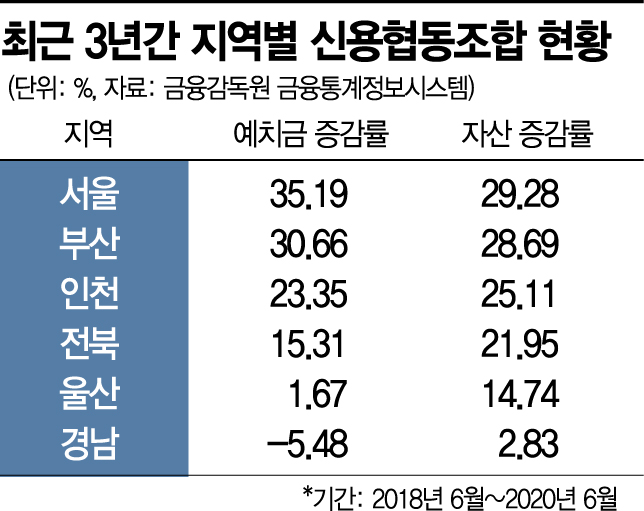 According to the semi-annual balance sheets of credit unions disclosed in the Financial Supervisory Service's Financial Statistics Information System, larger unions showed an increase in asset size and deposits, while smaller unions tended to stagnate or experience negative growth.
[Asia Economy Reporter Song Seung-seop] The National Credit Union Federation of Korea (NACUFOK) formed a task force (TF) to review coexistence plans among large, medium, and small cooperatives to prevent side effects from the expansion of loan service areas, but it has been confirmed that the plans were put on hold due to concerns over their coercive nature.
According to the financial sector on the 22nd, the Joint Solidarity Regionalization TF under NACUFOK excluded three coexistence plans from discussion: limiting the total number of offices per cooperative, prioritizing support for small cooperatives’ market entry, and strengthening the requirements for establishing branch offices.
Since May last year, NACUFOK has organized a TF involving about 100 cooperatives to review measures such as limiting the total number of offices per cooperative, strengthening the requirements for establishing branch offices, and supporting the priority market entry of small cooperatives.
This was a measure to prevent the gap between cooperatives from widening as the Financial Services Commission expanded the loan service areas of cooperatives, which were previously limited to cities, counties, and districts, to 10 nationwide regions starting this year, thereby broadening the areas where loans can be handled. There were significant concerns inside and outside the industry that capital would concentrate in large cooperatives with strong financial power.
An official from NACUFOK said, "Because it involves coercive elements, it was excluded," adding, "It is currently being discussed by the internal supervisory department rather than the TF, so it is difficult to say when it will be finalized and implemented."
Will the diluted coexistence plans reduce the gap between cooperatives?
The TF plans to expand and activate the currently implemented systems instead of introducing new coexistence plans. NACUFOK intends to increase linked loan programs that discover loan demanders and mediate loans to small and medium-sized enterprises, as well as performance products that entrust funds from small cooperatives, operate them on their behalf, and distribute profits.
However, this is merely utilizing systems that have already been in place since November last year, and the specific implementation date is undecided. There are concerns about whether this can resolve the gap issue between cooperatives.
According to the semi-annual financial statements of credit unions disclosed in the Financial Supervisory Service’s Financial Statistics Information System, the gap between large, medium, and small cooperatives has been widening from June 2018 to June last year.
The larger the cooperative, the more its asset size increases, while smaller cooperatives tend to stagnate or shrink. For example, the largest cooperative in the Seoul area, Eunpyeong Cooperative (assets of 460 billion KRW), increased its assets by more than 25% during this period. In contrast, Samsung Gongjo Cooperative in Gyeongnam (944 million KRW) saw a decrease of 9.95%.
Deposits also increased significantly in Seoul, where relatively large cooperatives are concentrated, growing by an average of 8.22% every half year, totaling a 35.19% increase. In regions with many medium and small cooperatives such as Gyeongnam (-1.27%), Ulsan (0.57%), and Jeonbuk (3.66%), deposits either decreased or rose slightly. The total change rates were -5.48%, 1.67%, and 15.31%, respectively.
© The Asia Business Daily(www.asiae.co.kr). All rights reserved.
![Clutching a Stolen Dior Bag, Saying "I Hate Being Poor but Real"... The Grotesque Con of a "Human Knockoff" [Slate]](https://cwcontent.asiae.co.kr/asiaresize/183/2026021902243444107_1771435474.jpg)
















