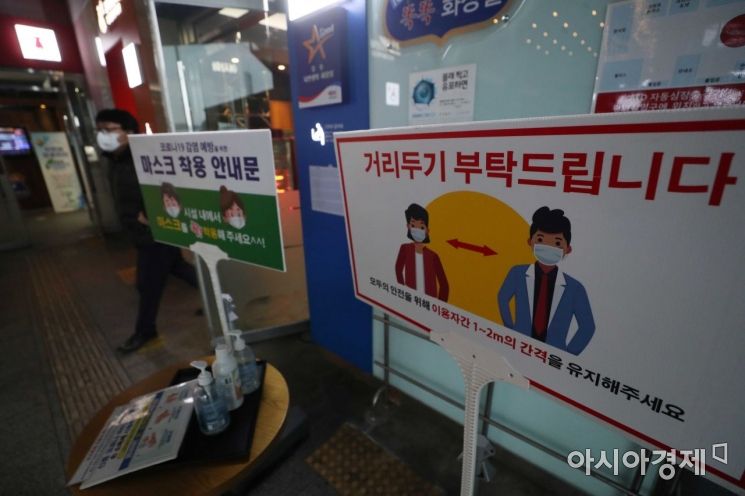
 On the 10th, one day before the Lunar New Year holiday, a social distancing notice to prevent the spread of COVID-19 was installed at the entrance of the restroom at Mannam Plaza Service Area on the Busan-bound side of the Gyeongbu Expressway in Seoul. Photo by Mun Ho-nam munonam@
[Asia Economy Reporter Lee Chun-hee] The quarantine authorities have announced plans to reorganize social distancing measures for COVID-19 prevention. The step system will be simplified, the criteria for each step will be relaxed, and the focus of distancing will shift from facilities to regulation of individual activities.
The Central Disaster and Safety Countermeasures Headquarters of the Ministry of Health and Welfare recently revealed these directions in a document titled "Direction for Reorganizing the Social Distancing System" during an online press briefing. However, the authorities explained that this document is only a draft focusing on the overall direction rather than detailed content, and "it may be added to or revised during future discussions."
Simplification of Distancing Steps
The core of the government's new social distancing reorganization plan is the simplification of distancing steps. Son Young-rae, head of the Social Strategy Division at the Central Disaster and Safety Countermeasures Headquarters, stated, "The existing five-step system had issues with unclear risk levels between 0.5 steps and unclear public behavioral response messages," and added, "The current escalation criteria were criticized for being too low, set at the level of the second wave."
Accordingly, the government plans to simplify the step system to clarify public behavioral messages for each step, while relaxing the criteria for each step to reflect enhanced medical capacity.
Professor Ki Moran of the National Cancer Center previously proposed a new social distancing system consisting of life quarantine (step 0) and steps 1, 2, and 3 during a discussion hosted by the quarantine authorities on social distancing reorganization.
Strengthening Regulation on Personal Responsibility... Minimizing Gathering Bans on Facilities
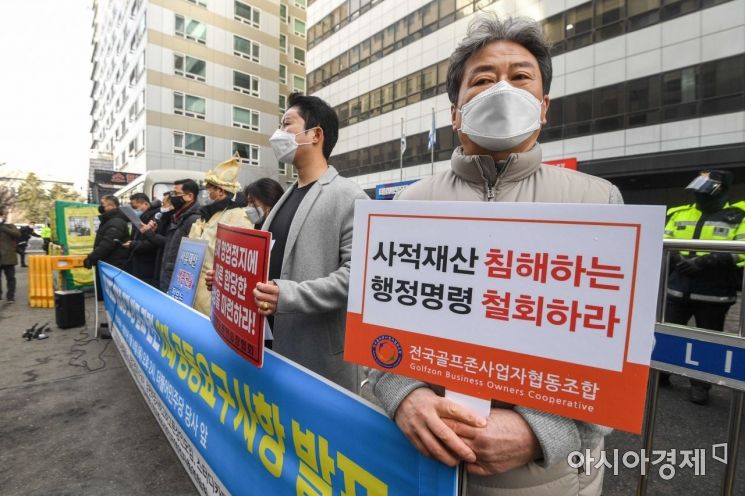 On the 14th of last month, in front of the Democratic Party headquarters in Yeouido, Seoul, representatives from gyms and Pilates studios, study cafes, screen golf, and coin karaoke announced the three major joint demands of self-employed business owners regarding the adjustment of business closure restrictions scheduled to be announced on the 16th. Photo by Kang Jin-hyung aymsdream@
There is a determination to improve the asymmetry in the quarantine system where regulations have been facility-centered, while regulations on individual behavior have been relatively weak.
Son explained, "There is a need to establish a system that distributes social and economic burdens to the entire population by strengthening stepwise management of high-risk activities such as outings, gatherings, and events."
In fact, mask-wearing mandates and some restrictions on the number of participants in gatherings and events have been introduced for individuals, but these only limited large-scale events. The "ban on private gatherings of five or more people" implemented since last month contributed to suppressing the spread but caused a decline in trust in the quarantine system, according to the authorities.
On the other hand, uniform operational restrictions and gathering bans on all facilities of the same industry increased economic difficulties for small business owners and self-employed individuals. The addition of quarantine measures not included in the system, such as the "10 p.m. business hour restriction for entertainment facilities," lowered predictability of quarantine measures, the authorities noted.
They also acknowledged criticism that despite recent cluster infections occurring in religious facilities, medical institutions, and nursing facilities, step adjustments have been focused on multi-use facilities.
Accordingly, the government is seeking to strengthen quarantine management centered on 'autonomy' and 'participation' for facilities while strengthening regulations on individual activities.
For individuals, the plan is to strengthen management of high-risk activities stepwise to distribute social and economic burdens across the entire population, enhance claims for damages against violations of quarantine rules, and promote campaigns for personal autonomy and responsibility.
Meanwhile, gathering bans on livelihood facilities will be minimized, but density adjustments to eliminate infection vulnerabilities will be pursued. However, regarding appropriate compensation for operational restrictions, the authorities stated, "There are limitations due to delays in discussions on financial capacity and legislation."
Highly Effective 'Ban on Private Gatherings of Five or More' May Become a Social Bubble?
Additionally, the introduction of the 'social bubble' concept is reportedly under consideration concerning the ban on private gatherings of five or more people.
Social bubbles are a concept applied in countries such as New Zealand and Canada. It is a social distancing quarantine strategy to block chains of cluster infections by setting small groups of fewer than 10 people, such as cohabiting family members and close colleagues met daily, and relaxing distancing measures within these groups while maintaining strict distancing with others during high-intensity social distancing periods.
In this system, bubbles cannot overlap with other bubbles, and members cannot be expanded or changed arbitrarily. It is evaluated to reduce psychological and emotional stress caused by social isolation and prevent situations where accumulated stress leads to breaking distancing rules.
© The Asia Business Daily(www.asiae.co.kr). All rights reserved.
![Clutching a Stolen Dior Bag, Saying "I Hate Being Poor but Real"... The Grotesque Con of a "Human Knockoff" [Slate]](https://cwcontent.asiae.co.kr/asiaresize/183/2026021902243444107_1771435474.jpg)
















