Trading Value and Investor Deposits Also Decline... KOSPI Sideways
Market Leadership Shifts from Individuals to Foreigners
"Won-Dollar Exchange Rate, Focus on Corporate Profit Growth"
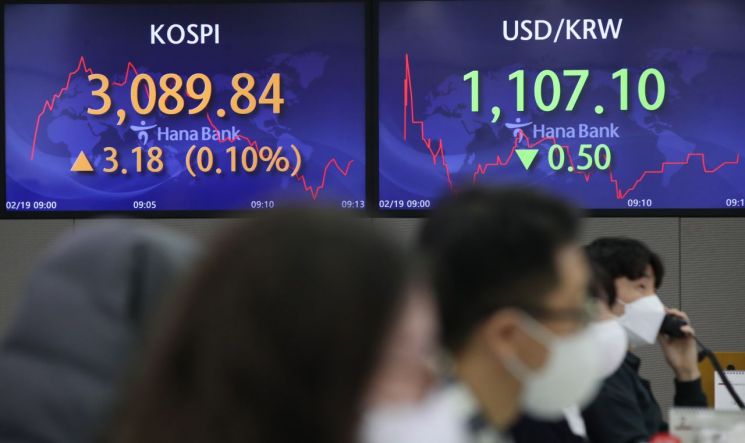 On the morning of the 19th, when the KOSPI started on an upward trend, dealers were busy at work in the dealing room of Hana Bank Headquarters in Jung-gu, Seoul. [Image source=Yonhap News]
[Asia Economy Reporter Minwoo Lee] The net buying volume of 'Donghak Ants' investors, which was around 26 trillion won in January, has sharply decreased to the 6 trillion won range. It appears that the stock market leadership is shifting to foreign investors.
According to the Korea Exchange on the 21st, individual investors have net purchased a total of 5.8004 trillion won in the domestic stock market from the beginning of this month until the 19th, including 5.2073 trillion won in KOSPI and 593.1 billion won in KOSDAQ. In KOSPI alone, they bought 22.3338 trillion won, which is only about a quarter of last month's record high of 25.8549 trillion won, showing a sharp decline. Even considering the two trading days off during the Lunar New Year holiday, the decrease is clear. This is even less than the 6.0341 trillion won recorded in February last year before the full spread of COVID-19.
Trading volume is also decreasing. Last month, the daily trading volume of KOSPI exceeded 20 trillion won every day, but this month it has dropped to the 10 trillion won range. On the 16th, it fell to 16.8461 trillion won. Although it recovered to 19.4294 trillion won on the 19th, it is still less than half of the all-time high of 44.4448 trillion won on the 11th of last month.
Investor deposits, which represent standby funds for the stock market, are also declining. According to the Korea Financial Investment Association, investor deposits recorded 66.0915 trillion won on the 18th. This has been steadily decreasing since the record high of 74.4559 trillion won on the 12th of last month. On the day before the Lunar New Year holiday, the 10th, it dropped to 63.8262 trillion won. This is a decrease of over 10 trillion won in just one month.
As the trading volume and 'ammunition' of individual investors who led the stock market decrease, KOSPI is also faltering. On the 11th of last month, it reached an intraday high of 3,266.23, setting a new record, and on the 25th, it surpassed the 3,200 mark for the first time at closing. However, it opened at 2,976.81 on the first trading day of this month, falling below the 3,000 level. Since then, it has slightly rebounded but has been hovering without settling above the 3,100 level.
In this situation, the leadership in supply and demand is shifting to foreigners. Yoojun Choi, a researcher at Shinhan Financial Investment, analyzed, "As the 3,200 level in KOSPI acts as resistance, individual investors who had driven the market have turned cautious. Institutions continue to reduce their stock holdings, and since mid-last month, the influence of foreign investors' supply and demand has expanded, causing the market to rise on days when foreigners net buy and fall on days when they net sell."
The main variables affecting the direction of foreign investors' supply and demand are exchange rates and profit growth. Researcher Choi explained, "When the won continues to strengthen, the foreign ownership ratio in KOSPI tends to increase. However, since January, the won's weakness has been sustained due to expectations of U.S. stimulus measures and the accelerated distribution of COVID-19 vaccines, limiting the upside. If the won returns to a strengthening trend, there is a possibility of additional inflows from foreign investors."
Regarding profit growth, he also diagnosed, "Due to the rapid upward revision of earnings estimates in the domestic stock market since the fourth quarter of last year, earnings improvement in the domestic market continues, but recently, other countries have shown greater improvements in earnings forecasts. Once the adjustment of earnings growth rates is completed, the perspective of foreign investors on the domestic stock market may also change."
© The Asia Business Daily(www.asiae.co.kr). All rights reserved.
![Clutching a Stolen Dior Bag, Saying "I Hate Being Poor but Real"... The Grotesque Con of a "Human Knockoff" [Slate]](https://cwcontent.asiae.co.kr/asiaresize/183/2026021902243444107_1771435474.jpg)















