Ministry of Education Announces 'Comprehensive Plan for High School Credit System'
Expansion of Elective Subjects, Reform of High School Education Paradigm
Graduation Requires Meeting Both Class Days and Academic Achievement
Field Emphasizes Teacher Recruitment and Securing School Space
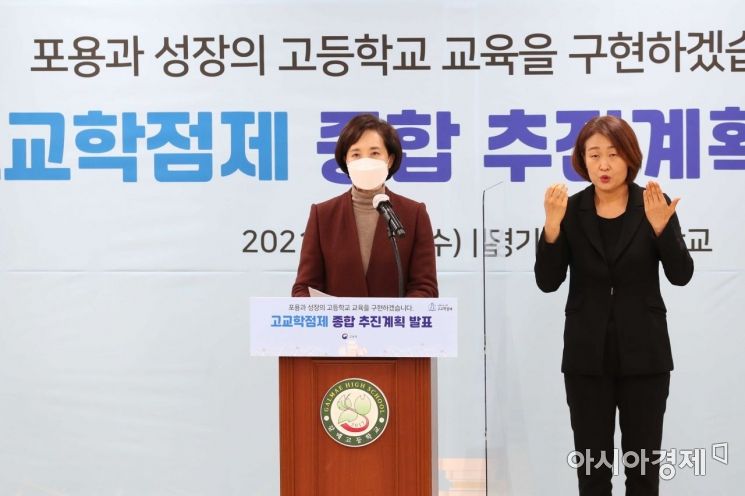 Deputy Prime Minister for Social Affairs and Minister of Education Yoo Eun-hye is giving a briefing on the comprehensive implementation plan for the high school credit system at Galmae High School in Guri-si, Gyeonggi Province on the 17th. On this day, Minister Yoo stated that the implementation of the high school credit system will be an opportunity for innovation in public education and a turning point to advance into future education. Photo by Moon Ho-nam munonam@
[Guri (Gyeonggi) = Asia Economy Reporter Han Jinju] Starting in 2025, when 6th-grade elementary students enter high school, the 'High School Credit System' will be fully implemented. Students will be able to select courses according to their career paths and must meet both attendance and minimum academic achievement requirements to graduate. The new curriculum, which will be implemented from 2028, will also reflect the high school credit system.
At the 'Comprehensive Promotion Plan Announcement for the High School Credit System' event held on the 17th at Galmae High School in Guri, Gyeonggi Province, Deputy Prime Minister and Minister of Education Yoo Eun-hye stated, "We will begin full discussions on the 2028 college entrance system reflecting the high school credit system starting this year," adding, "Research is currently underway, and some review of reform directions has begun in consultations with education superintendents."
Deputy Prime Minister Yoo said, "Our education will be divided into before and after 2025," explaining, "Because the new education system called the 'High School Credit System' will be applied to high schools nationwide, and autonomous private high schools, foreign language high schools, and international high schools will be completely converted into general high schools, starting operations under this new system." She continued, "The changes in high school education in 2025 will lead to changes in the 2028 college entrance exams, and Korea's education will break away from uniform education symbolized by multiple-choice CSAT questions and competition-centered education."
Graduation Requires Meeting Attendance and Achievement Rate Standards Under High School Credit System
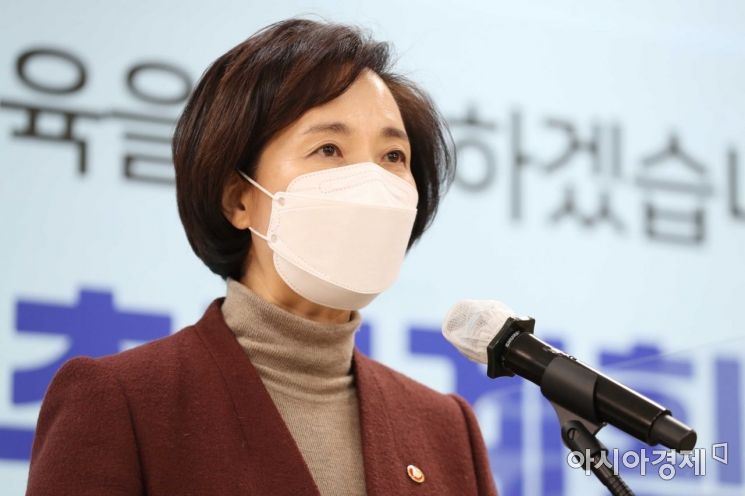 Yoo Eun-hye, Deputy Prime Minister for Social Affairs and Minister of Education, is giving a briefing on the comprehensive implementation plan for the high school credit system at Galmae High School in Guri, Gyeonggi Province on the 17th. On this day, Minister Yoo stated that the implementation of the high school credit system will be an opportunity for public education innovation and a turning point to advance into future education. Photo by Moon Ho-nam munonam@
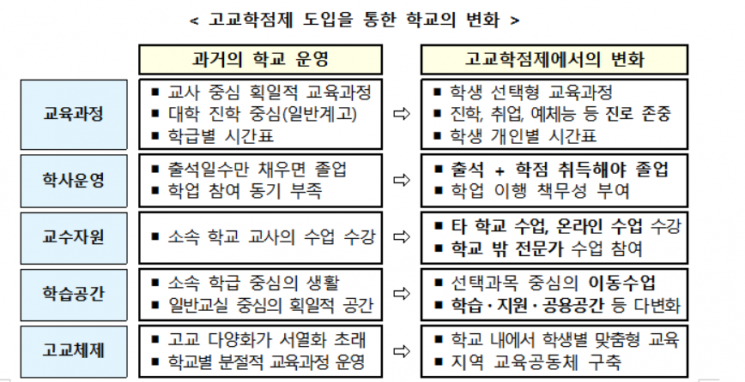
The high school credit system refers to a system where students complete various courses according to their career paths and are recognized for graduation if their accumulated credits meet the standards. With the introduction of the high school credit system, students can select courses tailored to their career paths, enabling customized classes, and even general high schools can offer advanced and specialized courses. It was introduced in Meister high schools last year, partially introduced in general high schools from next year, and will be fully applied in 2025. This is also the time when foreign language high schools and autonomous private high schools convert to general high schools.
Graduation requires meeting both attendance and academic achievement rates. Previously, students could graduate by attending two-thirds of the school days, but now they must meet a course attendance rate (two-thirds of class sessions) and an academic achievement rate (40% or higher). Students must complete 192 credits over three years, with one credit equaling 16 class sessions, similar to universities (15 sessions). The first semester of the first year is a career-focused semester to concretize career and academic plans. Additionally, the number of credits that can be earned per grade is set at 28 to prevent students from concentrating classes in a specific grade.
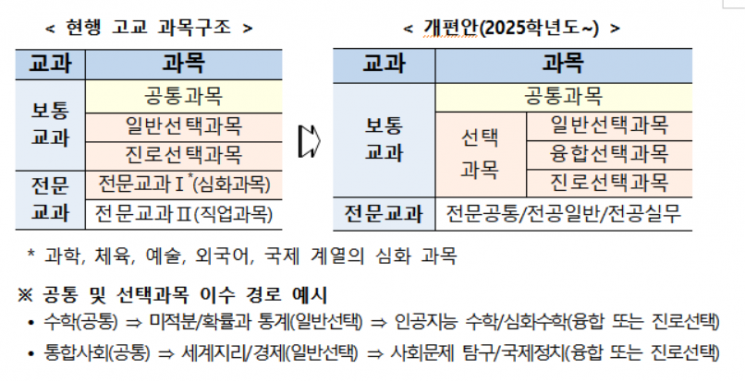
The method of calculating and recording internal grades will also change. Achievement levels will be recorded from A to E, and if the achievement rate is below 40%, an I (Incomplete) grade will be given. Students receiving an I grade, indicating academic achievement below 40%, must earn credits through supplementary courses (assignments, online courses, etc.). Common subjects such as Korean, English, and Math will record both achievement levels and rank grades, while elective subjects will be recorded by achievement level only. For example, for a course called Politics and Law, the raw score, achievement level (number of students enrolled), and the percentage of students by achievement level will be recorded together.
The Ministry of Education explained, "The achievement evaluation system is similar to an absolute evaluation system, comprehensively assessing written tests and process-centered evaluations to determine how closely students meet the curriculum goals," adding, "We will also establish a system to monitor the Curriculum Evaluation Institute and school grade status."
Teachers will focus on managing the academic achievement of a small number of students rather than attendance or behavioral guidance. The Ministry of Education plans to revise the teacher training system centered on single subjects and establish new teacher supply standards by next year. Starting this year, subject itinerant teachers will be assigned to education support offices to enable students to take various classes. In cases where securing teachers is difficult, such as for rare subjects or in rural areas, the system will be improved to allow hiring outside experts as contract teachers to conduct subject classes.
Teacher Recruitment and Space Securing Essential for High School Credit System... Policy Continuity Must Also Be Ensured
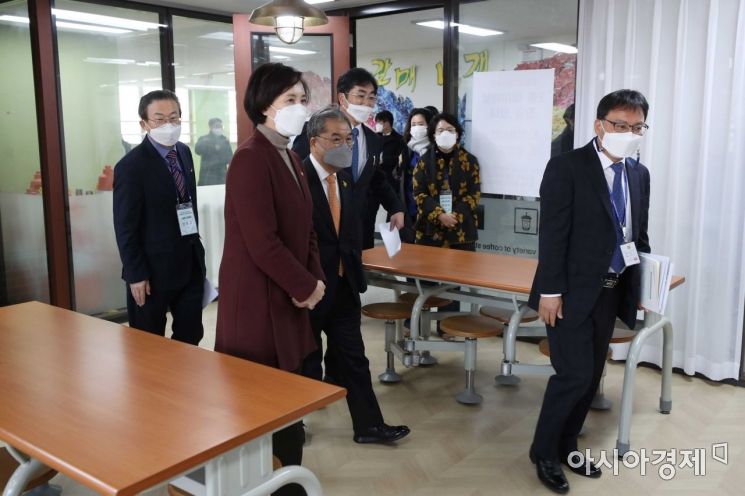 Yoo Eun-hye, Deputy Prime Minister for Social Affairs and Minister of Education, is touring the school after completing the announcement event of the comprehensive high school credit system promotion plan held at Galmae High School in Guri-si, Gyeonggi Province on the 17th. On this day, Minister Yoo stated that the implementation of the high school credit system will be an opportunity for public education innovation and a turning point to advance into future education. Photo by Moon Ho-nam munonam@
For the high school credit system to be properly established, it is necessary to expand the number of teachers required for elective courses and to make changes to school spaces designed for existing systems. According to a survey conducted earlier this month by the Korea Federation of Teachers' Associations targeting 2,399 teachers, the biggest difficulties with the high school credit system were 'inability to secure multi-subject teachers' (67.2%) and 'excessive multi-subject teacher assignments' (47.6%).
Ha Yoon-soo, president of the Korea Federation of Teachers' Associations, emphasized, "To guarantee students' course selection rights and establish the high school credit system, securing teachers is the most important prerequisite," adding, "We must first present special measures for sufficient teacher recruitment and expansion of facilities and infrastructure."
At the meeting held that day, teachers from research and pilot schools for the high school credit system also cited teacher supply issues as the top priority. Park Seo-young, a teacher at Galmae High School, said, "Other schools want to open courses, but there is a gap between schools because teacher supply is not smooth," and added, "Instead of recruiting 1.95 teachers per class, teachers should be recruited based on subjects to support opening courses that students want."
Jeon Hyo-jin, a teacher at Inhwa Girls' High School, pointed out, "Our school has space available, but in general schools, some have 35 to 40 students per class," adding, "For schools where increasing the number of classes is impossible, even if the high school credit system grants course selection rights, operational difficulties will inevitably be significant, so securing space is important."
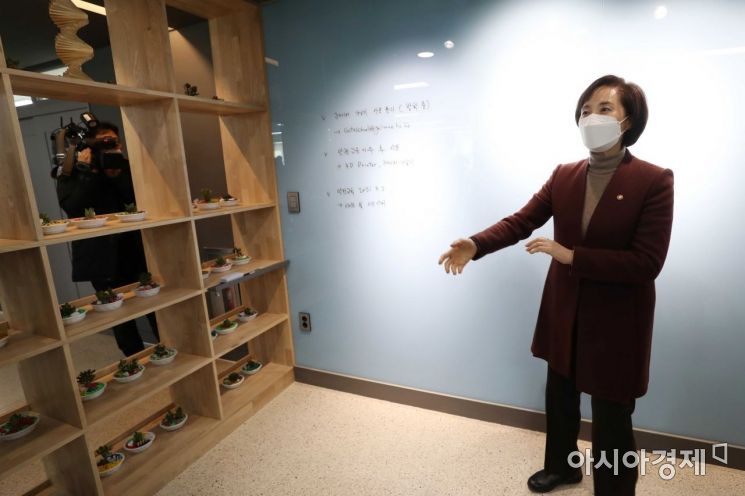 Deputy Prime Minister for Social Affairs and Minister of Education Yoo Eun-hye is touring the school after concluding the comprehensive high school credit system promotion plan announcement event held at Galmae High School in Guri, Gyeonggi Province on the 17th. On this day, Minister Yoo stated that the implementation of the high school credit system will be an opportunity for innovation in public education and a turning point toward future education. Photo by Moon Ho-nam munonam@
For the high school credit system not to remain an experiment, it is important that it harmonizes well with the new college entrance system applied from 2028. There are concerns that the high school credit system may emphasize internal grades and student records, which may conflict with college entrance policies moving toward expanding regular admissions.
Deputy Prime Minister Yoo explained, "The plan to expand regular admissions announced in 2019 was a measure to balance the excessive focus on school records, and the college entrance system from 2028, when the high school credit system is fully introduced, is expected to reflect changes in that system."
Deputy Prime Minister Yoo emphasized that the high school credit system will be institutionally supported to ensure it is consistently promoted regardless of the administration in power.
She said, "For the high school credit system to settle, support and cooperation from the government and education offices are important. We have revised enforcement ordinances related to the 2025 curriculum system transition to establish legal grounds," adding, "Once the National Education Commission is launched within this year, it will support consistent implementation of national education policies."
© The Asia Business Daily(www.asiae.co.kr). All rights reserved.
![Clutching a Stolen Dior Bag, Saying "I Hate Being Poor but Real"... The Grotesque Con of a "Human Knockoff" [Slate]](https://cwcontent.asiae.co.kr/asiaresize/183/2026021902243444107_1771435474.jpg)

















