Japanese Media "Discriminatory Remarks and Rumor Spread During Disasters"
1923 'Kanto Daijishin' Imitation Rumors Also Emerge
Some Japanese Netizens Call for "Immediate Reporting Upon Sight"
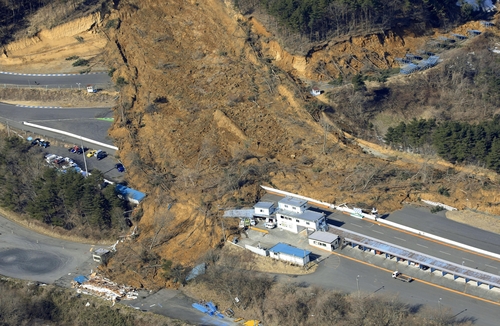 The morning of the 14th (local time), the day after a powerful magnitude 7.3 earthquake struck off the coast of Fukushima Prefecture, Japan, a car racing track in Fukushima Prefecture was damaged by landslide debris. / Photo by Yonhap News
[Asia Economy Reporter Lim Juhyung] Following a strong earthquake off the coast of Fukushima Prefecture, Japan, racially discriminatory fake news has reportedly spread primarily through social networking services (SNS), sparking controversy.
On the 14th (local time), the Japanese media outlet Mainichi Shimbun published an article titled "How to respond to rumors and discriminatory remarks that arise every time there is an earthquake," reporting that "discriminatory remarks, rumors, and uncertain information once again ran rampant on Twitter, YouTube, and other platforms surrounding the strong earthquake in Fukushima and Miyagi Prefectures."
Earlier, at around 11 p.m. on the 13th, a magnitude 7.3 earthquake on the Richter scale struck off the coast of Fukushima Prefecture. As a result, Fukushima and Miyagi Prefectures observed seismic intensity 6 upper (a level where people cannot stand properly) for the first time since the Great East Japan Earthquake in 2011. According to Japanese authorities, at least 142 people have been injured so far, and 950,000 households have experienced power outages due to this earthquake.
The media outlet pointed out, "The same phenomenon occurs every time there is a disaster," adding, "These remarks imitate rumors that spread during the 1923 Great Kanto Earthquake."
In fact, at 11:08 p.m. on the 13th, shortly after the earthquake, a Twitter user in Japan posted, "I saw a Joseon person poisoning a well in Fukushima."
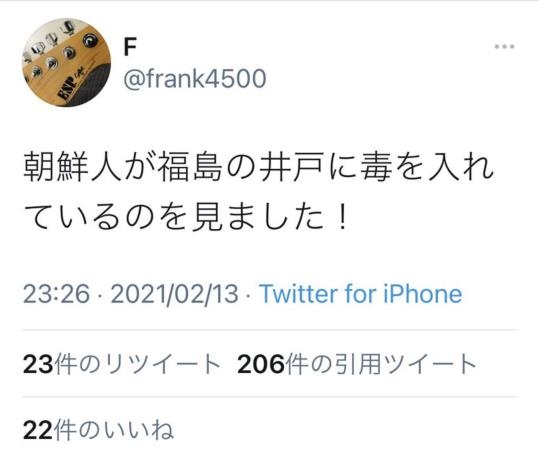 On the 13th, when the earthquake occurred, a Japanese netizen spread fake news claiming that "a Joseon person was seen poisoning a well." As of the 15th, the account has been deleted. / Photo by Twitter capture
This fake news appears to imitate the rumors that circulated during the Great Kanto Earthquake. At that time, rumors such as "Joseon people are committing arson" and "poisoning wells" spread, and believing these, Japanese vigilante groups unilaterally beat and assaulted Joseon people, resulting in thousands of deaths.
This is not the first time that racially discriminatory fake news has spread on SNS in Japan following natural disasters such as earthquakes.
According to Mainichi Shimbun, during the Great East Japan Earthquake in 2011, baseless claims that "foreigners are committing crimes" spread on SNS.
Also, when a magnitude 6.5 earthquake struck Kumamoto Prefecture in 2016, conspiracy theories circulated on Twitter suggesting that "Joseon people living in Kumamoto poisoned wells."
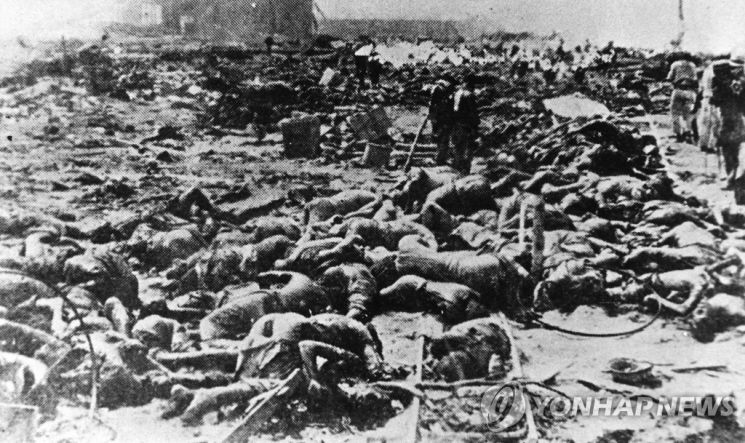 Corpses of Koreans massacred during the 1923 Great Kanto Earthquake in Japan. / Photo by Yonhap News
The problem is that unlike the Great Kanto Earthquake over 100 years ago, fake information now spreads rapidly through SNS and other platforms. Even baseless rumors can have a strong ripple effect.
Given this situation, voices calling for self-regulation to prevent the spread of fake news are emerging within Japan.
One user captured screenshots of accounts spreading rumors related to the earthquake on the 13th and emphasized, "There are good and bad kinds of jokes," adding, "They should be reported immediately upon sight to stop them."
Another user pointed out, "People who post hateful tweets taking advantage of the earthquake should be ashamed," adding, "If you go abroad, you will just be one of the foreigners and become a target of hatred."
© The Asia Business Daily(www.asiae.co.kr). All rights reserved.
![Clutching a Stolen Dior Bag, Saying "I Hate Being Poor but Real"... The Grotesque Con of a "Human Knockoff" [Slate]](https://cwcontent.asiae.co.kr/asiaresize/183/2026021902243444107_1771435474.jpg)

















