International Finance Center: "Long-term Interest Rate Rise Due to Uncertainty Rather Than Economic Recovery Expectations"
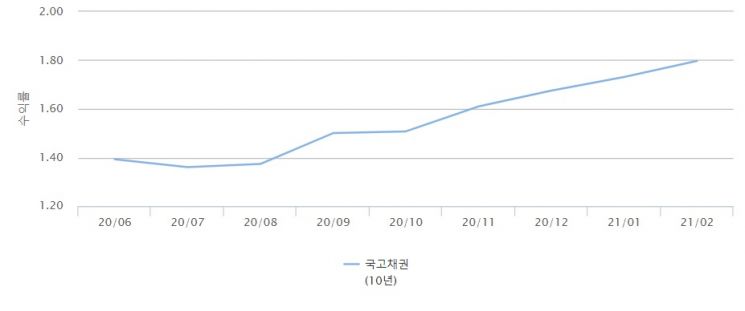
[Asia Economy Reporter Kim Eunbyeol] Recent rises in long-term government bond yields have been analyzed as effects of monetary expansion rather than expectations of economic recovery. Generally, increases in long-term bond yields are considered indicators of economic recovery, but the recent upward trend is attributed to the issuance of bonds to raise funds. As the government is considering issuing government bonds for disaster relief payments and fiscal stimulus, there is growing likelihood that bond yields will rise further.
On the 15th, the International Finance Center stated in its report titled "Reviewing Economic Recovery Expectations through US Long-term Interest Rates" that the yield reached 1.071% on the 29th of last month, rising 53 basis points (1bp=0.01 percentage points) compared to August 4 of last year. It analyzed that "of this increase, 19bp (36%) was due to expectations of economic recovery." On the other hand, concerns over deteriorating supply and demand in the government bond market and uncertainties in inflation outlook due to large-scale fiscal stimulus accounted for 34bp, or 64%, of the rise in bond yields. The US administration decided to inject large-scale funds for economic stimulus, which caused the rise in yields. The International Finance Center explained, "Supply-demand imbalances and inflation outlook uncertainties added a premium to long-term government bond yields."
This trend is similar domestically. On the 10th, South Korea’s 10-year government bond yield closed at 1.831%, up 1.8bp from the previous day, marking the highest level since November 2019. When deficit bonds are issued for supplementary budgets, the increased supply of government bonds in the market causes prices to fall and yields to rise.
The rise in government bond yields affects daily life through increases in loan interest rates. If loan rates rise without a proper economic recovery, the burden on ordinary citizens may increase further. This not only diminishes the effect of the Bank of Korea lowering the base rate to a historic low of 0.50%, but also places a burden on the government that has increased debt. This is why the ruling party is suggesting that the Bank of Korea should print money to purchase government bonds.
However, excessive monetary expansion in the market can lead to a decline in value and inflation, which is problematic. The Bank of Korea has stated that it will step up government bond purchases whenever the market becomes unstable. In its "2021 Monetary and Credit Policy Operation Direction," the Bank of Korea said, "If volatility in long-term market interest rates increases due to supply-demand imbalances, we will increase government bond purchases," and "We will announce the timing and scale of bond purchases in advance when necessary."
© The Asia Business Daily(www.asiae.co.kr). All rights reserved.
![Clutching a Stolen Dior Bag, Saying "I Hate Being Poor but Real"... The Grotesque Con of a "Human Knockoff" [Slate]](https://cwcontent.asiae.co.kr/asiaresize/183/2026021902243444107_1771435474.jpg)
















