Slight Increase in Jeonse Listings Since October Last Year
But Regulations Like Jeonse Rent Ban Law, Lease 3 Laws, and Public Redevelopment
Cause Jeonse Supply Decrease and Demand Increase... "Jeonse Price Rise" Expected
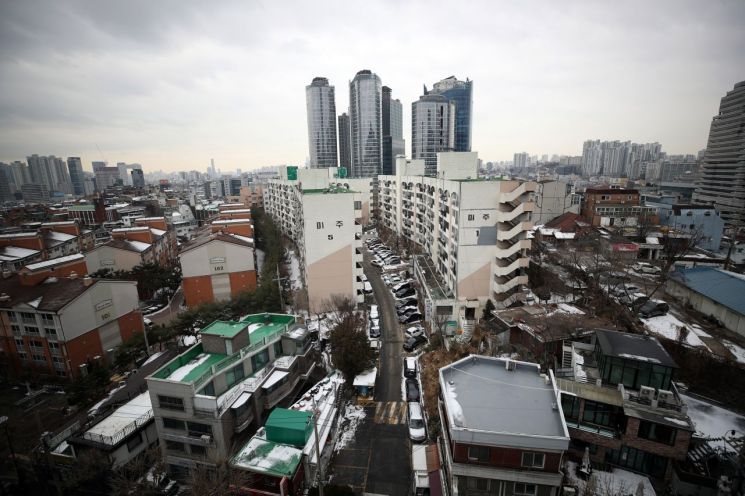 The Ministry of Land, Infrastructure and Transport, Seoul City, and Yongsan District announced on the 5th the promotion plan for the "Public Housing and Urban Regeneration Project to Improve the Residential Environment of the Seoul Station Gosiwon Area." The photo shows the area around District 1, Lot 1 of the Huam Special Planning Zone in Dongja-dong, Yongsan-gu, Seoul on that day.
 As the Lunar New Year holiday ends and the spring moving season kicks into full gear, dark clouds are once again gathering over the rental market. Although the number of jeonse (long-term lease) listings has slightly increased recently and the jeonse supply-demand index appears to be stabilizing, various government regulations are causing a balloon effect, fueling market instability.
According to Asil (Apartment Real Transaction Price), a real estate big data company, the number of jeonse apartment listings in Seoul was recorded at 21,274 as of the previous day. This marks a significant recovery compared to the period of September to October when listings shrank to below 10,000 following the implementation of the new lease law.
With the increase in listings, the severe supply-demand imbalance has somewhat eased. According to the KB Weekly Housing Market Trends, the nationwide jeonse supply-demand index stood at 169.2 as of the 1st. An index above 100 indicates that jeonse demand exceeds supply. After peaking at 192.8 on October 26 last year, the index has been on a slight downward trend.
Nevertheless, the prevailing assessment is that the rental market cannot be considered stable. The market structure still favors suppliers. Above all, successive government real estate policies such as the 'Jeonse and Wolse Prohibition Law,' 'Lease 3 Laws,' and the 2·4 Supply Plan are contributing factors to the decrease in rental listings.
Starting from the 19th, apartments in the Seoul metropolitan area subject to the price ceiling system for pre-sale approval applications will be required to have a minimum five-year actual residence obligation. This effectively halts a large volume of jeonse and wolse (monthly rent) supply. The market views this as the 'Jeonse and Wolse Prohibition Law' and expresses concerns about supply shortages.
The government's 2·4 Supply Plan is expected to expand jeonse demand. The government has pledged a nationwide 'supply bomb' of 2 million housing units, emphasizing the provision of pre-sale housing at prices lower than market rates. At the same time, the subscription system was reformed to increase the general supply portion in public housing from 15% to 30%. A lottery system (30%) was also introduced for the general supply portion to expand subscription opportunities. While the intention is to calm 'all-in' and 'panic buying,' concerns remain about increased jeonse demand due to subscription waiting lists.
The follow-up measure to the July 10 Real Estate Plan, the Lease Protection Act (contract renewal request right and rent ceiling system), has raised jeonse prices while increasing the number of half-jeonse contracts. According to the Seoul Real Estate Information Plaza, in the six months following the implementation of the new lease law, 24,909 transactions involving 'half-jeonse'?leases with monthly rent?were recorded. This accounted for 32.9% of all lease transactions, up 4.7 percentage points from 28.2% in the six months prior to the new lease law (February to July last year). It appears that tenants who cannot find jeonse or afford the increased jeonse prices are increasingly entering into half-jeonse contracts.
Kwon Il, head of the research team at Real Estate Info, said, "There seems to be no inflection point for jeonse prices to decline this year," adding, "The upward trend in the rental market is expected to continue for the time being." Seo Jin-hyung, president of the Korea Real Estate Society and professor at Gyeongin Women's University, also stated, "Due to the combined effects of the Lease 2 Laws and the 2·4 Plan coinciding with the moving season, the jeonse market is expected to continue its record-high march."
© The Asia Business Daily(www.asiae.co.kr). All rights reserved.
![Clutching a Stolen Dior Bag, Saying "I Hate Being Poor but Real"... The Grotesque Con of a "Human Knockoff" [Slate]](https://cwcontent.asiae.co.kr/asiaresize/183/2026021902243444107_1771435474.jpg)















