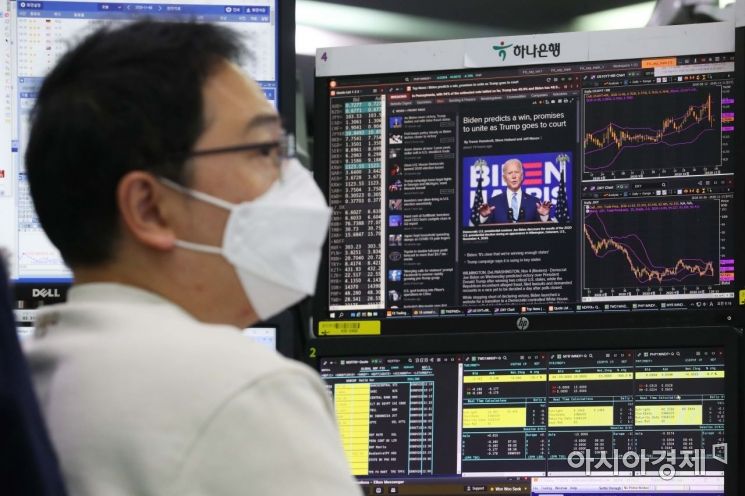
 On the 6th, dealers are working in the Hana Bank dealing room in Euljiro, Seoul. On this day, the KOSPI index started at 2,421.79, up 8.00 points (0.33%) from the previous trading day, maintaining a strong trend. Photo by Moon Honam munonam@
[Asia Economy Reporter Junho Hwang] In South Korea, on the 13th, which was during the Lunar New Year holiday period, the US Treasury yield rose to 1.2% (based on the 10-year Treasury Bond), increasing market tension. This level is comparable to that of March last year when the economy was shocked by COVID-19.
Regarding this, Gong Dong-rak, a bond research analyst at Daishin Securities, stated on the 15th, "Concerns about a so-called tantrum triggered in the bond market due to this rate hike are not expected to be significant." A tantrum refers to a phenomenon where the entire financial market becomes unstable due to the shock of interest rate increases.
The current level of US Treasury yields is the same as the level in March last year when the Federal Reserve cut the benchmark interest rate twice in response to COVID-19, causing a rebound. At that time, the central bank's strong message to stabilize the market did not work properly starting from the bond market. As a result, the aftermath led to severe turmoil such as a sharp drop in stock prices and gold prices.
However, the recent rise in bond yields is showing a different pattern. The volatility index (MOVE), which is usually used as a link between the bond and stock markets, is generally maintaining a stable trend. The VIX, a volatility index for the stock market, is also not showing significant changes. In fact, the situation is more stable compared to the volatility surge phase observed when the 10-year Treasury Bond yield surpassed 1% last November.
Researcher Gong explained, "From the perspective of bond market participants, the increased yields and curve steepening can naturally be factors causing losses or yield declines in held positions, but the possibility of shocks spreading to other financial markets, including stocks, is limited."
He added, "The reason why shocks originating from the bond market are not spreading to other financial markets is based on the upward revision of the US economic growth outlook," and interpreted, "While an increase in Treasury issuance to raise funds for economic stimulus is naturally unfavorable for bonds, the increased expectations for growth sufficiently offset the impact on other financial markets such as stocks."
© The Asia Business Daily(www.asiae.co.kr). All rights reserved.
![Clutching a Stolen Dior Bag, Saying "I Hate Being Poor but Real"... The Grotesque Con of a "Human Knockoff" [Slate]](https://cwcontent.asiae.co.kr/asiaresize/183/2026021902243444107_1771435474.jpg)















