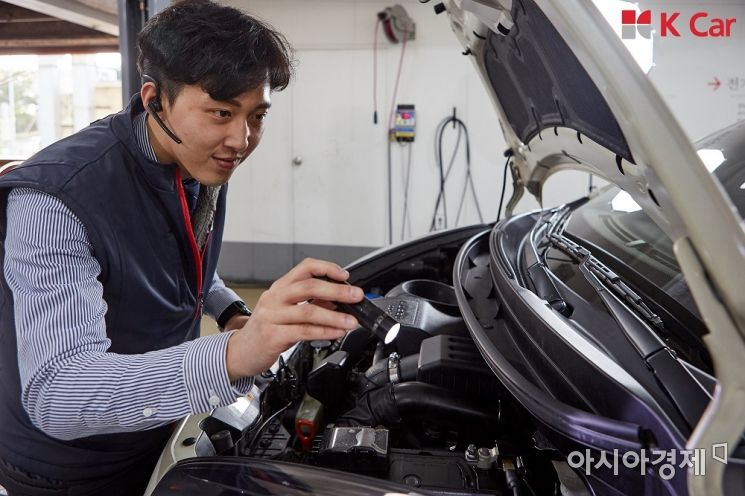
[Asia Economy Reporter Changhwan Lee] The nation's major holiday, Seol, is just around the corner. Due to the government's extension of social distancing and quarantine measures, overall interregional travel volume is expected to be lower than usual. However, the use of private cars for returning home is expected to increase as people tend to avoid public transportation.
To prevent unexpected accidents or breakdowns before long-distance travel home, it is essential to have your vehicle inspected. While it is best to receive free inspection services offered by manufacturers or insurance companies before the holiday, most insurers are not providing free inspections this year, and some drivers may not have the time to visit repair shops.
Hwang Gyuseok, head of diagnostics at the direct used car company K Car, revealed on the 11th how to perform a self-check of your vehicle in preparation for long-distance driving.
Checking tires is essential for safe driving. If tire conditions fall outside the proper range, braking power decreases, which can cause skidding accidents. First, check the recommended tire pressure for your vehicle and inflate the tires accordingly.
During the cold winter months, tire pressure can drop, so it is advisable to add about 10% more air than usual. Tire wear can be easily checked by inserting a 100-won coin into the tread grooves, and if the wear is severe, the tires should be replaced.
To prevent engine overload during long drives, engine oil and coolant should also be checked. It is recommended to change engine oil after one year or 10,000 km of driving. Open the car hood and check the yellow dipstick; if the oil level is between the F and L marks, it is normal. If it is close to or below the L mark, engine oil needs to be replenished. Coolant levels can also be visually checked via the gauge and should be between MAX and MIN.
Next is checking the brake pads and brake fluid. On congested highways, frequent braking can cause brake pads to wear out quickly. If you hear friction noises when braking, experience steering wheel shaking, or need to press the brake pedal deeper than usual for it to work, the brake pads and fluid should be replaced.
It is also important to prepare safety equipment in case of unavoidable accidents during travel. Since fires can occur due to engine overheating or electrical issues, it is advisable to keep a fire extinguisher in the vehicle. Additionally, if you must stop in the middle of the road due to an accident, use highly visible safety triangles and warning lights to prevent secondary accidents.
Hwang Gyuseok said, “This Seol holiday, the use of private cars is expected to increase due to social distancing measures and reduced public transportation use to prevent COVID-19. We hope everyone conducts vehicle inspections in advance and follows traffic safety rules for a comfortable and safe journey.”
© The Asia Business Daily(www.asiae.co.kr). All rights reserved.
![Clutching a Stolen Dior Bag, Saying "I Hate Being Poor but Real"... The Grotesque Con of a "Human Knockoff" [Slate]](https://cwcontent.asiae.co.kr/asiaresize/183/2026021902243444107_1771435474.jpg)















