Collapse of Democratic Regime Practicing Moderate Distancing... CMEC Resumption Expected
US Containment the Biggest Variable... Concerns Over Southeast Asia Hegemony Conflict Emerging
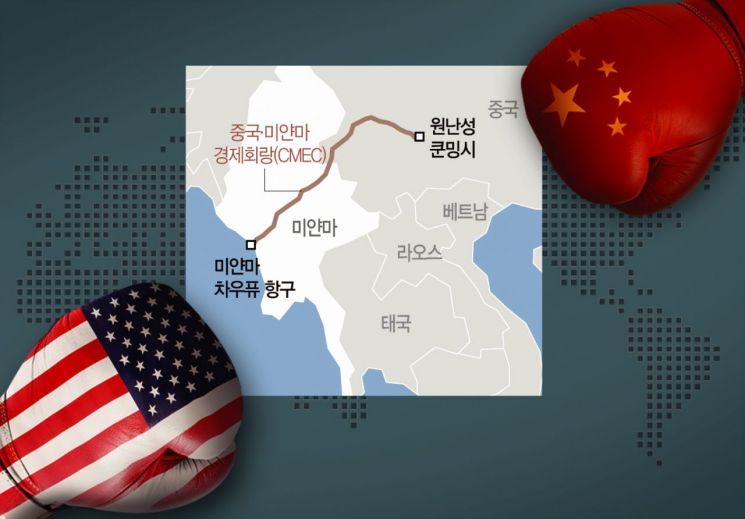
[Asia Economy Reporter Hyunwoo Lee] With the military coup in Myanmar leading to the collapse of the pro-American democratic government that had been distancing itself diplomatically and economically from China, there are expectations that the China-Myanmar Belt and Road Initiative (BRI) project (land and maritime Silk Road) will regain momentum. Analysts suggest that China will aggressively push forward the BRI project with Myanmar, even at a loss, to secure an outlet to the Indian Ocean and gain geopolitical advantage over India, with which it has ongoing border disputes.
Concerns are also raised that if the United States, which is trying to check China’s BRI projects in Southeast Asia, responds, the power struggle between the U.S. and China over Southeast Asia could become more overt.
◇ Myanmar-China Belt and Road Resumption Expected
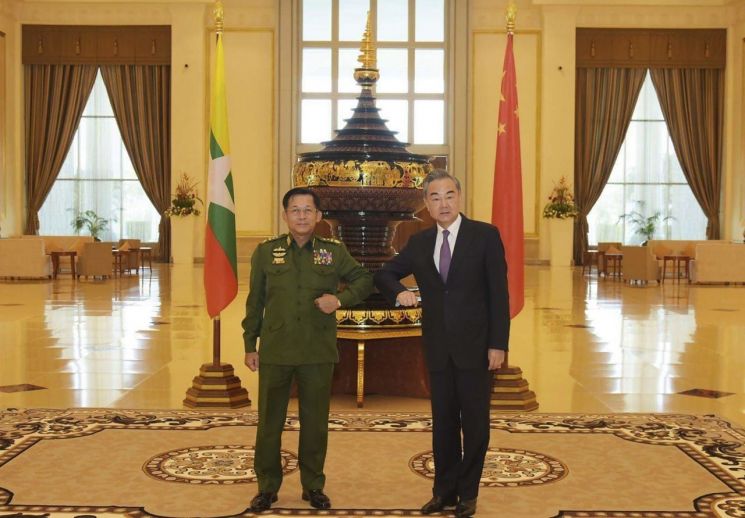 On the 12th of last month, Wang Yi, China's Foreign Minister (right), met with Min Aung Hlaing, Myanmar's Commander-in-Chief of the Defense Services (left) [Image source=AP Yonhap News]
According to foreign media including the Nihon Keizai Shimbun on the 9th, there are forecasts that Myanmar’s debt to China will increase again due to the military coup. This is because the ‘China-Myanmar Economic Corridor (CMEC)’ project, promoted as part of the BRI between China and Myanmar, is likely to resume.
Earlier, on the 12th of last month, fifteen days before the coup, Chinese Foreign Minister Wang Yi met with Min Aung Hlaing, the Commander-in-Chief of Myanmar’s Ministry of Defense who led the coup, and emphasized, "China hopes that the construction of the economic corridor will be fully implemented for Myanmar’s development."
China has been actively advancing the CMEC project since 2015. The CMEC involves dredging a modern port in the Myanmar port city of Kyaukpyu, which faces the Indian Ocean, and connecting it with Kunming in Yunnan Province, China, via approximately 870 km of roads and oil and natural gas pipelines. The project was initially launched in 2015 with a scale of $7.2 billion (about 8.09 trillion KRW).
China regards the CMEC project, along with the Pakistan Economic Corridor (CPEC), as a key part of the BRI. Geopolitically, Myanmar is located at the junction connecting the Indian Ocean and mainland China and shares a border with India. The Hong Kong-based South China Morning Post (SCMP) analyzed that as China grows diplomatically and economically closer to Pakistan and Myanmar through the CMEC and CPEC projects, it gains a geopolitical advantage by encircling India, with which it has border disputes, from east and west.
Myanmar’s various natural resources are also known to be part of China’s strategic interests. According to the U.S. economic broadcaster CNBC, Myanmar’s oil reserves are estimated at about 3.2 billion barrels, ranking fifth in the world. Its natural gas reserves are the largest in Asia. The country is also evaluated to have significant deposits of industrial metals such as copper, zinc, and tin.
◇ Reduced Dependence on China After Civilian Government Inauguration

However, after the civilian government took office in Myanmar, economic cooperation projects including the CMEC with China were continuously scaled down. In November 2018, the Myanmar government renegotiated with China and drastically reduced the scale of the CMEC project to about $1.3 billion. This was due to concerns that excessive dependence on China could pose security risks, and worries that if Myanmar failed to repay debts related to the Kyaukpyu port project properly, China might seize the port’s operating rights.
Due to these concerns, the Myanmar government has continued to distance itself from China by reducing the CMEC project and steadily lowering its debt to China. According to World Bank (WB) data, Myanmar’s debt to China was $3.3 billion at the end of 2019, about 30% less than in 2015.
The Myitsone Hydroelectric Power Plant project, jointly constructed by China and Myanmar since 2009, was also halted by the Myanmar government after two years amid rising concerns about dependence on China. China, which invested $3.6 billion in this project, has persistently requested Myanmar to resume the project.
The U.S. influence is also behind Myanmar’s move to distance itself from China. According to the Wall Street Journal (WSJ), the biggest factor influencing the reduction of the CMEC project between Myanmar and China was the advisory program of the U.S. Agency for International Development (USAID) under the U.S. State Department. At that time, USAID dispatched experts to several Southeast Asian countries to advise on the feasibility of BRI projects and the risks of national debt. As a result, Myanmar reduced the project scale, and Indonesia declared a temporary suspension.
WSJ pointed out that due to U.S. checks and ongoing South China Sea territorial disputes with Southeast Asian countries, China has faced difficulties in recovering the $304 billion invested in BRI projects in ASEAN countries since 2013. Going forward, U.S. checks are expected to be the biggest variable affecting China’s expansion into Myanmar.
Nevertheless, there are forecasts that China’s determination to advance into Myanmar will not waver and will continue. The U.S. diplomatic magazine The Diplomat predicted, "From China’s perspective, the CMEC project serves as a foothold for advancing into the Indian Ocean. Under China’s efforts to secure geopolitical advantages without calculating economic profits and losses, the project will continue."
© The Asia Business Daily(www.asiae.co.kr). All rights reserved.
![Clutching a Stolen Dior Bag, Saying "I Hate Being Poor but Real"... The Grotesque Con of a "Human Knockoff" [Slate]](https://cwcontent.asiae.co.kr/asiaresize/183/2026021902243444107_1771435474.jpg)


















