Conditional Approval Based on Ongoing Clinical Trial Results
Vaccination for Elderly Aged 65 and Over Deferred to Future Discussion by the Vaccination Expert Committee
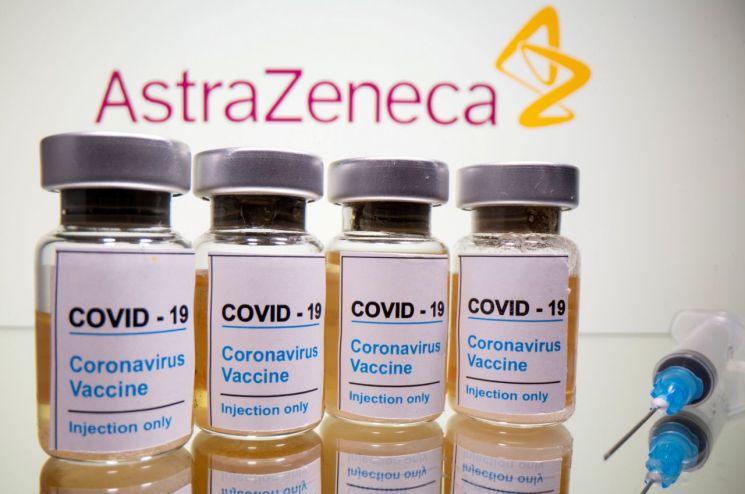
[Asia Economy Reporter Lee Chun-hee] The AstraZeneca COVID-19 vaccine has passed the second hurdle in the three-stage advisory process conducted by the Ministry of Food and Drug Safety (MFDS). However, the 'conditional approval' requiring submission of ongoing clinical trial results was maintained, and it was especially recommended that vaccination for those aged 65 and older be discussed by the Vaccination Expert Committee.
This outcome differs significantly from the first advisory, where the prevailing opinion was that despite insufficient clinical data for the elderly, vaccination could not be excluded solely on that basis. It appears to be a result of recent trends overseas, where countries have excluded elderly vaccination with the AstraZeneca vaccine or postponed vaccine approval altogether due to lack of clinical data.
On the 5th, the MFDS announced that the Central Pharmaceutical Affairs Deliberation Committee's advisory result on AstraZeneca's 'Korea AstraZeneca COVID-19 Vaccine' held on the 4th concluded that "the necessity for domestic COVID-19 prevention is recognized, and considering the advisory results from the verification advisory group, conditional approval can be granted upon submission of ongoing clinical trial results."
The MFDS conducts a three-stage advisory review process before approving COVID-19 vaccines and treatments: the verification advisory group, the Central Pharmaceutical Affairs Deliberation Committee, and the final inspection committee. The Central Pharmaceutical Affairs Deliberation Committee is the second stage, consisting of 18 external experts and 7 internal vaccine review team members from the MFDS. To ensure fairness and objectivity, the detailed list of participants is not disclosed.
Looking closely at the discussion results, the Central Pharmaceutical Affairs Deliberation Committee concluded that the dosage and dosing interval could be approved as two doses at the requested dosage with a 4 to 12-week interval, which has confirmed efficacy. Regarding the appropriateness of vaccination for those aged 65 and older, the efficacy and effectiveness are set the same as in Europe for individuals aged 18 and above, but the usage precautions will include a note stating, "Vaccination for those aged 65 and older should be decided cautiously due to insufficient data on effectiveness," and submission of analysis data from upcoming U.S. clinical trial results was recommended.
Regarding safety, adverse events occurring during clinical trials were considered acceptable, but monitoring after approval is necessary for neurological adverse events such as transverse myelitis. For vaccination during pregnancy and breastfeeding, vaccination during pregnancy is not recommended, and usage precautions will note that it is unknown whether the vaccine is secreted in breast milk.
Accordingly, the Central Pharmaceutical Affairs Deliberation Committee comprehensively concluded to grant conditional approval upon submission of clinical trial results, while recommending that vaccination for those aged 65 and older be discussed by the Vaccination Expert Committee.
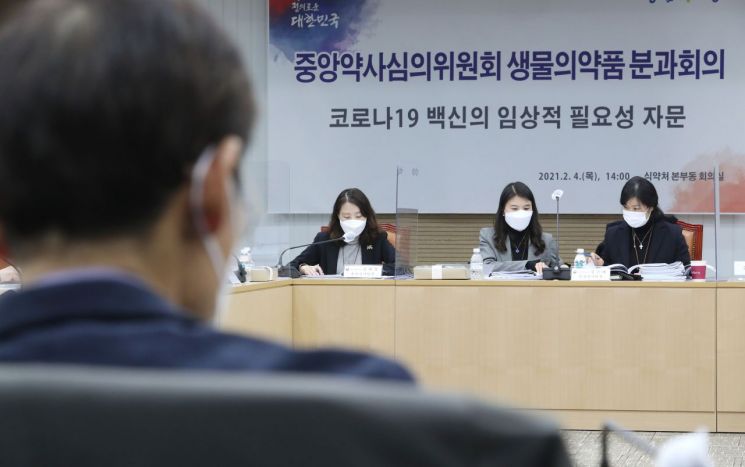 On the afternoon of the 4th, at the Ministry of Food and Drug Safety in Cheongju, Chungbuk, participants including Chairman Oh Il-hwan are reviewing materials in preparation for the advisory meeting of the Central Pharmaceutical Affairs Deliberation Committee regarding the approval of AstraZeneca's COVID-19 vaccine.
 [Photo by Yonhap News]
The announcement of the results on that day was delayed by one day from the original plan. The MFDS had planned to announce the advisory results at 5 p.m. on the day of the Central Pharmaceutical Affairs Deliberation Committee meeting on the 4th. However, the meeting lasted longer than expected and ended at 7:30 p.m., delaying the announcement.
It is reported that the meeting was extended due to divided opinions among committee members regarding the effectiveness for the elderly. Previously, the verification advisory group, while noting limited data for the elderly, expressed a majority opinion that "vaccination for the elderly cannot be excluded solely because of a small number of elderly participants," citing reasons such as the study design confirming efficacy and safety for those aged 18 and above, confirmed preventive effects including those aged 65 and older, and immune responses similar to adults.
However, recently Germany, France, and Sweden decided to vaccinate only those under 65 with the AstraZeneca vaccine, and Switzerland postponed vaccine approval altogether citing "lack of clear results on effectiveness for the elderly," indicating a shift from the verification advisory group's stance. It is also reported that some Central Pharmaceutical Affairs Deliberation Committee members expressed the need for more in-depth discussion. In fact, among 8,895 overseas clinical trial cases used by the MFDS for efficacy analysis, only 660 (7.4%) were aged 65 and older.
Especially since the AstraZeneca vaccine, along with Pfizer, is scheduled to begin first vaccinations for the elderly in Korea this month, it is reported that intense debates occurred among committee members regarding safety and effectiveness. If vaccination for those aged 65 and older is prohibited as in Germany and France, the government's vaccination plan to start vaccinating 750,000 elderly residents in nursing hospitals from February could be fundamentally shaken.
 On the afternoon of the 3rd, when the joint ministry simulation training for safe distribution of COVID-19 vaccines was conducted, a vaccine transport training vehicle arrived at the Central Vaccination Center of the National Medical Center in Jung-gu, Seoul.
 [Photo by Yonhap News]
Considering supply and approval, the only vaccines available for vaccination this month are AstraZeneca and Pfizer vaccines. However, the Pfizer vaccine requires an ultra-cold chain for distribution, making vaccination difficult outside designated centers. It is hard for nursing facility residents who are elderly or bedridden to visit vaccination sites. Therefore, the government has established a 'two-track' plan: Pfizer vaccine for COVID-19 medical staff and AstraZeneca vaccine for nursing facility-related individuals.
If the Vaccination Expert Committee ultimately disallows vaccination of the elderly with the AstraZeneca vaccine, vaccination for this group may only be possible after May when Janssen or Moderna vaccines arrive. Vaccination for approximately 8.5 million people aged 65 and older, starting in the second quarter, is also likely to be sequentially delayed due to supply issues.
© The Asia Business Daily(www.asiae.co.kr). All rights reserved.
![Clutching a Stolen Dior Bag, Saying "I Hate Being Poor but Real"... The Grotesque Con of a "Human Knockoff" [Slate]](https://cwcontent.asiae.co.kr/asiaresize/183/2026021902243444107_1771435474.jpg)

















